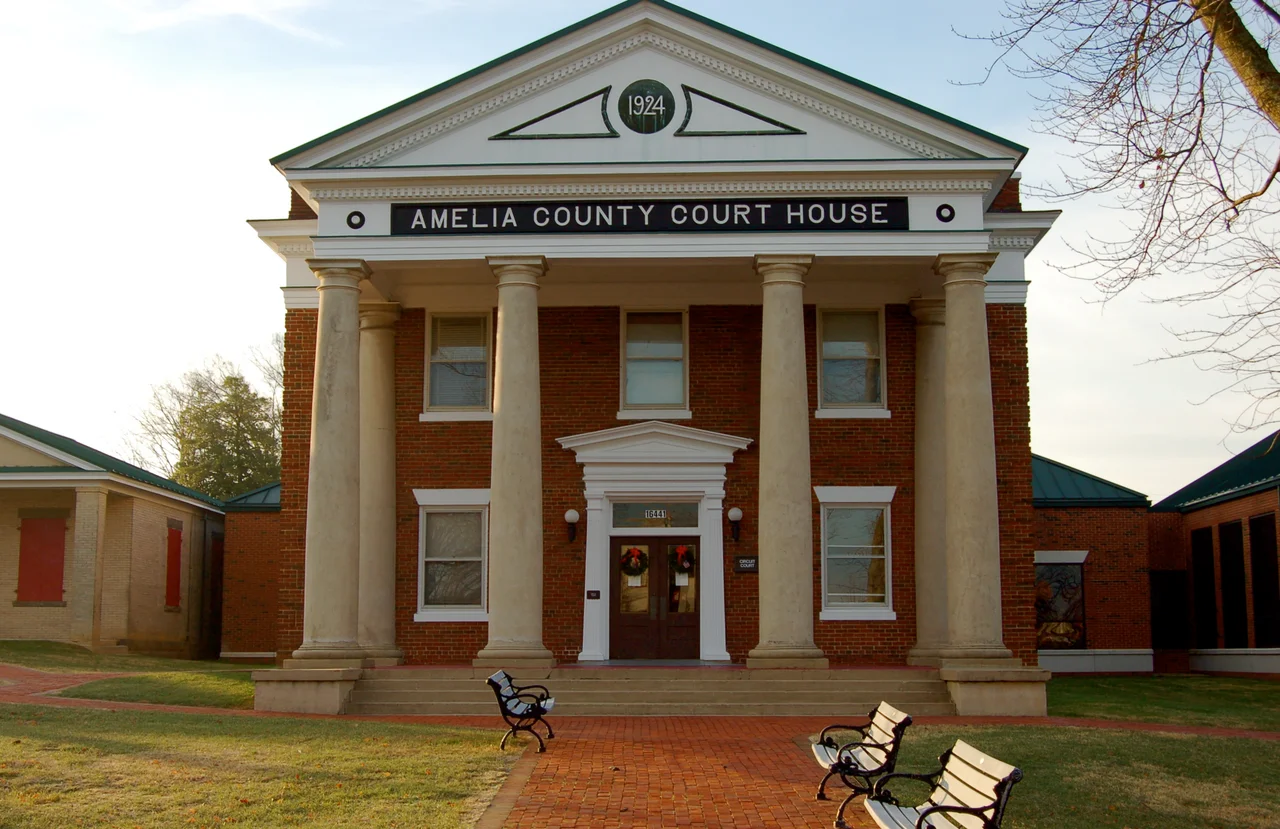

Amelia County, Virginia
The county was named for Princess Amelia of Great Britain, second daughter of King George II, who never set foot in Virginia and almost certainly never thought about it. The naming was a 1735 act of colonial deference to a faraway court. What the county actually is, two and a half centuries later, is rolling Piedmont farmland between the Appomattox River and Namozine Creek, with the highest concentration of amazonite in North America buried in its quartz veins, and one of the more consequential April weekends in American history embedded in its red clay.
Carved Out of Neighbors
Virginia's colonial counties grew by subdivision as the white population pushed west. Amelia was created by the House of Burgesses in 1734-1735 from parts of Prince George and Brunswick counties. As settlement filled the new territory, Amelia in turn was reduced to form Prince Edward in 1754 and Nottoway in 1789. The economic base across that whole period was plantation agriculture dependent on enslaved labor, tobacco mostly, exporting through the river system to the Chesapeake and the Atlantic markets. The land never developed a town big enough to incorporate. Even today there are no incorporated communities in Amelia County. The county seat, Amelia Court House, is officially a census-designated place rather than a town in its own right.
Lee's Last Confidence
On April 4 and 5, 1865, Confederate General Robert E. Lee made his headquarters at Amelia Court House. He had evacuated Petersburg three days before, and his army was supposed to find rations waiting at this rail station, supplies he had ordered shipped from Richmond. The rations were not there. Whether the supply train had been misrouted, looted, or simply lost in the collapse of Confederate logistics is still argued. The result was the same. Lee spent April 4 and most of April 5 trying to find food in the surrounding countryside, sending his men out into Amelia's fields with empty haversacks. By the time he resumed the march west, Sheridan had blocked the road south to Danville. The last major battle his army would fight was at Sailor's Creek on April 6, on the western border of the county. Three days later he surrendered at Appomattox Court House.
Amazonite at Morefield
The county's stranger fame is geological. The Morefield mine, in the central part of Amelia, contains the best supply of amazonite in the United States, a green variety of microcline feldspar prized by mineralogists and collectors. The pegmatite veins of Amelia County also yield beryl, columbite-tantalite, garnet, and other rare minerals. In the nineteenth century, the county's mineral springs were developed into small resorts that drew Virginians seeking medicinal water cures. Amelia Springs was one of these, near the western county line. The springs declined after the Civil War passed through and never recovered their antebellum reputation.
The Largest Potato Pancake
The county has a quieter sense of humor about itself than its history suggests. In 1986 the Amelia County Fair sponsored what was billed as the world's largest potato pancake, served with apple sauce, to raise money for the German American National Scholarship Fund. It weighed more than two and one-quarter tons. It required four truckloads of potatoes. Amelia Day, the annual May festival, started in 1985 with residents signing a long roll that was sealed in a time capsule beneath the courthouse green near the Confederate memorial. The capsule is scheduled to be opened in 2035, which means that someone born in Amelia today will be a decade old when their grandparents' signatures emerge.
Sons and Daughters
Robert Russa Moton was born in Amelia County in 1867, the son of formerly enslaved parents. Raised in nearby Rice, Moton succeeded Booker T. Washington as principal of Tuskegee Institute in 1915 and became one of the most influential African American educators of the early twentieth century. Van T. Barfoot, a Choctaw Mississippian who retired to Amelia, won the Medal of Honor in Italy in 1944. William Wyatt Bibb, born in Amelia County in 1781, became the first governor of Alabama. Mary Virginia Terhune, born here in 1830, became one of the most widely-read American women writers of the nineteenth century and the first woman elected to the Virginia Historical Society. The county is small. It contains, like all small counties, more lives than its surface suggests.
From the Air
Amelia County stretches across the central Virginia Piedmont near 37.34 N, 77.98 W, just southwest of Richmond and bounded by the Appomattox River to the north and west. From 4,000 to 6,000 feet you can pick out Lake Chesdin at the eastern county line, the Norfolk Southern rail corridor through Amelia Court House, and the Sailor's Creek battlefield on the southwestern border. Nearest field is Chesterfield County Airport (KFCI), 22 miles northeast. Richmond International (KRIC) is 35 miles northeast. Farmville Regional (KFVX) is 25 miles west-southwest.
Nearby Stories
- Appomattox Manor 7.2 km away
- Cactus Hill 12 km away
- Appomattox-Buckingham State Forest 30 km away
- Lewis Ginter Botanical Garden 35 km away
- Murder of Hannah Graham 39 km away
- Fort Christanna 42 km away
- Red Hill Patrick Henry National Memorial 45 km away
- John Wilkes Booth 59 km away