
American Museum and Gardens
It is the only museum of American decorative arts outside the United States, and it sits on an English hillside above Bath. Claverton Manor faces east, looking down the steep slope of the Avon valley, and inside its honey-coloured Bath stone rooms a New Orleans bedroom from 1860 stands next to a seventeenth-century Puritan parlour, a Conestoga wagon, and a tavern that would not look out of place in colonial Pennsylvania. Two Americans put it all here in 1961 - Dallas Pratt, a Standard Oil heir and psychiatrist from New York, and his partner John Judkyn - and the surprise has been working on visitors ever since.
The House on the Hill
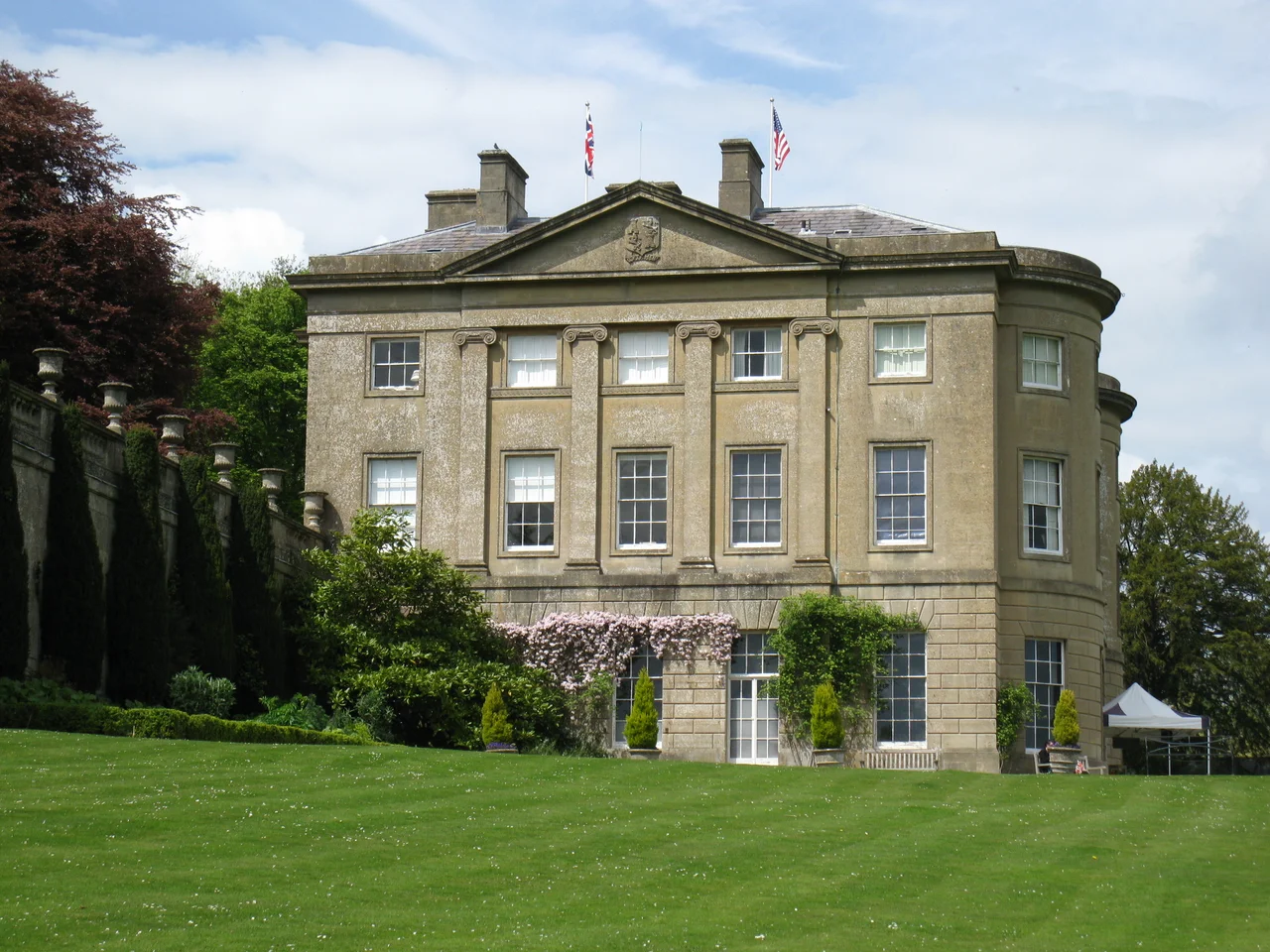
Claverton Manor was built between 1819 and 1820 to a design by Jeffry Wyatville, the architect who would later remodel Windsor Castle. The Vivian family commissioned it: John Vivian, a barrister, had bought the estate in 1816 from owners that included Ralph Allen, the quarry magnate who supplied the Bath stone that built Georgian Bath itself. Wyatville set the house on the steep west slope of the Avon valley, three storeys of pale ashlar with full-height bows on the east front and an Ionic-columned porch, the kind of disciplined Regency design that took advantage of every angle of the view. Grade I listed since 1956, the house has had a string of owners and one strange wartime turn - it served as the headquarters of an RAF barrage balloon group during the Second World War. In 1897, while the Skrines owned it, the lawn outside hosted the first public speech ever given by a 22-year-old Winston Churchill.
Pratt and Judkyn
Dallas Pratt was an American psychiatrist with a Standard Oil inheritance, a sharp eye, and a long partnership with the antiques dealer John Judkyn. In the late 1950s the two began assembling American decorative arts on a scale no European institution had attempted. They bought Claverton Manor in 1958 and opened it to the public on 1 July 1961. Pratt's idea was simple and pointed: postwar Britain knew almost nothing about America beyond Hollywood, and the cultural traffic ran heavily one way. He wanted to show, in real rooms with real objects, the textures of how Americans had actually lived. Judkyn died in a car accident in 1963. Pratt kept the museum running for decades afterward, and it remains the only one of its kind.
Rooms Across Centuries
The collection works by reconstruction. A late seventeenth-century Puritan keeping room with its dark oak furniture sits a few doors from a Shaker workshop with its hung tools. An eighteenth-century tavern stands beside a Pennsylvania German kitchen. The grandest is the New Orleans bedroom, transplanted from a Louisiana plantation house and dating from around 1860 - heavy carved bed, mosquito netting, the cusp of the Civil War in every detail. The quilts collection is exceptional: more than two hundred examples spanning two centuries, from spare Amish geometries to the riotous album quilts of Baltimore. Folk art, Navajo and Pueblo weavings, scrimshaw, decoys, and a Conestoga wagon round out the period rooms. Everything in the museum had to cross the Atlantic to get here, and there is a quiet wonder in that - a New England parlour, accurate down to the floorboards, reassembled within walls of Somerset limestone.
Washington's Garden in Somerset
The grounds run to thirty acres on the Avon valley slope. Lanning Roper designed an early mixed border. Then, on 26 June 1962, a replica of part of George Washington's garden at Mount Vernon was opened on the site of a former Italianate planting - and the British public could walk through a slice of Virginia colonial horticulture without leaving Somerset. A Lewis and Clark trail threads through an arboretum of American trees. There is a small grotto with a water spout, and a string of views over the valley toward Limpley Stoke and the silver line of the Kennet and Avon Canal. In high summer the planting is genuinely Atlantic - American natives in English light - and the effect is gently disorienting, which is what the museum has always done best.
From the Air
The American Museum and Gardens sits at 51.3768 N, 2.311 W on the steep west slope of the Avon valley, about two miles east of central Bath in Somerset. From the air, look for the distinctive Georgian manor of pale Bath stone perched above the village of Claverton, with the Kennet and Avon Canal threading along the valley floor and the spa town of Bath visible to the west. Bristol Airport (EGGD) is 15 nm to the west; RAF Lyneham/MoD Lyneham (now closed to fixed-wing but useful as a visual reference) is 15 nm east. Recommended viewing altitude 2,500-3,500 feet for the best perspective on the manor and valley.
Nearby Stories
- Marlborough Castle 1.4 km away
- Clevedon Pier 4.6 km away
- Stourhead 5.6 km away
- Siege of Bridgwater (1645) 8.4 km away
- Raglan Castle 10 km away
- Berkeley Castle 12 km away
- Mottisfont Abbey 20 km away
- Blenheim Palace 33 km away