
The Valley That Invented Its Own Language
Around 1890, in the hop fields outside Boonville, California, something linguistically improbable began. Women and children working the harvest started inventing words -- private code, at first, for saying things they did not want overheard. The habit spread. Within a generation, the residents of Anderson Valley had developed Boontling, a fully realized folk language with more than a thousand words, borrowing from English, Scottish Gaelic, Irish, Spanish, and the Pomoan languages of the valley's original inhabitants. "Harp" meant to complain. "Pike" meant to walk. "Bahl gorms" meant good food. By the time a University of Texas linguist named Charles Adams published a dictionary of the lingo in 1971, it was already fading. Today fewer than a hundred people speak it with any fluency, most of them old. But the impulse that created Boontling -- the desire of a small, isolated community to define itself in its own terms -- tells you everything about this narrow valley a hundred miles north of San Francisco.
Nineteen Villages in the Redwoods
Before Anderson Valley had a European name, it had two Pomo languages. The Late Pomo of the Yorkville area spoke Central Pomo; the Tabahtea Pomo from Boonville westward to Navarro spoke Northern Pomo. Nineteen known village sites stretched along the creeks and terraces, with an estimated population of 600 in 1855 -- already diminished from pre-contact numbers. The Pomo moved seasonally, wintering in the main valley villages and ranging into the hills for acorns, game, and the obsidian that could be traded across a wide network. Anderson Creek, Indian Creek, Rancheria Creek, and Soda Creek all feed the Navarro River, which begins just south of the town of Philo and flows through the Coast Range to the Pacific. The valley the Pomo inhabited was not empty wilderness but a managed landscape, shaped by fire and gathering practices refined over millennia.
Sheep, Timber, and the Bear Flag Man
The first European American settlers arrived after 1850, and the valley's namesake was one of them -- William Anderson, stepbrother of Henry Beeson, who had taken part in the Bear Flag Revolt of 1846. These early arrivals practiced subsistence farming and then, as capital and markets reached them, turned to the resources the land offered in bulk: timber and livestock. By 1880, a population of roughly a thousand people managed 75,000 sheep and 20,000 cattle. Commercial apple orchards and hop fields followed before the turn of the century. Then came the big cut. In the 1940s and 1950s, industrial automation and modern highways made it possible to liquidate the remaining redwood forests at a pace the earlier settlers could not have imagined. Lumber mills sprang up across the valley to process the boom. It was brief. By the 1960s, the sheep, timber, and apple industries were all in decline, and Anderson Valley began its next transformation.
Counterculture, Cannabis, and Cabernet
The 1970s brought a wave of urban refugees from San Francisco and the broader counterculture. Large tracts of former ranch and timber land were subdivided, and the new arrivals planted two things: marijuana and the first commercial wine grapes. Cannabis production flourished in the remote canyons and hillsides, becoming an open secret of the local economy. Meanwhile, the valley's particular geography -- cool marine air funneling through the coastal range, warm interior days, and well-drained alluvial terraces -- turned out to be ideal for Alsatian varietals, pinot noir, and sparkling wine. The Anderson Valley AVA was established, and producers like Roederer Estate and Lazy Creek Vineyards helped put the valley on the wine map. By the 1980s, the old economy had contracted to two small specialty lumber mills, four modest sheep ranches, and a fraction of the former apple acreage. Wine was the new engine.
Boonville, Philo, and the Valley Today
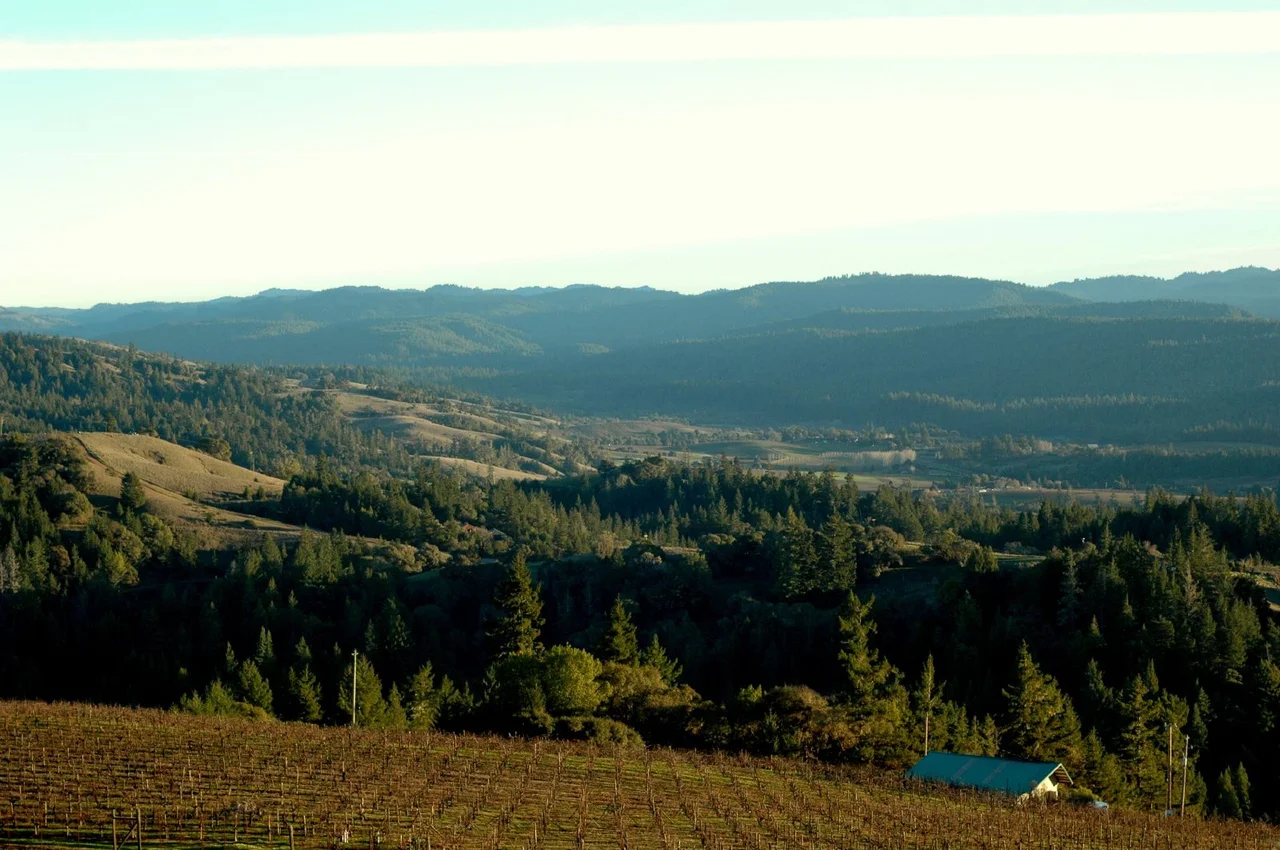
Anderson Valley stretches from Boonville on Anderson Creek through Philo on Indian Creek to Navarro on Soda Creek -- a string of small, unincorporated communities set among rolling terraces enclosed by steep, forested hills. The Navarro River watershed, at 315 square miles, is the largest coastal basin in Mendocino County. Elevation ranges from sea level to 2,500 feet. Summer days inland can top 100 degrees Fahrenheit, while the coast end of the valley stays cool and fog-wrapped. The Anderson Valley Brewing Company operates on the outskirts of Boonville, and in 1989 Sean Donovan founded KZYX, a community-supported NPR affiliate that serves as one of the valley's few shared institutions. Fine restaurants and boutique lodging cater to wine tourists, but the economic reality beneath the tasting rooms is the same one that shapes many beautiful rural places: upscale real estate priced beyond the reach of the farmworkers, cooks, and service employees whose labor makes the valley run. The language may be dying, but the isolation that created it -- the sense of a place apart, self-contained, answering to its own logic -- persists in the landscape itself.
From the Air
Anderson Valley runs roughly northwest-southeast in western Mendocino County, centered around 39.06N, 123.43W. From the air, the valley is a distinctive green corridor flanked by forested ridges, with the Navarro River visible winding westward through the Coast Range toward the Pacific. Boonville, Philo, and Navarro are small clusters of settlement along the valley floor. The nearest airport is Ukiah Municipal Airport (KUKI), approximately 20 nautical miles northeast. Sonoma County Airport (KSTS) is about 50 nautical miles southeast. Little River Airport (private, 0Q5) is near the coast about 20 miles west. Summer fog frequently fills the western end of the valley while the interior stays clear.
Nearby Stories
- Gualala River 9.5 km away
- Robinson Rancheria: The Tribe That Came Back 12 km away
- Cyrus 20 km away
- The Asbill Massacre 54 km away
- August Complex Fire 54 km away
- SS Camden 824 km away
- Westport, Washington 865 km away
- Red Sand Beach 3646 km away