
Apollo 11 Cave
On a July night in 1969, a German archaeologist crouched in a rock shelter in the southern Namibian desert and learned over a crackling shortwave radio that three men had walked on the Moon and come home alive. Wolfgang Wendt was digging through layers of the deep past, and the news arriving from the future moved him enough that he gave the site a new name: Apollo 11. The irony is almost too neat. The people who made art here had no notion of moons or machines, yet what they left behind is, in its own way, every bit as astonishing as a lunar landing. Buried in the floor of this shelter were painted stones older than almost any art yet found on the African continent.
Goachanas
Long before any of these names, the Nama people knew this country and called the area Goachanas. The shelter itself is less a cave than a deep overhang of rock, tucked into the mountains of what is now the Ai-Ais/Richtersveld Transfrontier Park, roughly 250 kilometers southwest of Keetmanshoop. People returned to it again and again across an almost unimaginable span. Archaeologists describe the deposits as a record of occupational pulses, layers of human presence laid down over at least forty thousand years, from around seventy-one thousand years ago to twenty-nine thousand years ago. Generation after generation sheltered under this same rock, and most of them left no name we will ever know.
The Apollo 11 Stones
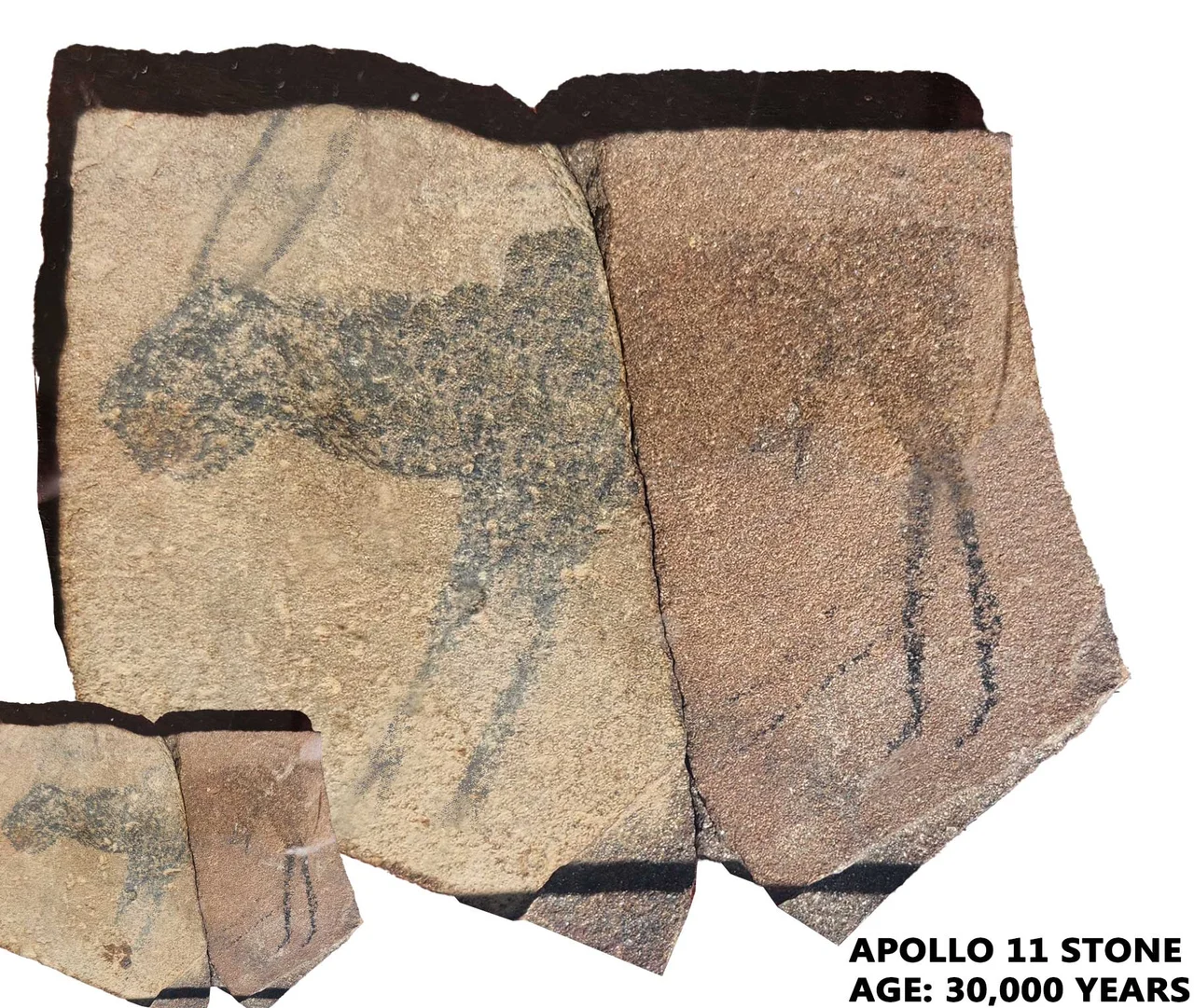
Seven slabs of grey-brown quartzite were excavated from the floor of the shelter, painted with charcoal, ochre, and white pigment. The charcoal associated with them has been radiocarbon dated to roughly twenty-five to twenty-seven thousand years ago, with more recent analysis placing the art near thirty thousand years before the present. These are the Apollo 11 Stones, among the oldest pieces of portable art ever found in southern Africa and some of the earliest figurative images known anywhere in Africa. They are small enough to hold in two hands. The artists carried them, painted them, and set them down in this shelter, where they waited in the dark for some three hundred centuries until Wendt's trowel found them. Today they are kept at the National Museum of Namibia in Windhoek.
The Creature That Is Not One Thing
The most famous of the stones shows a figure that refuses to settle into a single animal. It has the hind legs of a human, the body and horns of an antelope, and the head of a great cat. Scholars call such a being a therianthrope, part person and part beast, and across the rock art of southern Africa these hybrid figures recur often enough that many researchers read them as evidence of a spiritual world, the work of people who saw the boundary between human and animal as something that could be crossed. We cannot know exactly what the painter intended. But the image is deliberate and assured, the product of a mind reaching for something beyond the literal, and that reach across thirty thousand years is its own kind of message.
What Was Lost, What Remains
The shelter held more than the stones. Faded white and red paintings survive on the rock, ranging from simple geometric marks to depictions of bees, whose living descendants still trouble the occasional visitor. Nearby, on a riverbank and on a limestone boulder about 150 meters away, ancient hands engraved animals and patterns that emerge only under raking, angled light. But the site is fragile, and not all of it has been treated with the care it deserves. Researchers returning in 2007 found the shelter severely vandalized and called on the government to protect it. The art endured tens of thousands of years of desert silence; the question now is whether it survives us. To stand here is to feel the weight of a very old conversation, begun by people we cannot name but whose imagination we still recognize as our own.
From the Air
Apollo 11 Cave sits in the mountains of southwestern Namibia at approximately 27.75 degrees south, 17.10 degrees east, within the Ai-Ais/Richtersveld Transfrontier Park and about 250 km southwest of Keetmanshoop. The site is a discreet rock overhang in rugged, arid terrain and is not visible or identifiable from the air; it is best understood as a point within the broader desert-mountain landscape of the ǁKaras Region. From above, the surrounding country is starkly beautiful: dry watercourses, weathered rock, and almost no vegetation, with the Fish River Canyon system to the northeast. The nearest airport is Keetmanshoop (ICAO: FYKT), serving the region from the northeast; Lüderitz Airport (ICAO: FYLZ) lies to the west on the Atlantic coast. The extreme aridity usually means excellent visibility. Note that the cave is a protected archaeological site reached overland with permission, not a flight destination; respect for the site and its fragility is essential.
Nearby Stories
- Fish River Canyon 3.7 km away
- Ai-Ais/Richtersveld Transfrontier Park 12 km away
- Roter Kamm Crater 25 km away
- Bom Jesus (ship) 64 km away
- Aus, Namibia 88 km away
- Quiver Tree Forest 123 km away
- Warmbad, Namibia 126 km away
- Brukkaros Solar Observatory 186 km away