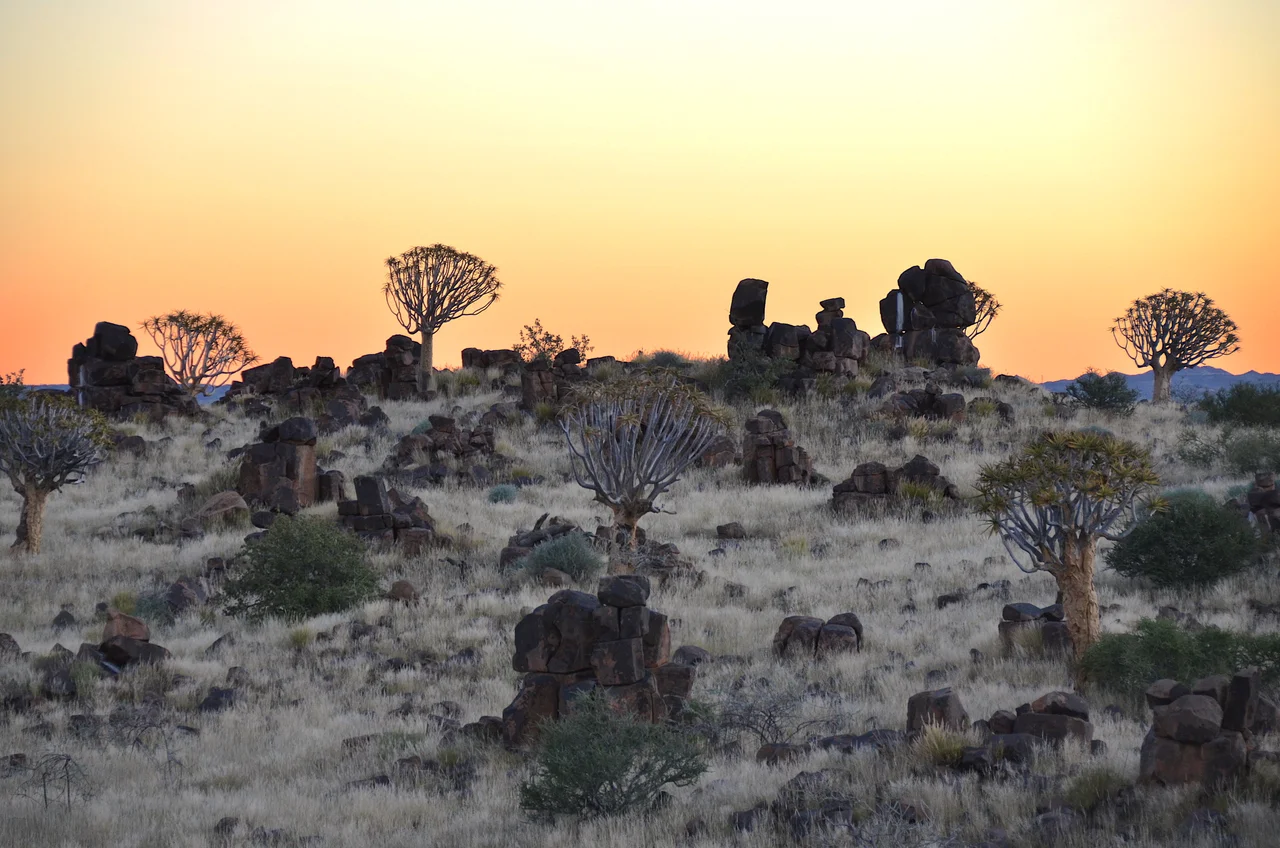

Quiver Tree Forest
The San hunters knew exactly what these trees were good for. The quiver tree's branches are soft inside and hollow easily, and for generations the San cut them, scooped out the fibrous core, and sealed one end to make a light, durable quiver for their arrows. That use gave the tree its name in two languages, kokerboom in Afrikaans and quiver tree in English, and it gave this place its identity. About fourteen kilometers northeast of Keetmanshoop, on the Gariganus farm, roughly 250 of these strange aloes have gathered on a rocky rise into one of the few natural forests of their kind on Earth. They were never planted. They simply grew here, on their own, over centuries.
Trees That Look Upside Down
The quiver tree is not really a tree at all but a giant aloe, Aloidendron dichotomum, and it grows like nothing else on the plain. A smooth, pale trunk rises and then splits, again and again, each fork dividing into two, until the crown spreads into a dense thicket of stubby, finger-like branches tipped with rosettes of blue-green leaves. People often say the tree looks upside down, as though its roots were waving in the air. The bark peels in papery golden flakes that catch the low sun. The tallest specimens in this forest are two to three centuries old, slow-grown survivors of a climate that gives them almost nothing, and at dusk their silhouettes against a burning sky have made this one of the most photographed places in Namibia.
Folklore and Diamonds
A tree this peculiar attracts stories. Local folklore holds that the quiver tree brings good fortune to anyone who tends and honors it. Another tale grew up after diamonds were discovered in Namibia: that beneath any quiver tree, if you dug it up, you would find diamonds in the ground where it had grown. But the trees, people say, are blessed, and so no one is willing to dig one up to test the claim. It is a small, telling piece of desert wisdom. The reverence and the greed cancel each other out, and the trees are left standing, which is perhaps the point of the story all along.
Life Among the Rocks
For most of the year the forest is a study in austerity, but in the depth of the Southern Hemisphere winter it comes alive. Bright yellow flowers open across the crowns from June into July, and the desert answers. Insects, birds, and mammals arrive for the sudden flood of nectar, turning the quiet grove briefly busy. Among the boulders at the trees' feet live rock hyraxes, the small, guinea-pig-like creatures whose closest living relative, improbably, is the elephant. The forest was recognized as a national monument of Namibia in 1995, an acknowledgment that this was not merely a curiosity but an ecosystem and a piece of the country's natural heritage worth protecting.
The Giant's Playground
Right beside the forest lies a landscape that looks deliberately built and is entirely natural. The Giant's Playground is a vast jumble of dolerite boulders, dark volcanic rock stacked and balanced into towers and corridors as though some enormous child had piled them up and wandered off. The blocks formed underground from cooling magma and were slowly exposed and weathered into these precarious shapes over ages. Walking among them, with the quiver trees standing sentinel nearby, you feel the strange theatricality of this corner of the Karas desert. True natural quiver tree forests are rare; another grows far to the south at Gannabos in South Africa's Northern Cape. But few places combine the trees and the stones quite like this stretch of the Gariganus farm, where the old aloes and the giant's scattered rocks share the same hard, beautiful ground.
From the Air
The Quiver Tree Forest lies in southern Namibia at approximately 26.48 degrees south, 18.24 degrees east, about 14 km northeast of Keetmanshoop on the Gariganus farm. The forest itself is a small feature, a cluster of roughly 250 aloes on a rocky rise, best appreciated from low altitude in clear conditions; the adjacent Giant's Playground appears as a distinctive field of dark dolerite boulders. The surrounding terrain is flat, arid scrubland typical of the ǁKaras Region. The nearest airport is Keetmanshoop (ICAO: FYKT), only a short distance to the southwest, making this one of the more accessible sites in southern Namibia. Hosea Kutako International (ICAO: FYWH) near Windhoek lies far to the north for international arrivals. Visibility is typically excellent given the dry climate. For viewing or photography, the low light of early morning or late afternoon dramatizes the trees' silhouettes and the textured rock; harsh midday sun flattens both. Light winds are common, with afternoon thermals over the open plain.
Nearby Stories
- Brukkaros Solar Observatory 48 km away
- Fish River Canyon 123 km away
- Apollo 11 Cave 124 km away
- Aus, Namibia 133 km away
- Duwisib Castle 147 km away
- Kgalagadi Transfrontier Park 181 km away
- South West Africa Campaign 182 km away
- ǀXam and ǂKhomani Heartland 194 km away