.jpg)
ǀXam and ǂKhomani Heartland
Look closely at South Africa's coat of arms and you will find a sentence in a language almost no one alive can still speak: *ǃke e꞉ ǀxarra ǁke* — "diverse people unite." The words belong to the ǀXam, a San people of the dry Karoo, recorded by two researchers in the 1870s from speakers who would be among the last. The ǀXam language fell silent as a mother tongue in the early twentieth century. Yet a nation chose its founding motto from that vanished speech, and the land where those words were once everyday conversation — the ǀXam and ǂKhomani heartland, north and south of Upington in the Northern Cape — is now recognized as a place the whole world is meant to remember.
Two Deserts, One People
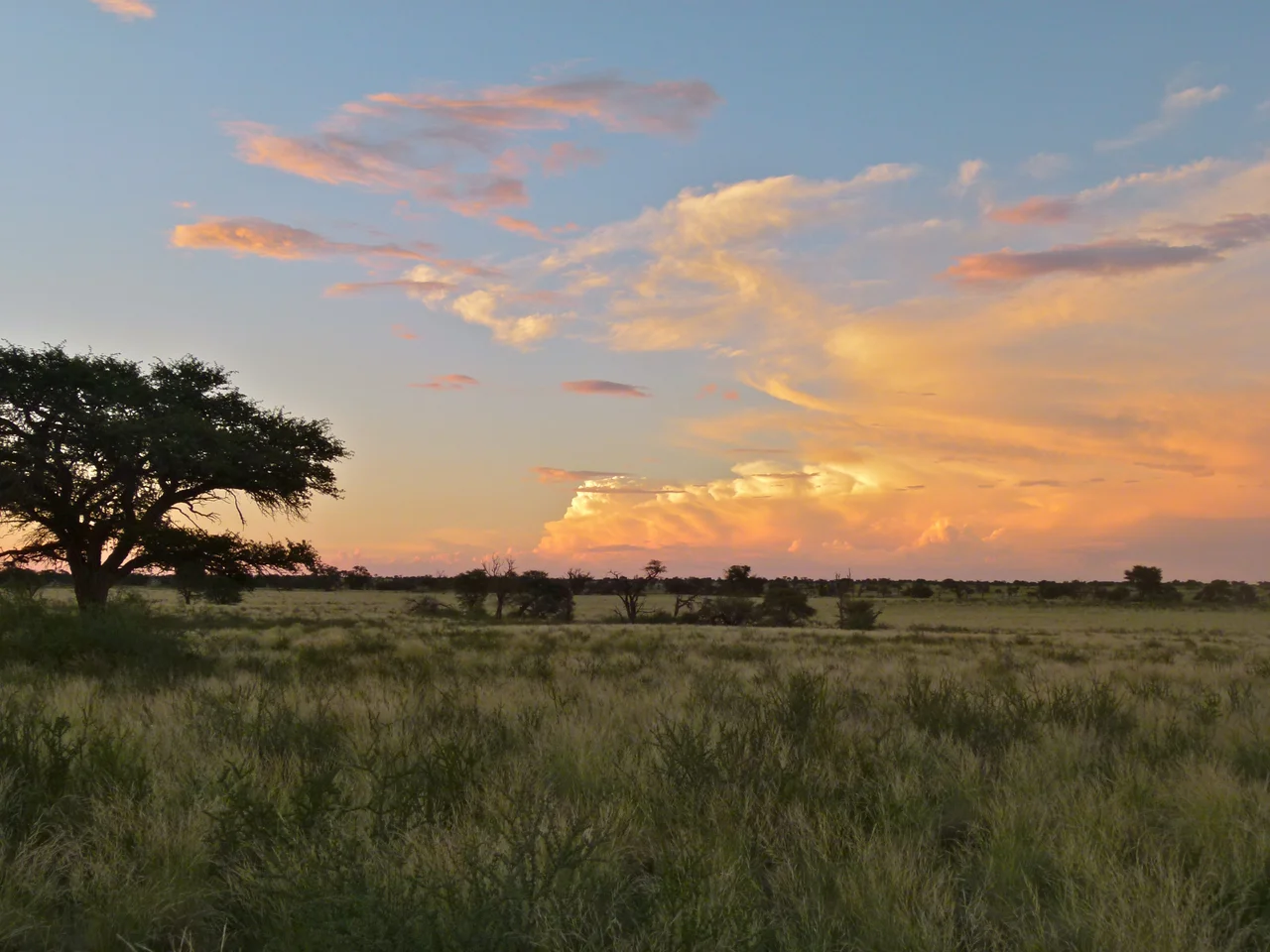
The heartland is really two landscapes joined by ancestry. To the south stretch the semi-arid plains of the Upper Karoo; to the north, the sandy red dunes of the southern Kalahari. The ǀXam belonged to the Karoo, the ǂKhomani — more properly the Nǁnǂe — to the Kalahari. They were linguistically kin, their tongues both part of the ǃKwi language group, both shaped by the demands of survival in country where water is scarce and knowledge of the land is the difference between life and death. For thousands of years San people read these deserts the way others read books, tracking game, finding hidden water, and timing their movements to seasons written in the sand.
Writing on the Rock
The southern hills hold a record older than any colony. The rocky outcrops of the Karoo — a region the ǀXam called *ǀXam-ka ǃxau*, "home of the ǀXam" — are dense with rock art, chiefly engravings pecked into stone over the long span of the Later Stone Age. These are not idle decorations. They are traces of a worldview, of ritual and belief and the close bond between people and the animals they hunted and honored. In the sandy north, the desert floor will not hold such art, but the ǂKhomani carry their heritage differently: through a cultural mapping project that records places, names, and traditions, kindling new interest among the young in what their grandparents knew.
The Words That Were Saved
The reason a dead language could become a living motto lies in an archive. In the 1870s, two researchers — Wilhelm Bleek and his sister-in-law Lucy Lloyd — sat with ǀXam men, several of them prisoners, and patiently transcribed their words, their stories, and their beliefs across thousands of pages. The speakers told of the stars, of the rain, of the eland and the mantis and the order of their world. Those notebooks became one of the richest records ever made of a San language and worldview, and it was from this archive that South Africa later drew the phrase on its coat of arms. The ǀXam who spoke those words could not have known that their language, dying even as it was written down, would one day speak for a whole nation.
Driven From the Land
In 1931, the South African government proclaimed the Kalahari Gemsbok National Park across the ǂKhomani's ancestral ground. The park drew its boundaries for animals, and the people inside them — most of the ǂKhomani, along with the Mier community who shared that country — were forced to leave. It is a familiar pattern in the history of conservation: land set aside for wildlife by removing the humans who had lived in balance with it for generations. For the ǂKhomani, the loss was not only of territory but of the daily practice of being themselves on their own ground. Decades later, after the end of apartheid, a land restitution claim finally began to return some of what had been taken.
A Heritage Reclaimed
The world has come to recognize what was nearly erased. Placed on UNESCO's tentative list in 2004, the area was formally inscribed as the ǂKhomani Cultural Landscape — a World Heritage Site — on 8 July 2017, honoring both the deep evidence of human life across the Stone Age and the living culture of the ǂKhomani San. Today most descendants of the ǀXam and Nǁnǂe are Afrikaans-speaking people on the farms and in the towns of the region. The ǀXam language is gone entirely; Nǁng survives in the memory of only a handful of elders. That a country builds its motto from words it nearly let die is either a tribute or a reckoning. Standing on this land, it feels like both.
From the Air
The heartland centers near 25.69°S, 20.37°E, spanning the country north and south of Upington in South Africa's Northern Cape, with the ǂKhomani landscape reaching to the Botswana and Namibia borders inside the Kgalagadi Transfrontier Park. Fly the southern Kalahari at 5,000–8,000 feet for the best read of the red-dune corridors and the rocky Karoo outcrops that hold the engravings; the dry winter air gives long, clear sightlines, while summer can bring heat haze and dust. Upington (Pierre van Ryneveld Airport, FAUP) is the regional gateway; the park's own Twee Rivieren airstrip serves the far north.
Nearby Stories
- Quiver Tree Forest 154 km away
- Mukurob 155 km away
- Tswalu Kalahari Reserve 214 km away
- South West Africa Campaign 229 km away
- Kalahari Desert 305 km away
- Upington 305 km away
- Duwisib Castle 317 km away
- Rehoboth, Namibia 399 km away