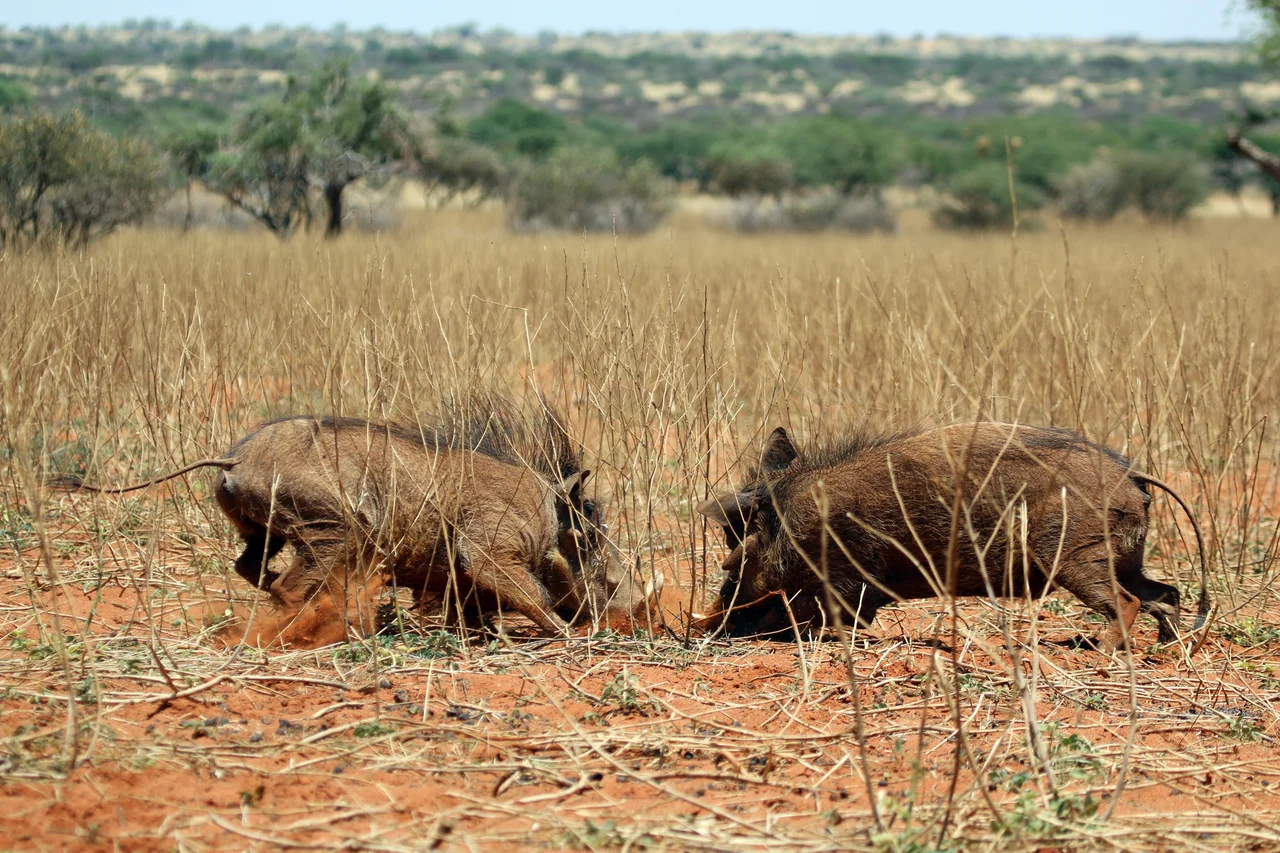
_young_males_fighting.jpg)
Tswalu Kalahari Reserve
The word *Tswalu* means "a new beginning," and on the red dunes of the southern Kalahari it earned the name twice over. First when a self-made Englishman named Stephen Boler began buying up worn-out cattle farms in the 1990s, stitching them together into a single wild expanse and trucking in the lions, giraffes, and antelope that human ranching had pushed out. Then again after his sudden death, when the land passed to one of the wealthiest families in Africa, who decided that the most valuable thing they could do with more than a thousand square kilometers of desert was let it become a desert again.
One Man's Obsession
Stephen Boler did not inherit Tswalu; he assembled it. He bought dozens of separate farms across the Northern Cape and merged them into a single conservation reserve, reintroducing African wildlife to ground that had been fenced and grazed for generations — lions, rare antelope, giraffes, buffalo, black rhino, and zebra. To pay for it all, the early estate even ran a controversial trophy-hunting operation. Then, in 1998, on his way to the reserve he had built, Boler died in Johannesburg. He had left unusual instructions in his will: Nicky Oppenheimer, the diamond magnate, was to have first refusal on the whole property. The Oppenheimer family took it, and Tswalu's second life began.
Tearing Down the Fences
The Oppenheimers reversed the old logic of the place. Trophy hunting was banned. Farm buildings, surplus structures, and internal fences came down. New land was folded in to widen the territories animals needed to roam. The reserve now covers more than 1,100 square kilometers — about 118,000 hectares — making it South Africa's largest private game reserve, a single unbroken stretch of the Kalahari held in private hands for the express purpose of being left mostly alone. The conservation work of Nicky and his wife Strilli Oppenheimer drew the WWF-Lonmin Award from the World Wide Fund for Nature in 2007.
The Small and the Strange
Tswalu makes a quiet boast: it holds four of the Big Five — lion, leopard, rhino, and buffalo — missing only the elephant, which the dry Kalahari cannot easily support. But the reserve has built its reputation on smaller, stranger residents. Black rhino share the dunes with pangolins, the scaled, ant-eating mammals so heavily trafficked elsewhere that simply glimpsing one is a rare privilege. African wild dogs, among the continent's most endangered carnivores, range across the grass in their painted packs. Meerkats stand sentinel over their burrows. In a place named for new beginnings, the headline acts are often the creatures other parks overlook.
A Desert Under the Microscope
Tswalu is not only watched; it is studied. The Tswalu Foundation funds long-running science across the reserve, much of it gathered under the Kalahari Endangered Ecosystem Project, which tracks how a warming climate ripples through the desert food web. Researchers here have built one of Africa's most sustained records of the secretive Temminck's pangolin, and they monitor the aardvark, an animal so elusive and so vital that its burrows shelter dozens of other species. The reserve counts roughly 85 mammal species and more than 260 kinds of bird across its plains and the Korannaberg's slopes. In a country where wild land is so often valued only for what can be shot or sold from it, Tswalu treats the Kalahari as a question worth answering.
Luxury at the Edge
Set against this wildness is the Motse, a luxury lodge of nine suites and a member of National Geographic Unique Lodges of the World, with the private Tarkuni homestead offering five suites more. Tswalu forms part of the Diamond Route, the network of conservation properties tied to the Oppenheimer name. Guests come for the red dunes and the wide silence, and for the chance to see a pangolin unfurl at dusk — but the deeper draw is the idea behind the gate. This is a working experiment in giving land back to itself, financed by the kind of fortune that once helped extract South Africa's riches from the ground, now spent putting a piece of it back.
From the Air
Tswalu lies at roughly 27.24°S, 22.41°E in the southern Kalahari of South Africa's Northern Cape, against the Korannaberg range that breaks the otherwise flat red-dune country. The reserve maintains its own airstrip for guest charters. Approach across the Kalahari at 5,000–8,000 feet for the cleanest views of the dunes and the dark spine of the Korannaberg; the dry winter months bring stable air and sharp visibility, while summer afternoons can stack up dust and convective turbulence. Upington (Pierre van Ryneveld Airport, FAUP) is the nearest commercial gateway, about 240 km to the southwest.
Nearby Stories
- Kalahari Meerkat Project 58 km away
- Wonderwerk Cave 103 km away
- Witsand Nature Reserve 126 km away
- Upington 127 km away
- Kgalagadi Transfrontier Park 189 km away
- Augrabies Falls 214 km away
- ǀXam and ǂKhomani Heartland 236 km away
- Battle of Rooiwal 241 km away