
Archaeological Museum of Eretria
The museum is small, and it has to be. It sits right next to the dug ground it serves, on the edge of ancient Eretria, the powerful Euboean city-state that once fought wars over the fertile Lelantine Plain and sent colonists across the Mediterranean. Walk in and you are not looking at objects shipped from somewhere else. You are looking at what the spade turned up just outside the door, the physical residue of a city whose name the Romans almost mistook for the word "Greek" itself. Among the treasures is a sculpted group, carved around 510 BC, showing the hero Theseus carrying off the Amazon Antiope, attributed to the celebrated Athenian sculptor Antenor.
A Museum on the Dig
The collection was established in 1960, then enlarged in the early 1960s and substantially renovated and extended between 1987 and 1991, a project carried out by the Greek Archaeological Service in partnership with the Swiss School of Archaeology in Greece, whose excavators have worked this corner of Euboea for decades. That partnership matters, because the finds here come from a constellation of nearby sites the Swiss and Greek teams have explored: Xeropolis and the cemeteries of Lefkandi, the hill of Geraki and Paliochora at Amarynthos, and Eretria itself. The museum's quiet rooms hold the harvest of all that careful work, arranged within sight of the temple of Apollo Daphnephoros and the other ruins they came from.
Stories Carved in Clay and Stone
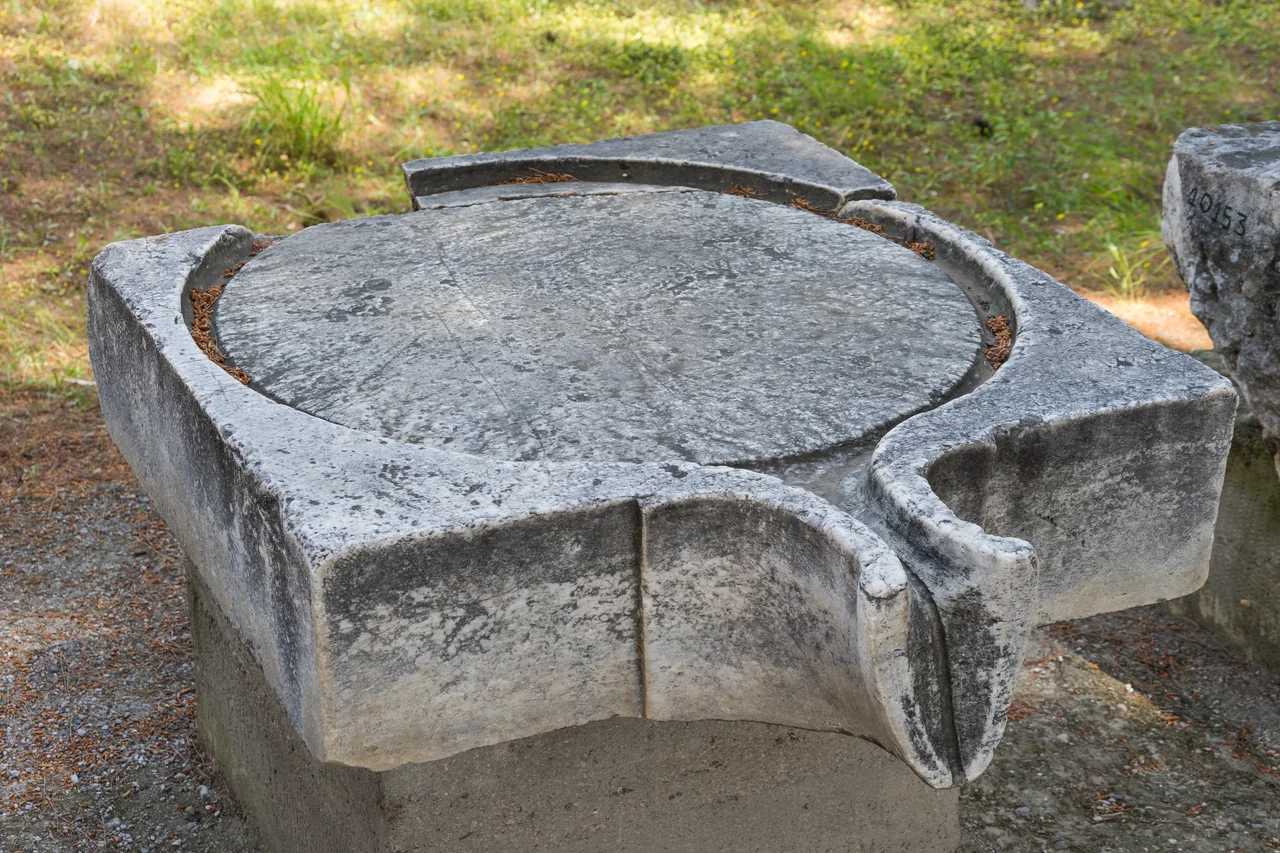
The objects span centuries and carry vivid stories. There are Archaic relief fragments from great storage jars, called pithoi, dating to the seventh century BC and decorated with an unsettling scene of birds devouring bodies. There is the marble Theseus and Antiope group, a rare survivor of late sixth-century Athenian sculpture, depicting a moment from myth with real tension in the stone. And there is the everyday alongside the heroic: a funerary stele showing a man and a boy, a piece of an ancient wine or olive press, the ordinary tools of a working Greek city. Together they let a visitor move from the lofty world of gods and heroes to the plainer one of farmers, traders, and the dead who were mourned by name.
The Necklace That Crossed the Sea
One small object pulls the deepest history out of the cases. It is a necklace of faience beads shaped to represent the Egyptian deities Isis and Horus, probably made in Cyprus and dating to the Protogeometric period of the eleventh and tenth centuries BC. Think about what that means. Three thousand years ago, in the dark centuries after the Mycenaean palaces fell, when Greece is often imagined as isolated and poor, someone here owned a piece of jewelry that carried Egyptian imagery and had traveled by ship from Cyprus. It is a single strand of beads, easy to walk past, and it quietly overturns the idea that early Iron Age Euboea was cut off from the wider world. Eretria, this object says, was already reaching across the sea.
From the Air
The museum stands at 38.40 degrees north, 23.79 degrees east, in the town of Eretria on the south coast of central Euboea (Evia), beside the ancient archaeological site and its temple of Apollo Daphnephoros. From the air, find Eretria on the north shore of the South Euboean Gulf, roughly 20 km southeast of Chalkida; the grid of the ancient site lies between the modern town and the water. Nearest major airport is Athens International (LGAV) about 35 km to the south across the gulf. A coastal flat with the mountains of Euboea rising behind makes the setting easy to identify in clear weather.
Nearby Stories
- Hellenic Police 2.9 km away
- Tower of Aliartos 8.5 km away
- Great Sand Beach 13 km away
- John the Russian 22 km away
- Saint George Monastery, Aidipsos 23 km away
- Sousaki Volcano 25 km away
- Skyros 32 km away
- Carystus 46 km away