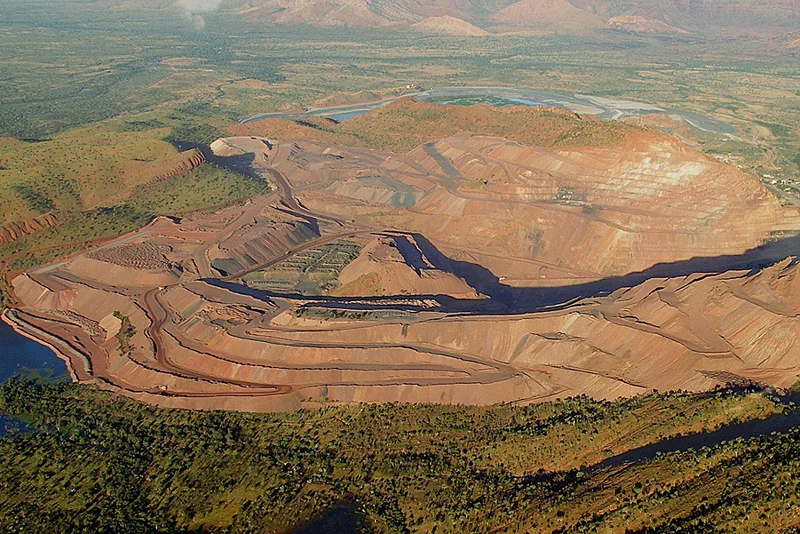

Argyle Diamond Mine
A geologist named Maureen Muggeridge was working a floodplain near Lake Argyle in 1979, following a trail of alluvial diamonds upstream, when she reached the headwaters of a small creek called Smoke Creek. What she found there — a volcanic pipe, unlike any commercially mined diamond source in the world — would become the Argyle diamond mine, one of the most extraordinary mining operations in history. The discovery took a decade to trace. It took another 40 years to exhaust.
A Different Kind of Pipe
Most diamond mines in the world exploit kimberlite pipes — the geological formation long associated with diamond-bearing rock. Argyle was something different: a lamproite pipe, a much rarer type of volcanic structure. The Argyle pipe, formally designated AK-1, was composed of olivine lamproite, erupted through a zone of weakness in the ancient continental crust somewhere between 1.1 and 1.2 billion years ago. The diamonds it contained were older still — dated at around 1.58 billion years of age, predominantly eclogitic, meaning their carbon is of organic origin. A billion-year gap separates the diamonds from the volcano that brought them to the surface. The Argyle mine, commissioned in December 1985 at a cost of A$450 million for the open pit alone, was the first successful commercial operation to exploit a lamproite pipe anywhere in the world.
The Pink Diamond Problem
Most of what Argyle produced was not particularly valuable. Eighty percent of its diamonds were brown — difficult to sell, requiring an entire marketing campaign by Rio Tinto to rebrand them as 'champagne' and 'cognac' tones. Only 5% of the mine's output reached gem quality, well below the worldwide average of 20%. But buried within that output was something almost without precedent: pink and red diamonds. Argyle produced between 90 and 95% of the world's supply of these stones, the rarest naturally coloured diamonds in existence. The mine's annual Pink Diamond Tender, run from 1984 to 2021 as an exclusive invitation-only sale, set records repeatedly. In 2016 it became the highest-grossing tender in its then-20-year history. The mine's closure in 2020 did not end the tender — the final sale in 2021 broke records again, as collectors absorbed the reality that no comparable source would replace Argyle.
Scale and Scope
At its peak in 1994, Argyle produced 42 million carats of rough diamonds in a single year. By 2018, annual output had fallen to 14 million carats — still enough to make it the largest diamond producer in the world by volume. Over its full operational life, the mine yielded more than 865 million carats of rough diamonds. The open pit, which reached approximately 600 metres deep at its lowest point, operated until 2010. Underground block cave mining then took over, extending the mine's life another decade. The 520 workers on site mostly commuted from Perth — over a thousand kilometres away — on alternating two-week shifts, living in a purpose-built residential camp because the nearest town, Kununurra, was too far away for a daily drive.
Closure and What Comes After
Rio Tinto announced in 2018 that Argyle was no longer economically viable. On 3 November 2020, production stopped. The remaining ore was processed over the following six months; diamond sales continued into 2022 in both Australia and the United States. The site is now being decommissioned and rehabilitated in conjunction with the traditional owners of the land — a process expected to continue through at least 2025. The open pit, the infrastructure, and the residential camp will gradually return to something closer to the East Kimberley landscape that existed before a geologist following a creek upstream found the source of something extraordinary.
From the Air
Coordinates: 16.712°S, 128.398°E — East Kimberley, approximately southwest of Lake Argyle. The decommissioned open pit is visible from the air as a large terraced excavation in the Matsu Ranges. Nearest commercial airport: Kununurra (YPKU), approximately 170 km to the northeast. Argyle Airport (YARG) is on site. Flying southwest from Kununurra along the Ord River system will bring the mine site into view before the terrain rises into the ranges.
Nearby Stories
- Purnululu National Park 45 km away
- The Speewah 52 km away
- Boab Prison Tree, Wyndham 108 km away
- Auvergne Station 141 km away
- Canning Stock Route 148 km away
- Gibb River Road 173 km away
- Daguragu 193 km away
- Nackeroo Airfield 205 km away