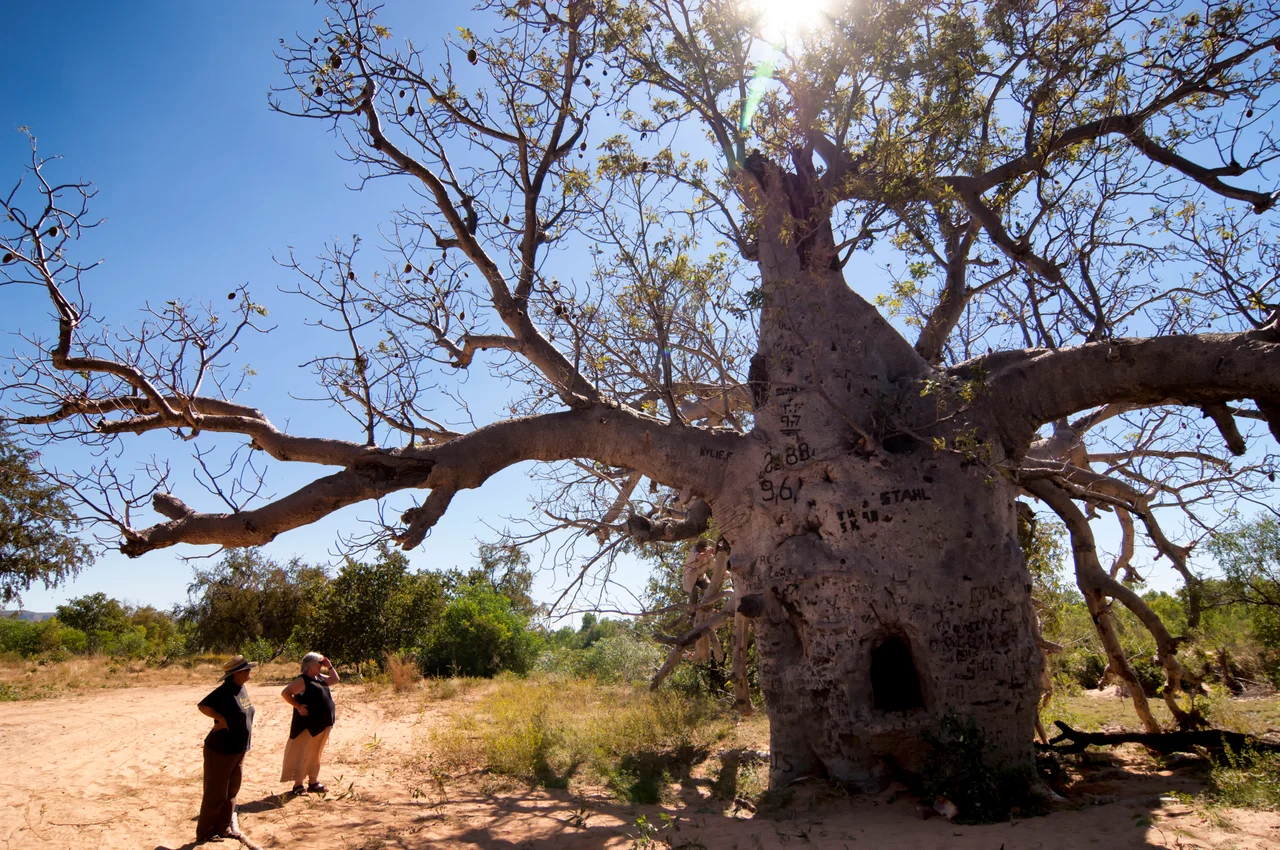

Boab Prison Tree, Wyndham
The tree was already ancient when police first cut a door into its side. Adansonia gregorii — the boab, Australia's version of the African baobab — grows with extraordinary slowness, its massive swollen trunk accumulating girth across centuries. By the 1890s, the tree south of Wyndham was already over 2,000 years old, with a circumference of nearly 14 metres. Someone noticed that holes in the upper branches indicated the interior was hollow. An opening was cut. The tree became a prison.
The Hillgrove Lockup
Police on patrol from Wyndham in the 1890s were bringing Aboriginal prisoners to town for sentencing — long journeys through remote country with no formal facilities. The hollow boab on King River Road offered a practical solution. The opening cut into the trunk allowed Aboriginal men to be locked inside overnight while the patrol rested, then moved on to Wyndham the following morning. The tree was known then as the Hillgrove Lockup, after the police station, and the words 'Hillgrove Police Station' were carved deeply into the soft bark along with the names and initials of travellers passing through. By the time later accounts were written, nearly all of this had been overwritten by a century of subsequent carvings.
When the Tree Was Not Enough
A 1940 newspaper account adds a detail that shifts the story: when there were more prisoners than could fit inside the tree, they were chained to the outside. The account records the escape of one man chained there — described as tall, powerfully built, and apparently capable of bending the iron bolt to which his chain was padlocked until it folded back on itself like a hairpin. By daybreak, both the man and the chain were gone. The incident appears in the colonial record as a curiosity, a remarkable feat of physical strength. What it also records is the reality of Aboriginal men shackled to a tree in the Western Australian night, awaiting transportation to a court that held them in contempt.
The Tree That Really Was a Prison
A 1966 newspaper article noted that the more famous Boab Prison Tree at Derby — the one most tourists visited — had never actually been used as a prison. The article confirmed that the Wyndham tree had. This distinction matters: the Wyndham boab is not a myth or a legend or a tourism invention. It is a documented site of colonial incarceration, in use during the era when the Kimberley's Aboriginal people were systematically dispossessed of their land and subjected to a legal system that treated them as subjects rather than citizens. The tree has been a tourist attraction since at least the early 1900s, which adds its own uncomfortable layer to the story.
Two Thousand Years of Witness
The tree still stands on King River Road, about five kilometres south of Wyndham's Diggers Rest area, near the Moochalabra Dam. Its circumference is approximately 14 metres. By any measure of time, the events of the 1890s are recent — the merest fraction of the tree's life. It was old when the Kimberley's Aboriginal peoples first encountered European settlers; old when Afghan cameleers moved cattle and supplies through; old when the meat-packing factory in Wyndham opened in 1913. When visitors come to stand beside it and try to take its measure, the tree is indifferent. It has been here far longer than the stories attached to it, and will very likely be here long after those stories are forgotten.
From the Air
Coordinates: 15.631°S, 128.095°E — approximately 5 km south of Wyndham on King River Road, near the Moochalabra Dam. The tree is not visible from the air but the surrounding landscape — the Cambridge Gulf mudflats, the five river mouths, and the Bastion Range above Wyndham — are distinctive. Nearest airport: Kununurra (YPKU), 100 km to the southeast; Wyndham has an airstrip at the east edge of town.
Nearby Stories
- Forrest River Massacre 33 km away
- The Speewah 49 km away
- Drysdale River National Park 91 km away
- Bilinarra Language 102 km away
- Argyle Diamond Mine 103 km away
- Gibb River Road 132 km away
- Auvergne Station 144 km away
- Victoria River Downs Station 259 km away