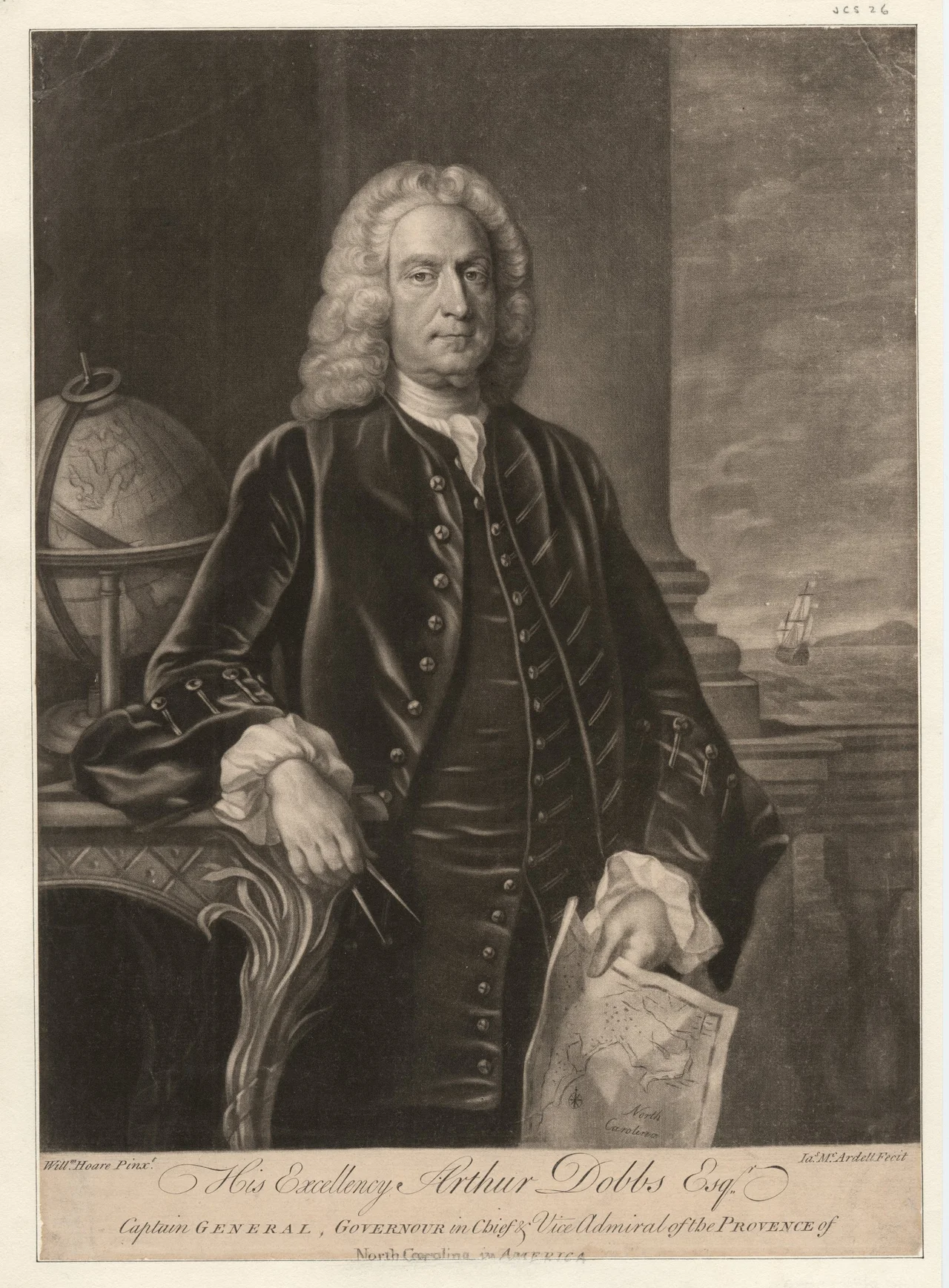

Arthur Dobbs
In January 1760, Arthur Dobbs sat in Brunswick, North Carolina, and wrote a letter to the botanist Peter Collinson in London. He described a plant unlike anything English science had on file: a leaf with hinged jaws that snapped shut on whatever touched it. The natives, he wrote, knew it grew in latitude 34 but not in 35. He had been collecting seeds. The letter was the first scientific description of what would soon be named the Venus flytrap. Dobbs was sixty when he wrote it, near the end of a life that had already taken him from Ayrshire to Antrim to Dublin to the Northwest Passage debate, and finally to a colonial governorship he would not survive.
Born in Ayrshire, Raised in Antrim
Dobbs was born on April 2, 1689, in Girvan, Ayrshire, where his mother had been sent for safety during political and religious unrest in Ireland. His family seat was Castle Dobbs in County Antrim, built in 1599 by his great-great-grandfather John Dobbs, an officer who had arrived in Ireland in 1596 under Sir Henry Dockwra. Arthur's father became Sheriff of Antrim in 1694. Arthur himself served briefly in a dragoon regiment, then took over the family estate. Jonathan Swift was a neighbor and family friend despite their political differences. In an Ireland still raw from the Williamite wars, Dobbs grew up Protestant, Anglo-Irish, and ambitious.
The Surveyor and the MP
Sir Robert Walpole appointed Dobbs Engineer-in-Chief and Surveyor-General of Ireland. In that role, he supervised the construction of the Irish Parliament House in Dublin, the world's first purpose-built bicameral parliament building and now the Bank of Ireland on College Green. He was named High Sheriff of Antrim in 1720 and elected Member of Parliament for Carrickfergus in 1727, a seat he held until 1760. In 1731, he became one of fourteen founders of the Dublin Society, which would later become the Royal Dublin Society. He was, by his forties, a man of accomplished public service in two countries that did not always like each other.
Hunting the Northwest Passage
Dobbs spent the 1740s arguing with the Hudson's Bay Company. He believed the company was sitting on its trade monopoly and ignoring the search for a Northwest Passage through the Canadian Arctic. From 1741 to 1747, he personally stimulated and funded exploration expeditions, hoping that revoked monopolies and competing traders would crack the route open. The expeditions failed to find the passage, and a 1749 Parliamentary inquiry ended the campaign against the Hudson's Bay Company's charter. But the voyages produced significant new geographic knowledge and changed how Britons thought about the Arctic's economic potential. Dobbs was also an amateur scientist who published astronomy papers and a pamphlet on honeybees.
Governor of North Carolina
While serving in the Irish Parliament, Dobbs bought 400,000 acres in North Carolina in 1745 and pushed for Scots-Irish settlement of the colony. When Governor Gabriel Johnston died, Dobbs was confirmed as his successor on January 25, 1753. He did not arrive in North Carolina to take up the post until October 1754. He served as governor from 1754 until 1764, when William Tryon arrived as his lieutenant-governor. His most ambitious idea was to establish a permanent colonial capital called George City near Tower Hill on the Neuse River. The plan never came together. The capital question remained unresolved for decades after his death.
Catch Fly Sensitive
Dobbs's lasting scientific contribution came from the wet, longleaf pine country around the lower Cape Fear. In 1759 he made the first written notice of the plant, calling it a Catch Fly Sensitive. The following January, in Brunswick, he wrote the more detailed letter to Peter Collinson describing how the leaves snapped shut on contact. His description preceded the better-known letters from John Ellis to The St James's Chronicle and to Carl Linnaeus, who would eventually classify the plant as Dionaea muscipula. The Venus flytrap remains endemic to a narrow band of the Carolina coastal plain, roughly latitude 34 in Dobbs's careful observation. He died on March 28, 1765, still in North Carolina, never having seen the species named or his colonial capital built. Castle Dobbs, in County Antrim, still stands.
From the Air
Arthur Dobbs spent his final years near Brunswick Town, which lay along the Cape Fear River near 34.04 degrees N, 77.95 degrees W, in present-day Brunswick County, North Carolina. The site is now the Brunswick Town/Fort Anderson State Historic Site, just north of Southport. Wilmington International (KILM) is 18 miles north; Cape Fear Regional Jetport (KSUT) is 12 miles south on Oak Island. From low altitude, look for the ruins of Brunswick Town along the west bank of the Cape Fear, surrounded by longleaf pine and live oak. The Venus flytrap's native range still hugs this stretch of coast roughly 100 miles north and south of the river mouth.
Nearby Stories
- Lake Waccamaw, North Carolina 11 km away
- Ocean Isle Beach house fire 14 km away
- Topsail Beach, North Carolina 25 km away
- Marine Corps Base Camp Lejeune 35 km away
- HMT Bedfordshire 63 km away
- Huntington Beach State Park 67 km away
- Atalaya Castle 114 km away
- Mercury-Redstone 4 707 km away