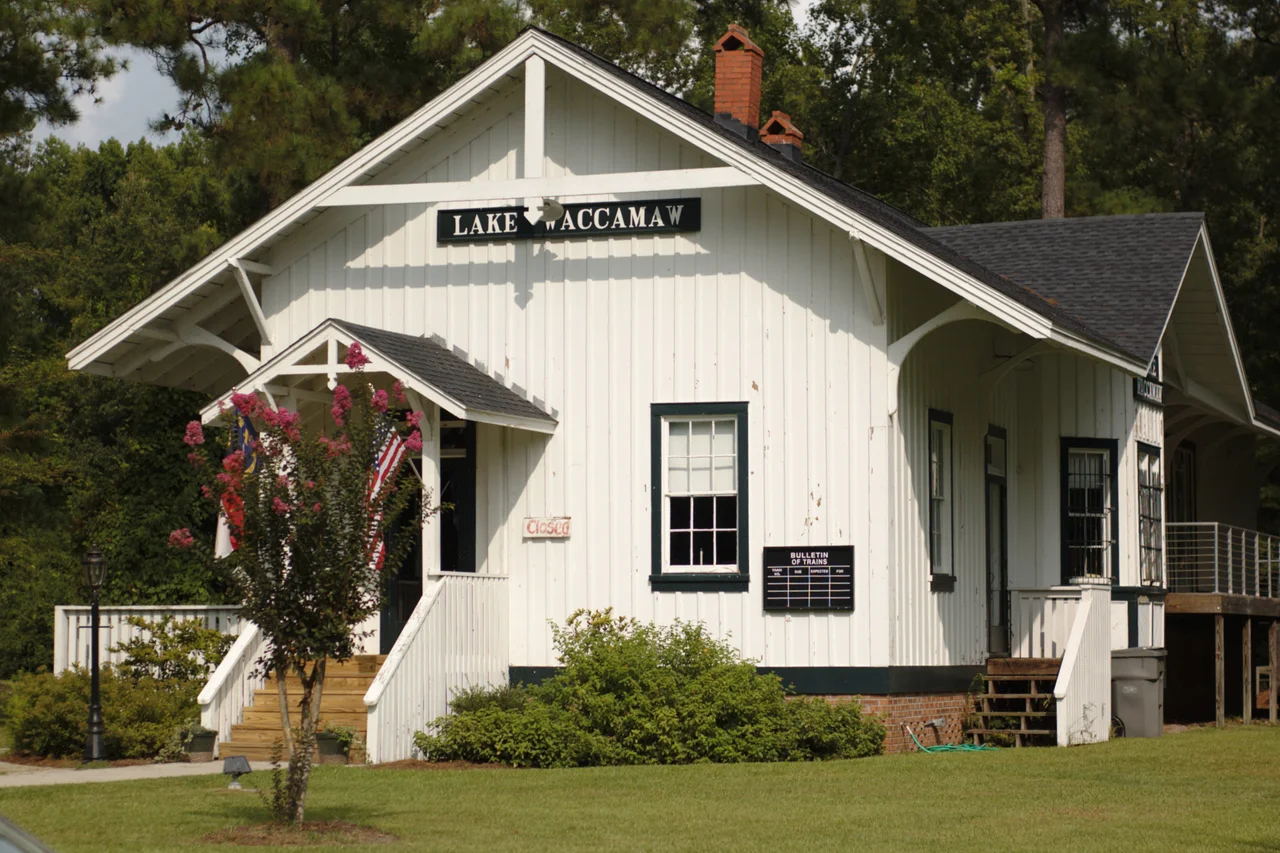

Lake Waccamaw, North Carolina
The Waccamaw Siouan call themselves People of the Falling Star. The story is older than the European maps, and it explains the lake the way no geologist quite can: a meteor struck here, carved out the basin, and left the water behind. Scientists place Lake Waccamaw among the Carolina bays, those mysterious oval depressions scattered across the coastal plain, but the origin remains debated. What no one disputes is what swims in the lake. The Waccamaw silverside, the Waccamaw killifish, the Waccamaw darter, and two endemic snails live in this water and nowhere else.
A Lake That Should Not Be This Alive
Most Carolina bays are acidic and dark, fed by tannins from surrounding peat. Lake Waccamaw is different. Limestone outcrops along the southern shore push the pH up and the alkalinity higher than its neighbors, creating a freshwater chemistry rare on the southeastern coastal plain. That difference is why the endemic species are here. The Waccamaw silverside, a small translucent fish, can be found in the lake and in a few connected reaches downstream, but its core population lives in these 9,000 acres. The Waccamaw amnicola and Waccamaw siltsnail crawl along the bottom. Lose this water chemistry and you lose them all.
Settlement on the Edge
Native peoples lived here long before John Powell of Virginia arrived with cattle in the mid-eighteenth century. His sons Absalom and Issac bought up land. Issac eventually owned most of the lake. By 1804 he was a major of militia and by 1806 a justice of the peace. The economy ran on naval stores, then turpentine. When the discovery of turpentine oil made the area commercially attractive, the Wilmington and Manchester Railroad pushed its tracks through, hauling out shingles and lumber. A shingle company became a lumber company. In 1910, townspeople founded the Waccamaw Club, an early sign that this place was becoming a destination as much as a worksite.
Take the Lake
Columbus County kept ranking last among North Carolina's 100 counties for health outcomes. Organizers responded with Take the Lake, a free fitness event held every Labor Day weekend. Participants can walk the 15-mile shoreline, paddle 14 miles around, bike 12 and walk 3, or swim 4 miles across. No winners are announced. Awards go to anyone who finishes. The event is built around the Bohemian Girl Scenic Bridge, named for John A. McNeil, a celebrated local citizen, which completes the lakeside path and offers fishing platforms with panoramic views. The Waccamaw Dam, built by the state in 1926 to keep the lake from shrinking in dry weather, got a new bridge in 2018.
Woodpeckers, Kites, and Bears
Lake Waccamaw State Park protects the longleaf pine forests and forested wetlands that surround the lake. Red-cockaded woodpeckers live here, though their numbers have dropped as the pine forest matured and timber harvesting changed the canopy. The town has the densest population of swallow-tailed kites in North Carolina, sleek black-and-white raptors that ride the summer thermals over the cypress edges. Black bears use the forest for dens, food, and shelter. Brown-headed nuthatches, parula warblers, and white-eyed vireos work the understory. Prescribed burning keeps the longleaf pine system functioning the way it has for thousands of years, when fire was the lake's most reliable neighbor.
People of the Falling Star
The Waccamaw Siouan are one of eight tribes recognized by the state of North Carolina. They live on the edge of the Green Swamp in a protected swampland refuge, and they are distinct from the Waccamaw People of North Carolina and the Waccamaw Siouan of Farmers Union in South Carolina, despite the shared names. Their own oral history names them People of the Falling Star, after the meteorite they say created the lake. White settlers shortened their earlier names from Waccon to Waccammassus to Waccamaw because the English tongue stumbled over the original syllables. The lake itself sits at the heart of their story, which means the strange biology of this water carries cultural weight as well as scientific value.
From the Air
Lake Waccamaw lies at 34.31 degrees N, 78.51 degrees W in eastern Columbus County, North Carolina. The lake is one of the largest Carolina bays in the state, and from cruising altitude its near-perfect oval shape and northwest-southeast long axis are unmistakable, aligned like the other bays of the region. Wilmington International (KILM) sits about 35 miles east; Myrtle Beach International (KMYR) is 50 miles south. The closest GA field is the small unpaved Lake Waccamaw airstrip. Look for the dense longleaf pine canopy and pocosin wetlands surrounding the lake, and the Green Swamp Preserve stretching south.
Nearby Stories
- Robeson County, North Carolina 0.9 km away
- Orton Plantation 10 km away
- Leland, North Carolina 15 km away
- Sunset Beach, North Carolina 25 km away
- 1950 Myrtle Beach USAF C-46D Crash 33 km away
- Duplin County, North Carolina 36 km away
- Pembroke, North Carolina 36 km away
- The Robesonian Takeover 39 km away