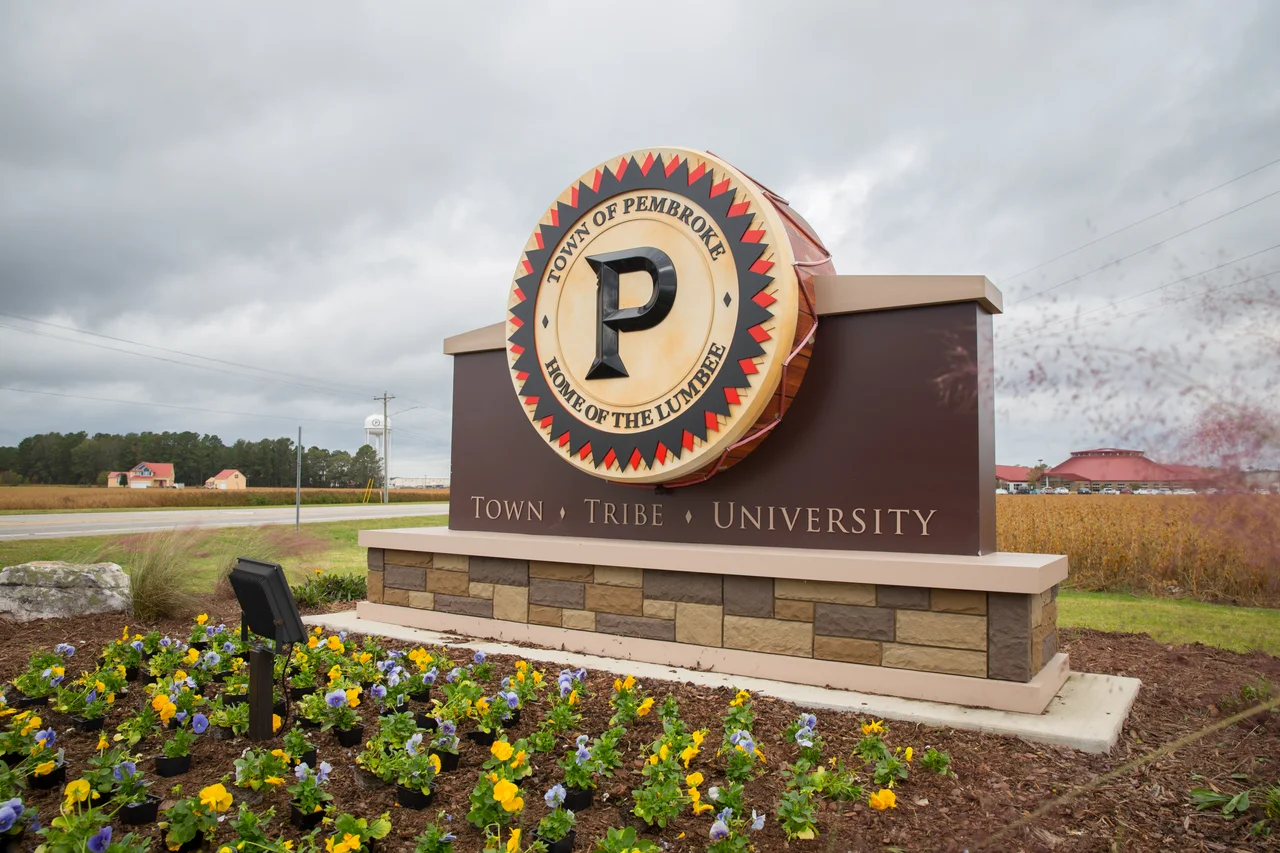

Pembroke, North Carolina
More than half of Pembroke's residents are Lumbee. This single fact reorganizes everything you might assume about a small Southern town. The Jim Crow signs that defined nearby towns through the mid-twentieth century never fully took hold here, because the local majority was the people the signs would have sorted into a third category. The university at the center of town was founded by an act of the legislature in 1887 specifically to train Lumbee teachers. The town's first elected Lumbee mayor took office in 1947, after a delegation of Lumbees petitioned the governor for the return of democratic local government. Pembroke is not a town that explains itself with reference to other places. It is the kind of town other places get explained against.
A Mill, A Railroad, A Name
Before there was Pembroke there was Campbell's Mill, a small community in Robeson County along the Wilmington, Charlotte and Rutherford Railroad's east-west line from 1860. In 1892 the Wilmington and Weldon Railroad wanted to build a north-south line through nearby Moss Neck. A prominent Moss Neck citizen opposed it, so the railroad moved its line a few miles west — to Campbell's Mill. The Atlantic Land and Improvement Company surveyed one square mile of streets centered on the new station, and a town materialized. In 1895 it was incorporated and named Pembroke — not for the Welsh town or the British title, but for a railway worker named Pembroke Jones. The Croatan Normal School followed in 1909, moving here from the nearby community of Pates. From that arrival forward, the town's center of gravity has been education.
Who the Lumbee Are
The Lumbee are the largest tribe east of the Mississippi and, since December 2025, a fully federally recognized nation. Their origins are multi-tribal, drawing from groups including Cheraw, Saponi, Tuscarora, and others displaced and re-aggregated over centuries of disease, war, and removal. In the 1950s, when the community formally chose a tribal name, they took it from the Lumber River — a river they had lived along for generations and which had carried earlier names in earlier languages. The North Carolina legislature has used a confusing variety of designations for this same people over time: Croatan in 1885, Indians of Robeson County in 1911, Cherokee Indians of Robeson County in 1913, and finally Lumbee in 1953. Federal recognition was sought for over a century and finally achieved in December 2025, when Congress passed the Lumbee Fairness Act as part of the National Defense Authorization Act and President Trump signed it into law — a milestone on which most Lumbees of any political stripe had long agreed was overdue.
A Town That Held Its Ground
Because Lumbee residents formed a strong majority in Pembroke through the early twentieth century, the social architecture of Jim Crow took a different shape here. There were still racial categories and separations. But the kind of total exclusion practiced in nearby white-majority towns of St. Pauls or Red Springs was harder to enforce where the excluded group ran most of the local businesses. Even so, the town was governed by its white minority through a state-imposed appointment system from 1917 until 1947, when local Lumbee organizing finally persuaded the governor to restore elected government. The Lumbees promptly elected their first Lumbee mayor. Old Main, the original Croatan Normal School building, and the former Pembroke High School are both on the National Register of Historic Places — markers of a community that built its own institutions when it had to.
UNC Pembroke and Givens Performing Arts Center
The university that began in 1887 with one teacher and 15 students has surpassed 8,000 students today and a remarkable distinction: as an institution founded by American Indians for the education of American Indians, with the continued explicit support of the Lumbee Tribe, UNC Pembroke is one of the few schools in the country where 'Braves' as an athletic nickname is not controversial. The campus also hosts the Givens Performing Arts Center, which functions as the cultural anchor for the eastern Sandhills — touring Broadway shows, orchestras, and the Distinguished Speaker Series that has brought Cory Booker, Bill Nye, Gabby Douglas, and Hill Harper to a town of 2,823 people. The Museum of the Southeast American Indian, inside Old Main, preserves what most American museums never set out to preserve: a Southeastern Native perspective on Southeastern Native history.
Distance and Closeness
Pembroke is about ninety miles inland from the Atlantic, twenty miles north of the South Carolina line, and a short drive from Lumberton in one direction and Maxton in the other. Drive any back road and you pass churches — Lumbee churches, Black churches, white churches, often within a few hundred yards of each other — and modest houses set back among the long-needled pines. The collard sandwich, fried cornbread folded around collards and fatback, is a Lumbee specialty served in places that do not appear on any guidebook. The Lumbee Homecoming, held in late June and early July, brings thousands of Lumbees back to a town small enough that the homecoming becomes the town. Many of the streets are named for the railway workers and educators who built the place. One of them, of course, is Pembroke.
From the Air
Pembroke sits at 34.68°N, 79.20°W in Robeson County, North Carolina, about 90 miles inland from the Atlantic. Nearest airports: Lumberton Municipal (KLBT) 12 miles southeast, Laurinburg-Maxton (KMEB) 15 miles west, Fayetteville Regional (KFAY) 35 miles north. The town sits in the Lumber River basin, surrounded by longleaf pine flats and swamps. From altitude, look for the distinctive cross of railroad tracks at the town center (the original Wilmington-Weldon north-south line intersecting the Wilmington-Charlotte east-west line), the UNC Pembroke campus on the eastern edge with its red-roofed Old Main visible in clear weather, and the meandering Lumber River to the east.
Nearby Stories
- Cheraw, South Carolina 8.6 km away
- Delta Force 17 km away
- Darlington County, South Carolina 20 km away
- Columbus County, North Carolina 23 km away
- Battle of Colson's Mill 32 km away
- Battle of Averasborough 33 km away
- 1958 Mars Bluff B-47 Nuclear Weapon Loss Incident 45 km away
- Sampson County, North Carolina 46 km away