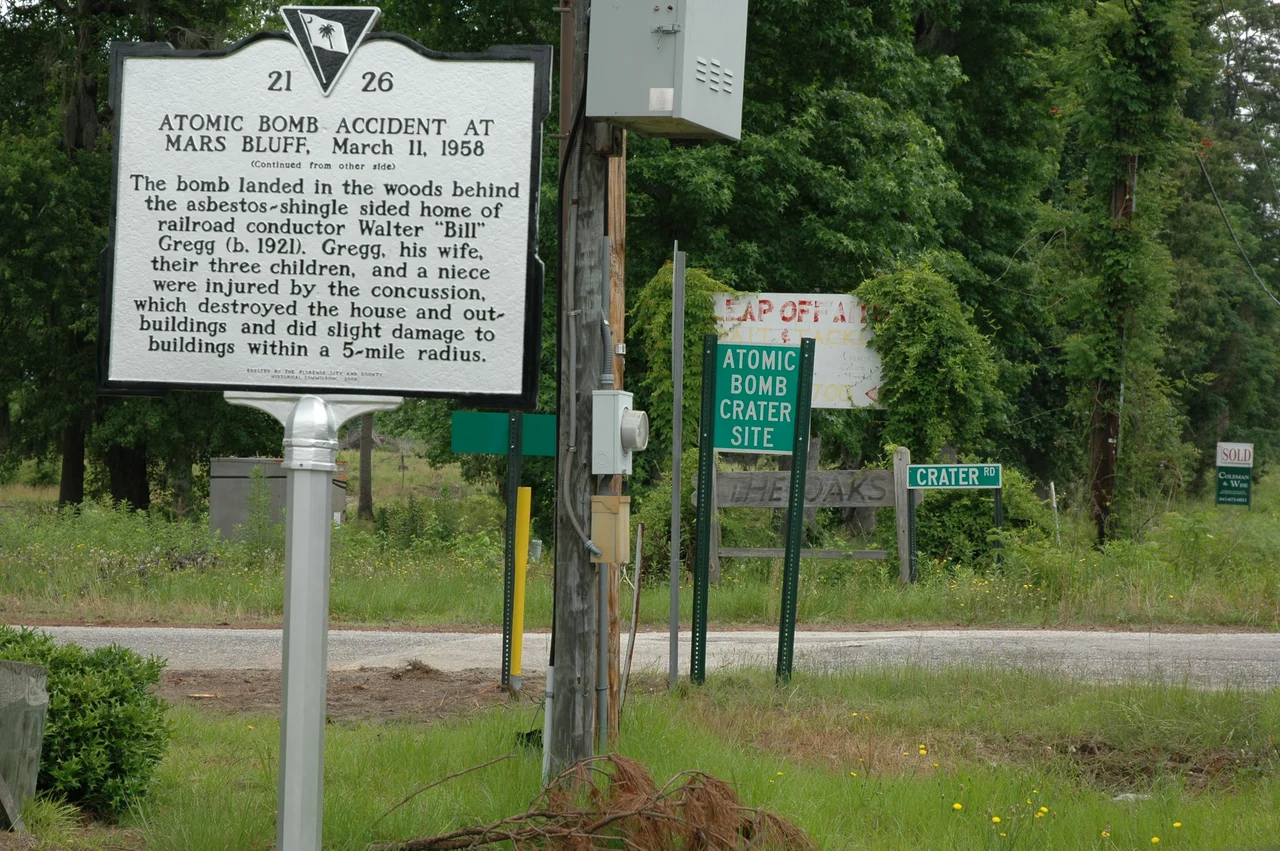

1958 Mars Bluff B-47 Nuclear Weapon Loss Incident
The two girls were playing in the yard - Helen and Frances Gregg and their cousin Ella Davies - when the bomb came down. It was about 4:30 on the afternoon of March 11, 1958. Walter and Effie Gregg were inside the family home on a country road outside Mars Bluff, South Carolina, with their son Walter Jr. The B-47 that had just released a Mark 6 hydrogen bomb over their playhouse was a speck somewhere above. The conventional high-explosive charge inside the weapon detonated when it hit the ground and tore a crater roughly seventy feet wide and thirty feet deep where Walter Gregg's vegetable garden had been. The playhouse was gone. The Gregg house collapsed inward. And every member of the Gregg family - somehow, miraculously - walked out alive.
The Greggs
Walter Gregg was a railroad conductor and a World War II veteran. He and Effie had built a quiet life with their three children, Walter Jr., Helen, and Frances, on a rural property near Mars Bluff in Florence County, South Carolina. Their niece Ella Davies, age nine, was visiting that day. Walter took the worst of the injuries - a deep cut to his right arm. Effie was struck by a dislocated piece of plaster and cut on the head. The Gregg children took flying debris and were left with mostly superficial wounds. Ella's injuries were more serious; she required surgery for internal bleeding. The family chickens were not so lucky. Several were killed outright by the blast. The Gregg house was a ruin. But the people were alive, and that is the part of this story that matters most.
Aircraft 53-1876A Has Lost A Device
The bomb came from B-47E aircraft 53-1876A out of Hunter Air Force Base near Savannah, Georgia, bound for Britain as part of Operation Snow Flurry. Captain Bruce Kulka was the navigator-bombardier. Somewhere over the Pee Dee region, a warning light indicated the bomb-locking pin was not engaged. Kulka climbed back into the bomb bay to inspect it; in the cramped space he grabbed for a handhold, accidentally took hold of the manual release lever, and the Mark 6 hydrogen bomb - a weapon weighing about 7,600 pounds and capable of a yield in the megatons - dropped through the bomb bay doors and out of the aircraft. Crucially, the bomb's fissile core was stored separately, as was U.S. practice during peacetime transit. What fell on Mars Bluff was a nuclear weapon without its nuclear charge. What detonated was the several thousand pounds of conventional high explosive used in the weapon's design - more than enough to flatten a house.
The Crater in the Garden
The blast blew the playhouse to splinters and lifted Helen and Frances and Ella into the air. It collapsed the Gregg home around Walter and Effie. The shock wave damaged buildings within a mile and was heard for many more. When the Air Force crews arrived, they found a crater seventy feet wide and thirty feet deep in the Gregg's garden - measurements that have been reported variously in different sources, but in any version, a substantial hole where the family's tomatoes and beans had been growing the day before. The B-47 circled back, the crew confirmed the loss, and the message went up the chain of command in language that has become an icon of Cold War understatement: aircraft 53-1876A had lost a device. Walter Gregg later sued the Air Force and received about 54,000 dollars - far less than he had asked for, far more than military families typically got.
Not the First and Not the Last
The New York Times reported that this was the first time a nuclear weapon had been accidentally dropped on the United States outside testing grounds. It was not even the first that year. A few weeks earlier, a B-47 had collided with an F-86 over Tybee Island, Georgia, and jettisoned a hydrogen bomb into the Atlantic that has never been recovered. The Department of Defense's later "Broken Arrow" inventory of serious nuclear weapon accidents lists at least thirteen before Mars Bluff. The Mars Bluff incident did prompt one quiet operational change: nuclear weapons aboard U.S. aircraft were thereafter more securely fastened, making it harder to release them - accidentally or intentionally. The fix took an afternoon and a hydrogen bomb landing on a family's playhouse.
The Historical Marker
The crater filled in over the years. The Gregg family rebuilt and stayed in Florence County. Walter Gregg died in 2003 at age eighty-one; Effie died in 2010. The site is on private land and not generally accessible, but a roadside historical marker was placed nearby in 2008, and the Florence County Museum in downtown Florence has a full-size replica of the Mark 6 weapon on display, along with shards of the original bomb casing. Visitors stand and look at the replica and think about the family who survived this. The technical lesson was about bomb-locking pins. The human lesson is that Walter and Effie Gregg's children grew up, and grew old, in a country that had just barely - by the absence of one carefully stored core - not detonated a hydrogen bomb on top of them.
From the Air
Approximate site at 34.20N, 79.66W, in the Mars Bluff community east of Florence, South Carolina. The site itself is private land off Mars Bluff Road. Cruise at 2,500-4,000 feet AGL for context; the Pee Dee River meanders just east, and Florence Regional Airport (KFLO) lies about 8 miles west. The B-47 had taken off from Hunter Air Force Base near Savannah (now Hunter Army Airfield, KSVN) about 150 miles southwest. Other nearby airports: Marion County (KMAO) 25 miles east, Conway-Horry County (KHYW) 45 miles southeast. The Florence County Museum, where the bomb replica is displayed, sits in downtown Florence.
Nearby Stories
- Horry County, South Carolina 11 km away
- Marlboro County, South Carolina 17 km away
- Sumter, South Carolina 17 km away
- Moore Farms Botanical Garden 19 km away
- Lumberton, North Carolina 21 km away
- Tabor City, North Carolina 22 km away
- Shaw Air Force Base 38 km away
- Battle of Hanging Rock 48 km away