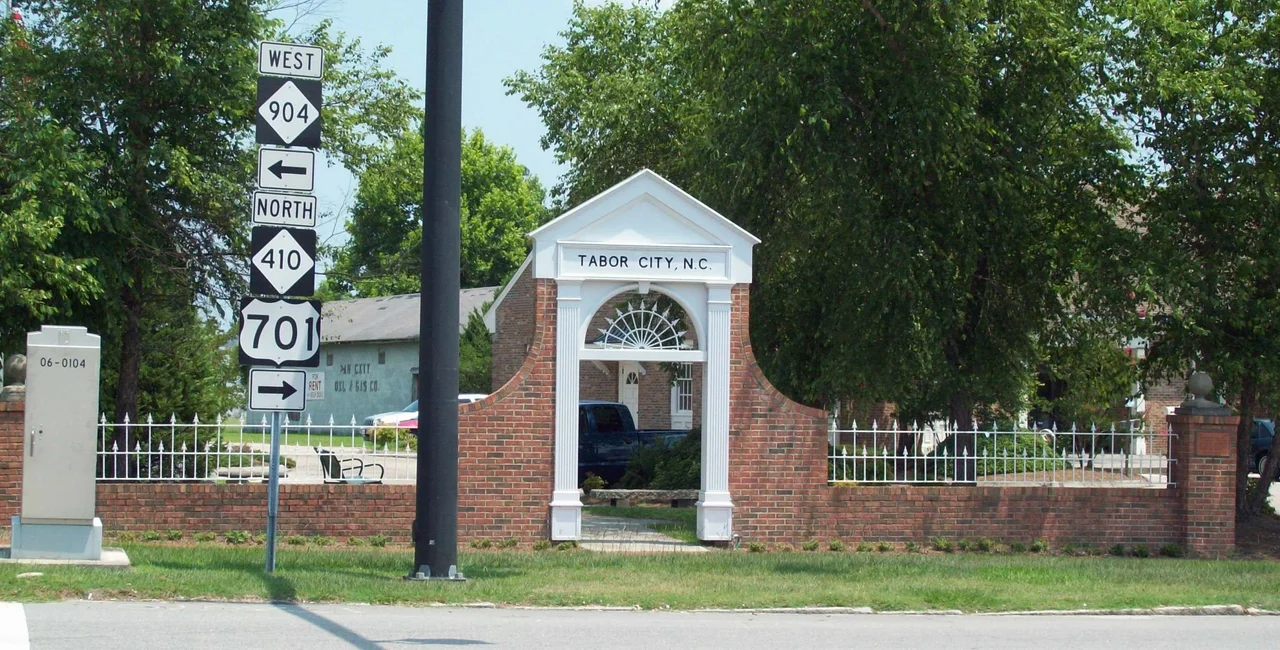

Tabor City, North Carolina
In 1950, the Ku Klux Klan began a recruitment campaign in the small tobacco town of Tabor City, North Carolina. The editor of the local weekly newspaper, the Tabor City Tribune, was a 29-year-old named W. Horace Carter. He began writing editorials against the Klan — week after week, at considerable personal danger, in a town where many of his readers either wore the robes or sympathized with those who did. Three years later, on the same day the Whiteville News Reporter received the same honor, the Tribune won the Pulitzer Prize for Public Service. They were the first weekly newspapers to win one.
Mount Tabor, Renamed
The town began as a Baptist congregation. Around 1837, settlers in this corner of southern Columbus County built a log church and named it Mount Tabor, after the biblical mountain. A village grew around the church, organized as a town shortly after 1840 and officially incorporated in 1904. The original name lasted nearly a century. By 1935, the Postal Service had grown tired of confusing Mount Tabor mail with Tarboro mail farther east, and demanded a change. Tarboro was bigger, so it kept its name. The Tabor people picked a new one: Tabor City. The phrase suggested ambitions the town never quite reached — but the name stuck.
The Editor and the Dragon
When the Klan began organizing in southeastern North Carolina in 1950, most local newspapers stayed quiet. Horace Carter did not. His editorials in the Tribune named names, described floggings, and refused to accept that hooded terrorism was a normal feature of small-town life. The economic and personal risk was real — Carter received threats, lost advertisers, and worked through years of harassment. The Pulitzer Prize citation in 1953 read that the award honored 'their successful campaign against the Ku Klux Klan, waged on their own doorstep at the risk of economic loss and personal danger, culminating in the conviction of over one hundred Klansmen and an end to terrorism in their communities.' A documentary made decades later was titled The Editor and the Dragon. Carter died in 2009. His New York Times obituary noted that his small-town paper had taken on something nobody else would.
Border Belt Tobacco
Tabor City sits in what was called the Carolina Border Belt — a network of tobacco markets and warehouses stretching along both sides of the North Carolina-South Carolina line. The first tobacco warehouse went up in 1909, and by 1925 the town had several auction warehouses, two re-drying warehouses, and a prizery for packing leaf into hogsheads. All within a block of the railroad tracks. Strawberries had been the previous boom — the Anderson Shingle Company shipped them out in crates by the hundreds of thousands — but tobacco became the golden crop. The Border Belt produced prime flue-cured leaf for cigarette companies around the world. The dominance lasted into the 1990s, when changing consumer habits and global economics finally pulled the industry apart.
Yams and Survivors
Since 1948, the fourth Saturday in October has belonged to the North Carolina Yam Festival. There's a parade, a Miss Yam Festival pageant for various age groups, classic cars, train rides, vendors, and an art show. It is the kind of small-town festival that survives by being unembarrassed about itself. Lake Tabor, a 2-acre municipal lake, hosts boat events when it isn't fighting algae or hurricane damage — it went completely dry in 1998 after floods destroyed the retention dam, but the town rebuilt it. The old train depot serves as a small museum during the Yam Festival, with a retired caboose for kids to climb. None of it is fancy. All of it is durable.
What Remains
The Tribune still publishes, renamed the Tabor-Loris Tribune in 1996. A small W. Horace Carter Newspaper Museum at the Tribune offices holds artifacts from the Klan crusade. The Ritz Theater on Main Street, rebuilt in 2014 with government grants, hosts community arts events. Town welcome signs were updated in 2019 to recognize country music singer Stonewall Jackson, a Tabor City native who left for Nashville and became a Grand Ole Opry regular. Tabor City has had hard decades — population loss, business closures, deep poverty — but its name still appears in journalism textbooks and Pulitzer histories, because once, in the early 1950s, a small-town editor decided that he wouldn't stay quiet.
From the Air
Tabor City sits at approximately 34.15°N, 78.87°W in southern Columbus County, North Carolina, about 30 miles inland from North Myrtle Beach. From the air, the town reads as a cluster of small streets around the rail line, with a grid of tobacco-warehouse buildings near the depot and surrounding farmland giving way to pine forest. Nearest GA fields include Myrtle Beach International (KMYR) about 30 miles southeast and Curtis L. Brown Jr. Field at Elizabethtown (KEYF) about 50 miles northeast. The terrain is flat coastal plain, agricultural fields broken by blackwater drainages.
Nearby Stories
- Horry County, South Carolina 5.3 km away
- 1958 Mars Bluff B-47 Nuclear Weapon Loss Incident 19 km away
- Lumberton, North Carolina 21 km away
- Brunswick County, North Carolina 23 km away
- Marlboro County, South Carolina 26 km away
- Oak Island (North Carolina) 27 km away
- Moore Farms Botanical Garden 35 km away
- Pender County, North Carolina 47 km away