
Moore Farms Botanical Garden
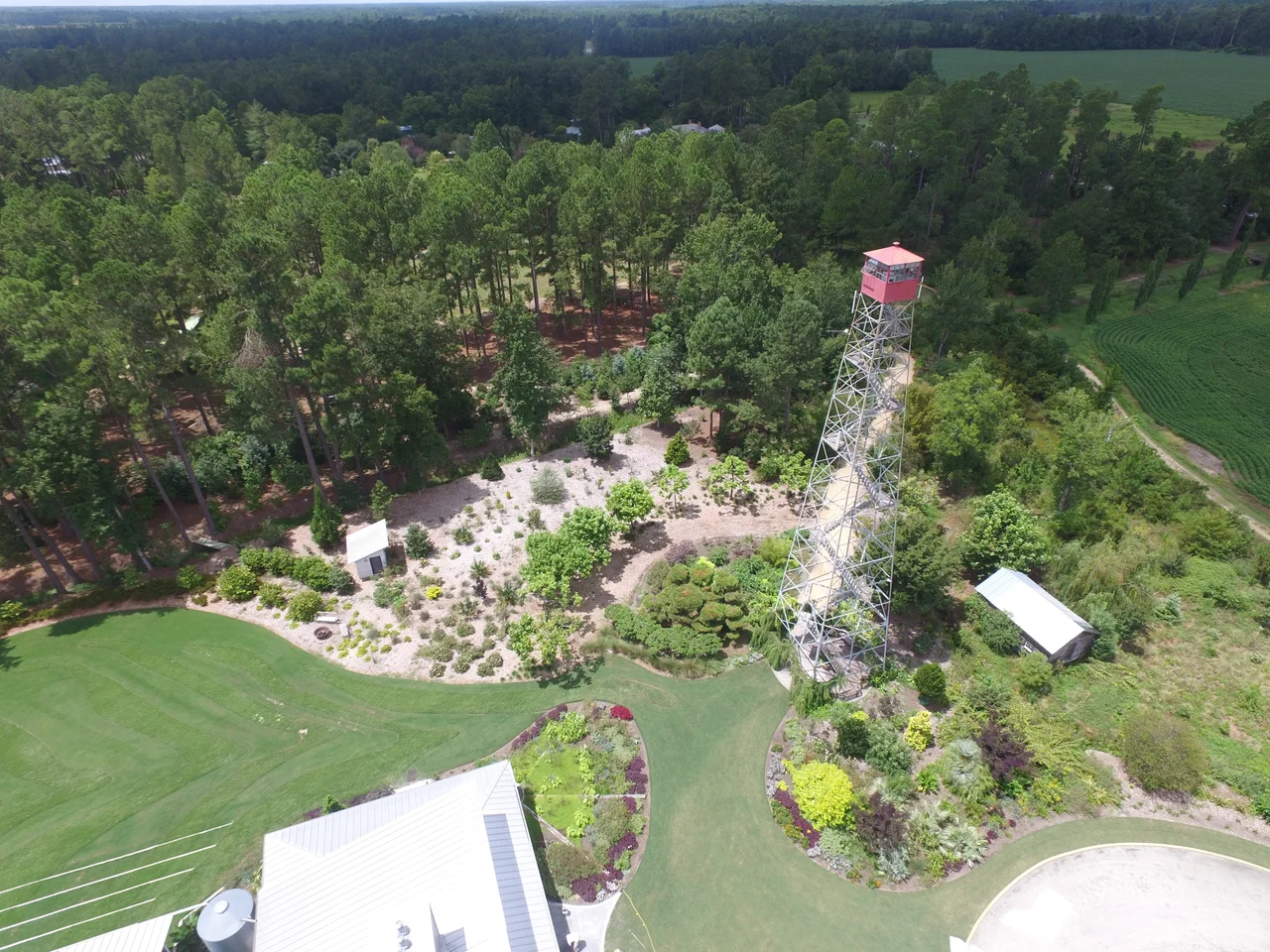
The fire tower came up for auction in Olanta, South Carolina, in 2004. It was a hundred feet of steel lattice, the kind that once stood over the loblolly pine plantations of the coastal plain so a watchman with binoculars could see smoke before it became disaster. Nobody auctions fire towers anymore. Darla Moore bought it, hauled it down the road, and made it the centerpiece of a garden. Today a southern bald cypress cultivar called "Emerald Falls" climbs that tower, trained patiently by horticulturists to do what cypress was never meant to do - reach up the side of an iron skeleton.
A Family Farm, Reimagined
Darla Moore grew up in Lake City, in the Pee Dee region of South Carolina, on land her family had farmed for generations: corn, soybeans, cotton, and once, tobacco. She left for finance and made a fortune in New York. In 2002 she came back, and on the family acres she founded a botanical garden - not a public one, exactly. Moore Farms is still not open every day. Visitors come by appointment, on Open Garden days, or for one of the seasonal events that bring the surrounding community in. The garden sits stitched into the surrounding fields, so signature views from one bed lead the eye out across rows of working agriculture. It is a garden that refuses to pretend the farm around it does not exist.
Coastal Plain Country
The land here is flat. Elevation barely registers. Summers are humid and brutal; winters are mild enough to grow plants that would die a hundred miles north. The garden sits in USDA Hardiness Zone 8a, in the inner Atlantic coastal plain, with a humid subtropical climate that suits the things Moore Farms most loves to grow. Magnolia. Camellia. Crinum lilies. Southern live oak. Sixty-eight cultivars of Magnolia grandiflora alone, plus seventeen unnamed hybrids - probably the deepest single-species magnolia collection south of the Mason-Dixon line. In 2017 the garden finished planting a Taxodium collection of about sixty-one cultivars covering the three recognized species: bald cypress, pond cypress, and Montezuma cypress.
Native Plants and the Pine Bay
Moore Farms takes seriously its obligations to South Carolina's own flora. The garden collects across the state - coastal plain, Piedmont, even Blue Ridge - to build a working assemblage of native plants for preservation and horticultural introduction. Some of what they grow is rare. Some is little-known: the Georgia false indigo, the Carolina bogmint, the Coastal Plain swamp aster. The most naturalistic area, Pine Bay, was once a working loblolly pine plantation. It now displays over four hundred taxa of South Carolina natives, a quietly radical statement that the working forest and the botanical garden are not opposites - they can share land, and one can teach the other.
The Fire Tower and the Spring House
Around the fire tower itself sits a bog garden full of pitcher plants - the carnivorous Sarracenia native to the southeastern wetlands. The Firetower Center, completed three years after the tower came home, houses the offices and the welcome desk. Elsewhere, the Spring House is built from timber milled in a neighboring county, with walls of onsite-grown bamboo and a thatched roof of reed grass. The Formal Garden uses yaupon holly hedges in place of the boxwood you'd expect, and includes topiaries by Pearl Fryar, the self-taught Bishopville topiary artist whose work has drawn international attention. On the maintenance building, a six-thousand-square-foot intensive green roof doubles as a research plot, watered entirely by captured rain.
Quiet Work in Lake City
Moore Farms grows roughly thirty thousand plants a year on site, with plans to expand the nursery and add greenhouses for vegetable trials. Plant records run through a Filemaker database the staff designed themselves; voucher specimens go to the A.C. Moore Herbarium at the University of South Carolina, a herbarium named, perhaps fittingly, for another Moore - a Columbia botanist of an earlier century. The garden also serves as a venue for community work in Lake City, the small Pee Dee town that has spent the last two decades remaking itself around arts and agriculture. A private garden on a family farm has somehow become one of the most ambitious botanical projects in the American South - quietly, by appointment, with a fire tower at its heart.
From the Air
Located at 33.86N, 79.82W, in Lake City, Florence County, South Carolina, in the Pee Dee region. Cruise at 2,500-4,000 feet AGL to spot the distinctive fire tower rising from flat agricultural land - it is the tallest structure for miles. Nearest airports: Lake City Municipal (8J9) immediately adjacent, Florence Regional (KFLO) 18 miles north, and Marion County Airport (KMAO) 25 miles east. The Pee Dee River meanders to the east; cotton, soybean, and corn fields dominate the landscape in geometric patterns.
Nearby Stories
- Poinsett State Park 4.5 km away
- Battle of Boykin's Mill 7.2 km away
- Florence, South Carolina 21 km away
- 1950 Myrtle Beach USAF C-46D Crash 24 km away
- UFO Welcome Center 30 km away
- Brookgreen Gardens 33 km away
- Tabor City, North Carolina 54 km away
- Francis Marion National Forest 54 km away