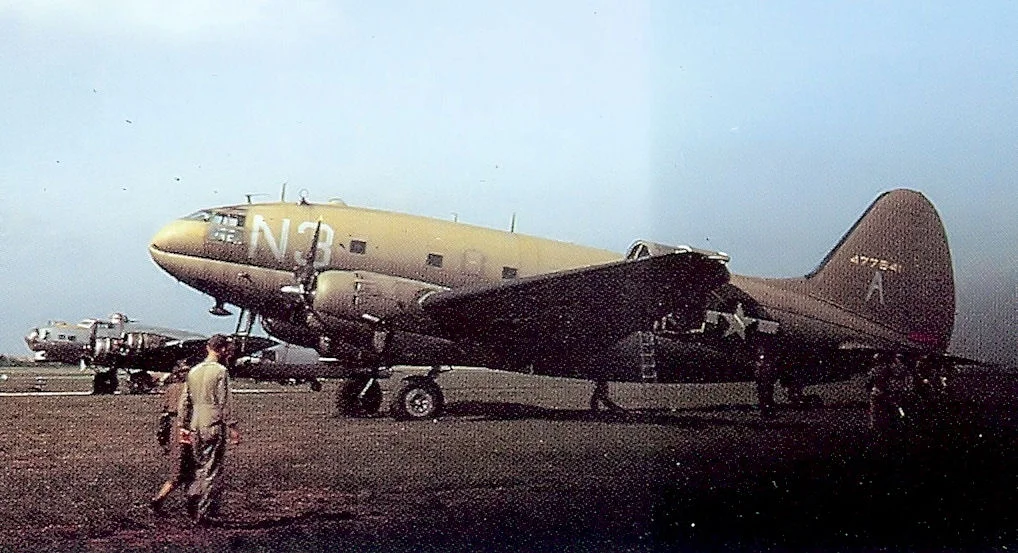

1950 Myrtle Beach USAF C-46D Crash
Most of the men aboard the C-46 had spent the previous two weeks at Myrtle Beach for summer training. They were Tennessee Air National Guardsmen, citizen-airmen with regular jobs back in Nashville and the surrounding country - bank clerks, teachers, farmers, mechanics - who put on uniforms two weeks a year. It was Sunday, July 23, 1950, a hot summer afternoon on the South Carolina coast. The Korean War had begun less than a month earlier, but for the men in this aircraft the war had not arrived yet. They were going home to their families. They never made it.
The Aircraft
The plane was a Curtiss C-46D-10-CU Commando, serial number 44-77577, delivered to the Army Air Forces on December 14, 1944. It had spent the postwar years in various transport roles. In July 1949 it had been converted to a trainer designation, TC-46D, though its essential role of moving people and freight remained the same. The C-46 was a bigger, faster cousin of the C-47 Skytrain, capable of carrying heavier loads, infamously demanding to fly, and a workhorse on the Asian and Pacific supply routes during World War II. By 1950 the type was being phased out by the Air Force in favor of newer transports, but it was still used widely for National Guard support missions. The crew that Sunday was four. The passenger load brought the total souls on board to thirty-nine.
Summer Training
The men aboard had just finished two weeks of summer training that involved Air National Guard units from multiple states gathered along the South Carolina coast. About thirty of them were Tennessee Air National Guardsmen who had been training out of Myrtle Beach and were heading back to Nashville. National Guard summer training was - and remains - a fundamental part of how the Guard kept its skills current between deployments. For these men it would have meant flight time, classroom hours, exercises, and the camaraderie of a group of men temporarily away from work and family. The training ended. The aircraft was loaded. The C-46 took off from the Myrtle Beach airfield - the same facility that would later become Myrtle Beach Air Force Base and is today Myrtle Beach International (KMYR).
The Aileron
What happened next took only minutes. The aircraft climbed to somewhere between one and two thousand feet over the pine forest northwest of Myrtle Beach. Without warning the left aileron - the flight control surface on the trailing edge of the left wing that controls roll - broke apart in its central section and tore free of the aircraft. The C-46 went out of control. Within seconds the aerodynamic stress on the airframe tore both wings off the fuselage. The wreckage fell into the pine woods northwest of Myrtle Beach. Pieces of wing were found a substantial distance from where the fuselage came down - so far apart that investigators at first suspected an onboard explosion. They later determined that the wings had been torn off in flight, not blown off, but for the men on board the practical effect was the same. Nobody survived. The fire that followed the impact left little to recover.
What the Investigation Found
The Air Force accident report identified the cause as the structural failure of the left aileron. Why the aileron broke apart in flight was harder to pin down - fatigue cracking in an aging airframe, possibly, in an aircraft type that had been worked hard since 1944 and was scheduled for retirement. The C-46 had a reputation for finicky maintenance demands. The investigation did not produce dramatic reforms. By 1950 the Air Force was already moving away from the C-46; the Korean War would not change that path. But for the Tennessee Air National Guard and the families in and around Nashville, the loss was catastrophic - thirty Guardsmen lost in a single afternoon, plus four crew, plus a small number of additional passengers. The unit took years to rebuild.
The Deadliest in the State
Thirty-nine deaths. It remains the deadliest single aviation accident in South Carolina history. There is no major memorial at the crash site, which is on private land and has long since grown back to mixed pine. The Tennessee Air National Guard honored the lost men through unit history rather than monuments; their names appear in the records of the Tennessee guard units that flew them. Each man had a family. Each name represented a household - parents waiting in Nashville, wives expecting husbands home for Monday-morning shifts, children who would learn at dinnertime what had happened. The Korean War would kill many more Tennessee Guardsmen over the next three years. For the families of the men aboard 44-77577, the war never began. It ended on a Sunday afternoon, a few miles inland from the beach, with the snap of a metal hinge.
From the Air
Approximate crash site at 33.82N, 79.20W, in the pine woods northwest of Myrtle Beach, South Carolina. The departure airport was the wartime Myrtle Beach airfield, now Myrtle Beach International (KMYR). Cruise at 3,000-5,000 feet AGL for context; the route from Myrtle Beach northwest toward Nashville would have followed the modern direction of US 501. Nearby airports: Myrtle Beach International (KMYR) is the original departure point, Conway-Horry County (KHYW) 15 miles west, Grand Strand (KCRE in North Myrtle Beach) 25 miles northeast along the coast, Marion County (KMAO) 30 miles west. The flat coastal plain of pine forest stretches inland; the Atlantic Ocean is visible to the east.
Nearby Stories
- Moore Farms Botanical Garden 3.1 km away
- Atlantic Beach, South Carolina 5 km away
- Brookgreen Gardens 18 km away
- Columbus County, North Carolina 19 km away
- Darlington Raceway 24 km away
- 1958 Mars Bluff B-47 Nuclear Weapon Loss Incident 37 km away
- 1886 Charleston Earthquake 77 km away
- USS Comfort (AH-3) 690 km away