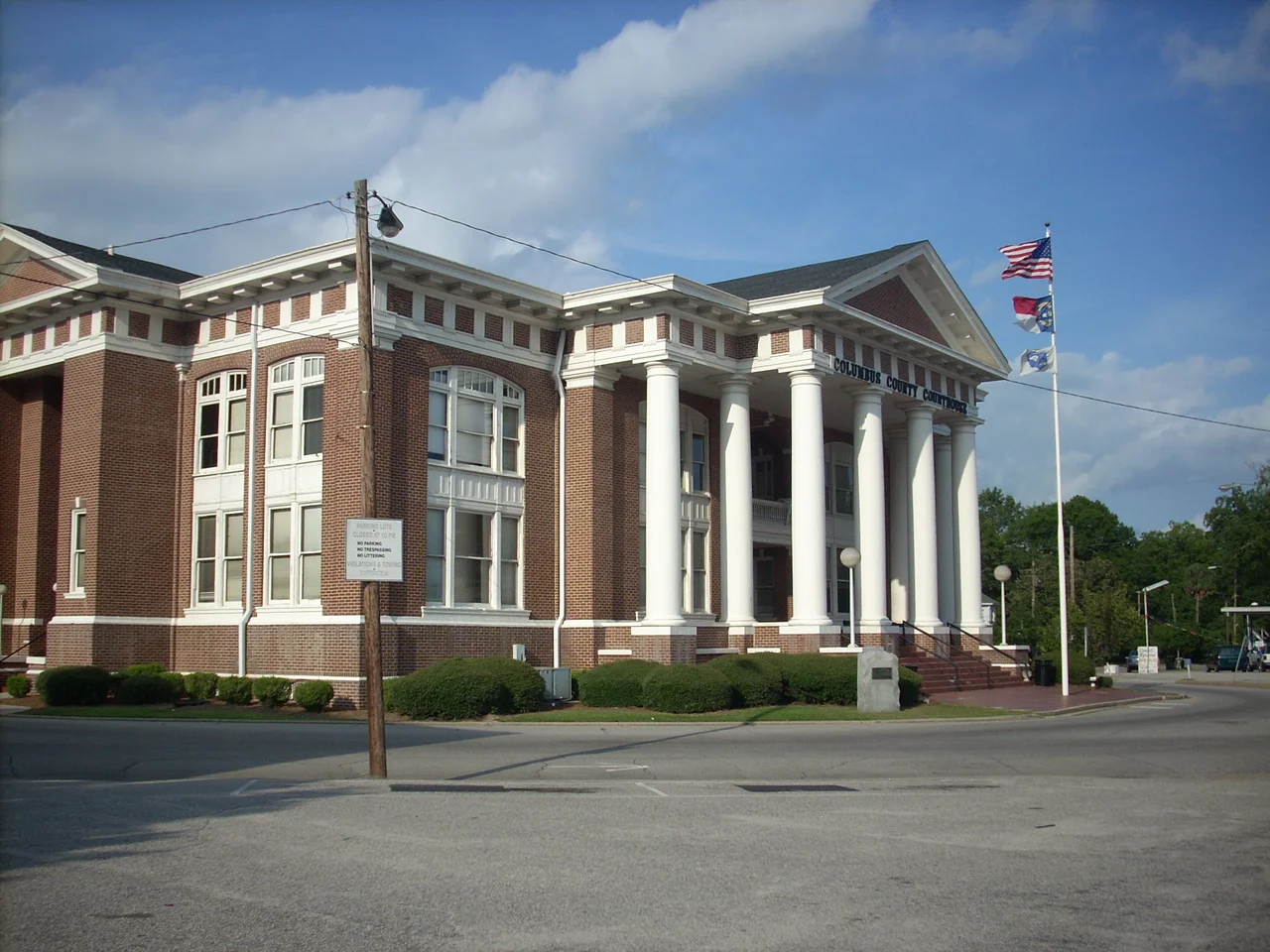

Columbus County, North Carolina
Columbus County is going the other way. While the rest of coastal North Carolina booms, Columbus shed 7,475 residents between 2010 and 2020, a 12.9 percent decline. The U.S. Census Bureau recorded population drops in 12 of 14 reported communities. Census experts expect more of the same through 2030. Whiteville, the county seat, is still the largest municipality. Almost ninety percent of residents live in rural areas. This is the part of the Cape Fear region that the Wilmington-bound retirees fly over.
Carved Out for Convenience
The General Assembly created Columbus County on December 15, 1808, mostly so locals would not have to ride all the way to the Brunswick County seat to file paperwork. They formed it from parts of Bladen and Brunswick and named it for Christopher Columbus. In 1810, surveyors platted a courthouse town on land owned by James B. White, calling it White's Crossing. It was incorporated as Whiteville in 1832. Before any of this, in the 1730s, the Pennsylvania botanist William Bartram traveled to Lake Waccamaw to catalog the flora and fauna of the region, leaving the first detailed written account of a landscape Native peoples had known for millennia.
Strawberries, Tobacco, and the Long Decline
The Wilmington, Columbia and Augusta Railroad arrived in the 1860s and changed everything. Naval stores and lumber surged, then corn and cotton dominated the postwar economy. In 1895, growers introduced strawberries at Chadbourn. By 1907, Chadbourn was one of the leading strawberry producers in the world, with farmers loading rail cars by hand. Tobacco arrived in 1896 and overtook cotton by the end of World War I. Then the manufacturing economy that replaced agriculture began its own collapse. Between 1999 and 2014, Columbus County lost about 2,000 manufacturing jobs. Hurricane Florence hit in 2018 and made things worse. The North Carolina Department of Commerce now classifies the county as economically distressed.
The Klan, the Editor, and the Sting
In 1950, Thomas Hamilton, a South Carolina Klan leader, started recruiting in Chadbourn, Fair Bluff, Tabor City, and Whiteville. They paraded through Tabor City with handbills. W. Horace Carter, publisher of the Tabor City Tribune, ran an editorial the next day calling the Klan a violent group and telling neighbors to ignore them. Someone left a threatening note on his car. Carter kept writing. He won a Pulitzer Prize for his coverage. Three decades later, the FBI ran an undercover sting here called Colcor, posing as Detroit Mafia bagmen and even running an illegal gambling club in Lake Waccamaw. The North Carolina State Board of Elections later nullified the Bolton liquor referendum after the FBI's vote-buying involvement came out.
Green Swamp and the Waccamaw Siouan
The Green Swamp Preserve sprawls across Columbus and into Brunswick County, one of the last great pocosin wetlands on the Atlantic coastal plain. Carnivorous plants grow here: Venus flytraps, pitcher plants, sundews, all native to a narrow band of the Carolinas. The Waccamaw Siouan people live on the swamp's edge, one of eight tribes recognized by North Carolina, in a protected community that traces its presence back centuries. Throughout the nineteenth century, white officials seldom mentioned the Waccamaw Siouan in the historical record. Children of mixed marriages were assumed to lose their Indian status, and a slave society classified anyone with visible African features as Black first. The community persisted anyway.
What Stays
The hospital ranking is grim: Columbus County placed 91st of 100 in the 2022 County Health Rankings, an improvement after years at the bottom. The county led North Carolina in opioid pills per person from 2006 to 2012, averaging 113.5 pills per person per year. International Paper is the largest employer. Over 14,000 residents commute to other counties for work, while only about 7,600 work within Columbus. But the county still produces pecans, peanuts, soybeans, potatoes, corn, cattle, poultry, and catfish. Take the Lake, the annual fitness event around Lake Waccamaw, started as a direct response to the health rankings. The 9,000-acre lake offers 15 miles of shoreline, and on Labor Day weekend, people walk, paddle, bike, or swim the whole thing. No winners are named. Completion is the award.
From the Air
Columbus County sits at roughly 34.26 degrees N, 78.67 degrees W, west of Brunswick County. From cruising altitude, look for the elongated, perfectly oval shape of Lake Waccamaw, one of the largest Carolina bays, and the dark green expanse of the Green Swamp to its south. The nearest controlled airports are Wilmington International (KILM) to the east and Myrtle Beach International (KMYR) to the south. Conway-Horry County Regional (KHYW) lies just across the South Carolina line. The county's flat coastal plain makes for easy VFR navigation; agricultural patterns and the Waccamaw River corridor stand out clearly.
Nearby Stories
- Southport, North Carolina 2.4 km away
- Leland, North Carolina 5.8 km away
- Sunset Beach, North Carolina 7.6 km away
- 1950 Myrtle Beach USAF C-46D Crash 15 km away
- Pender County, North Carolina 16 km away
- Robeson County, North Carolina 20 km away
- The Robesonian Takeover 44 km away
- 1958 Mars Bluff B-47 Nuclear Weapon Loss Incident 51 km away