
The Robesonian Takeover
Jimmy Earl Cummings was unarmed when a sheriff's deputy shot and killed him during a traffic stop on November 1, 1986. He was Lumbee. The deputy was the sheriff's son. The deputy was not charged. Billy McKellar was Black and asthmatic when he died in the Robeson County jail in January 1988 without receiving medical attention. He was the latest name on a list that had been growing in the county for years. On February 1, 1988, two armed Tuscarora men walked into the offices of The Robesonian newspaper in Lumberton, North Carolina, and announced that nobody was leaving until the governor sent someone to listen. The hostage standoff that followed lasted ten hours. It is not, in the end, a story about hostages. It is a story about what people do when they have exhausted every other way to be heard.
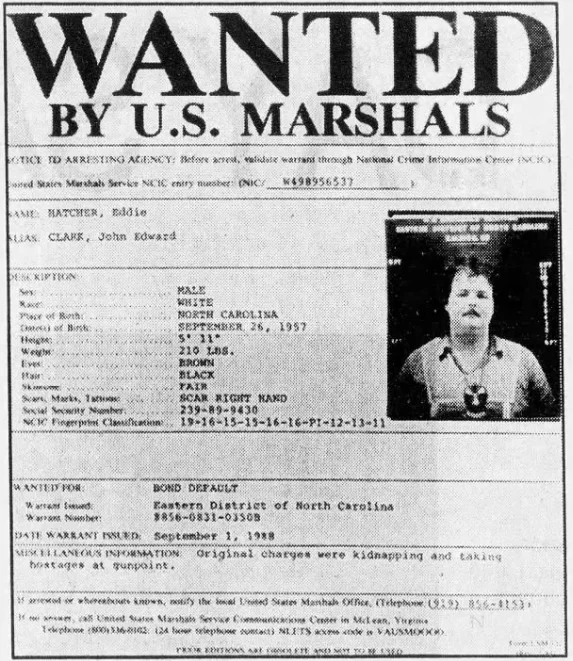
Eddie Hatcher and Timothy Jacobs
Eddie Hatcher was a Tuscarora man, an activist, and a member of the Concerned Citizens for Better Government — a multiracial group that had formed in Robeson after the Cummings killing to push back against what its members described as a pattern of unaccountable violence by the sheriff's office. In January 1988 Hatcher came into possession of a map. It had been drawn by John Hunt, a drug dealer and alleged informant for the State Bureau of Investigation. The map depicted networks of cocaine distribution running through Robeson County — and implicated, in Hatcher's reading, officials of the local court system in the trade. Hatcher consulted an attorney. The attorney said the map was not evidence of anything that would hold up. The Pembroke police chief warned him to drop it: he was about to provoke dangerous people. Timothy Jacobs, a Tuscarora man and a friend of Hatcher's, agreed to help. They concluded that no court, no prosecutor, no investigator was going to act. So they made a different plan.
The Newspaper
The Robesonian was the county's daily paper, headquartered in downtown Lumberton near the courthouse. It had a circulation of about 15,000 and a reputation for representing the white mainstream of the county. Its editorials regularly disagreed with The Carolina Indian Voice, the smaller weekly paper run from Pembroke by Lumbee journalists. Hatcher had previously written an op-ed in the Voice describing The Robesonian as controlled by 'political trash.' He and Jacobs also noticed the building had mirrored windows — visible from the inside, opaque from the outside. A useful tactical detail. On the morning of February 1, they walked in armed and announced that the staff was being held. About 100 law enforcement officers responded. Eighteen people were inside the newsroom. Hatcher called the State Bureau of Investigation in Raleigh and started talking.
Ten Hours, Four Demands
Governor James G. Martin refused to speak directly with the hostage-takers — for fear, the official story went, of setting a precedent. His chief of staff, Phil Kirk, took five phone calls from inside the newsroom. Over those hours Hatcher and Jacobs released hostages one and two at a time. By evening seven remained. Four demands were eventually agreed: investigate McKellar's death; investigate the corruption Hatcher believed he had documented; remove John Hunt from sheriff's custody; allow Hatcher and Jacobs to surrender to the FBI rather than to local authorities. The siege ended at 8:45 p.m. The two men walked out under federal protection. Tuscarora tribal chairman Cecil Hunt, asked by a reporter if he was surprised, said: 'No. The people in this county have got to have some relief from the oppression that's been occurring over the years.'
What the Investigation Found
Governor Martin assembled a three-person task force. Hatcher and Jacobs met with it once. Then, after the task force refused to grant them immunity, they stopped cooperating. The investigation concluded there was no evidence of wrongdoing in the sheriff's office. Eighteen days after the takeover, the North Carolina Commission of Indian Affairs released a report — initiated after the 1986 Cummings shooting — concluding that Native Americans in Robeson were arrested and incarcerated at significantly higher rates than whites and that the community lacked trust in county law enforcement. Five hundred Robeson residents came to its presentation in Pembroke. In March 1988, Lumbee judicial candidate Julian Pierce was murdered under circumstances the official version of which his community has never accepted. In federal court, Hatcher and Jacobs were acquitted of every charge — the first two people ever charged under the 1984 Act to Combat International Terrorism. The local jury that heard them found their argument credible. The state of North Carolina indicted them anyway on second-degree kidnapping. Hatcher fled, was caught, served prison time, contracted HIV, was paroled in 1995, and died in prison in 2009. Jacobs pled guilty; sentenced to six years, he served fourteen months.
The Vindication That Came Later
Hatcher's central claim — that the Robeson County Sheriff's Office was corrupt — was officially rejected by the 1988 task force. Fourteen years later, the North Carolina State Bureau of Investigation opened Operation Tarnished Badge after a series of incidents at the same agency. By the time it ended, 22 officers had been convicted, including the sheriff. It remains the largest police corruption case in North Carolina history. Sheriff Hubert Stone, who had retired in 1994, denied to the end that anything wrong had happened under his watch. Many of the deputies caught up in Tarnished Badge had served under him. Jacobs and former district attorney Johnson Britt both later said the same thing in slightly different words: the 1988 takeover opened a political space in the county that eventually led to more Native and Black representation in local government, to a generation of activists, and to the possibility — never finished, never complete — of some kind of accountability. The hostages did not deserve what happened to them. Hatcher and Jacobs did not deserve what happened to them either. Both things can be true. In Robeson County, they often are.
From the Air
The Robesonian building site is in downtown Lumberton, North Carolina, near the Robeson County Courthouse, at approximately 34.62°N, 79.01°W. Nearest airport: Lumberton Municipal (KLBT) 3 miles south. Other regional fields: Laurinburg-Maxton (KMEB) 25 miles west, Fayetteville Regional (KFAY) 35 miles north. The newspaper still publishes; the building has been remodeled. The Lumber River runs a few blocks east of the site. The 1988 events themselves left no physical marker — the takeover is commemorated in Lumbee and Tuscarora community memory and in the BorderBelt Independent's ongoing reporting on the case's anniversary.
Nearby Stories
- Sampson County, North Carolina 2.8 km away
- Fayetteville Regional Airport 4.3 km away
- Laurinburg, North Carolina 5.6 km away
- Richmond County, North Carolina 27 km away
- Columbus County, North Carolina 32 km away
- 1958 Mars Bluff B-47 Nuclear Weapon Loss Incident 34 km away
- Leland, North Carolina 42 km away
- Duplin County, North Carolina 49 km away