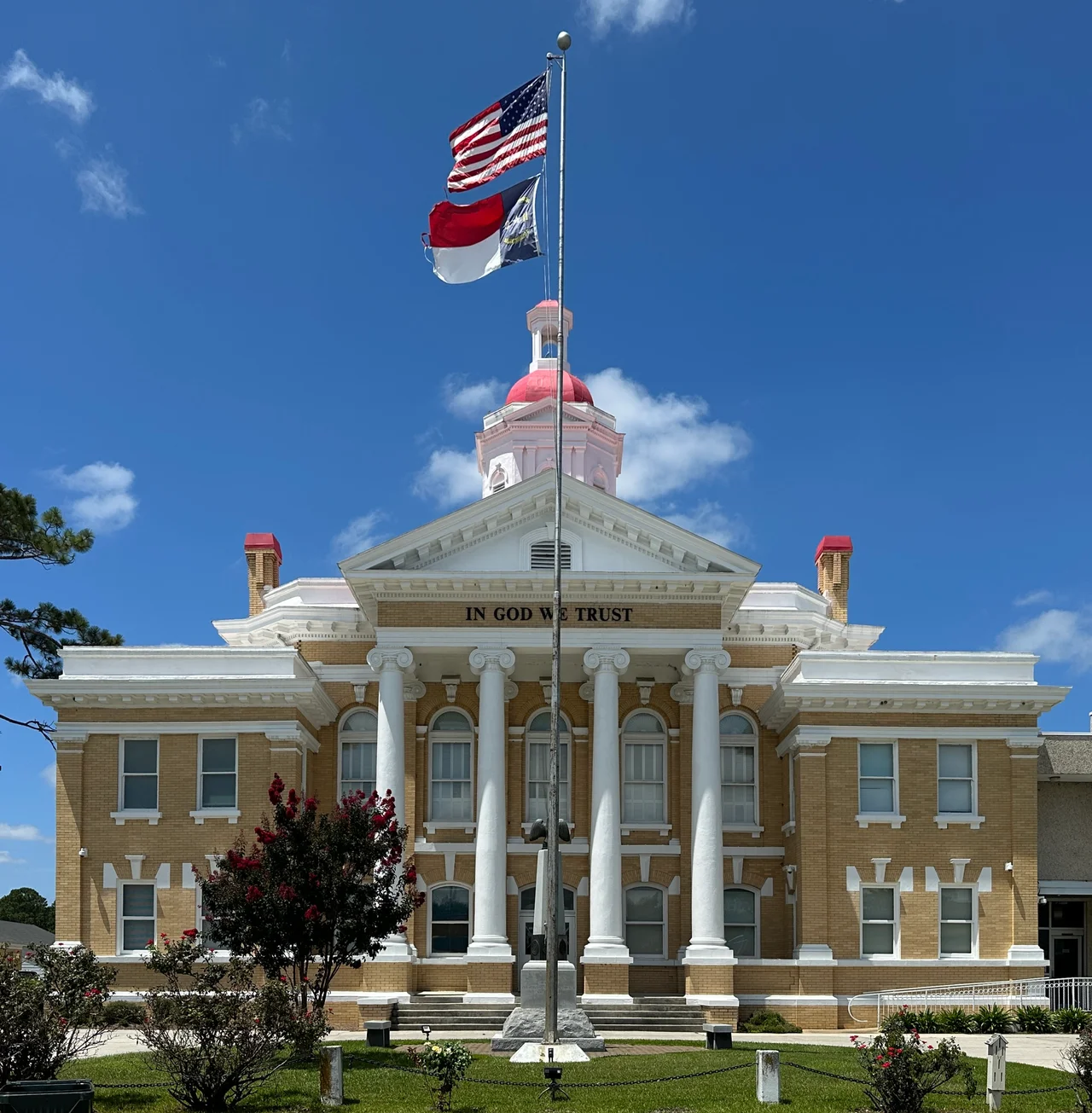

Duplin County, North Carolina
Duplin County has 48,715 people and 2.2 million hogs. That is more hogs than the entire state of Iowa raised at the time of the 1998 count, more hogs than any other county in the United States, more hogs than most countries on earth. The county also produces the wine, the chickens, the turkeys, and the tobacco of eastern North Carolina, and it gave the world the man who invented Pepsi. A lot of stories begin and end on the Northeast Cape Fear River, which runs through Duplin's middle like a slow brown spine.
Named for a Forgotten Lord
The county was carved out of New Hanover County in 1750 and named for Thomas Hay, Viscount Dupplin, a Scottish nobleman who happened to be serving on the British Board of Trade and Plantations in the 1740s. He never set foot in Carolina. He later became the 9th Earl of Kinnoull, which is how he is more often remembered, except in this one corner of North Carolina where his earlier title still labels everyone's driver's license. In 1784 the western half of the county broke off to become Sampson County. Kenansville, named for the Revolutionary officer James Kenan, became the county seat and remains so. The economy was built on plantations worked by enslaved African Americans, and Duplin's wealth in those decades was wealth built on their labor.
Tuscarora Country
Before the Europeans the country belonged to the Tuscarora, who used the swamps and pine forests of eastern Duplin as hunting ground. The Tuscarora War of 1711 to 1715 broke their power. Fort Neoheroka burned, and most of the surviving tribe walked north over years to join the Iroquois Confederacy in New York as its sixth nation. Their burial mounds still rise from the rural land near Hallsville and Sarecta, four of them within a ten-mile radius of Beulaville, holding roughly a hundred ancestors. By 1736 the land emptied of Tuscarora was filling with Ulster Scots and Swiss Protestants brought over by a wealthy Londoner named Henry McCulloh, who had a 71,160-acre Crown grant to populate. Their first settlements were Sarecta and the grove that became Kenansville.
Two Million Hogs
The Northeast Cape Fear River made Duplin's first economy. Loggers and turpentine producers floated naval stores downstream to Wilmington and the Atlantic. When demand for tar and pitch faded, corn took over, then tobacco. When federal tobacco buyouts ended the small-grower era, Duplin pivoted hard into hogs. The 2.2 million figure for 1998 is staggering on its face; for context, Duplin's hog population was greater than the human population of 47 states. Industrial hog operations have shaped the county's economy, its waterways, and the daily lives of people who live next to lagoons full of waste. Chicken and turkey processing has joined the mix. Duplin Winery in Rose Hill, the oldest and largest winery in the South, has become a destination of its own, marketing muscadine wines made from native grapes.
Notable Locals
Caleb Bradham was born in Chinquapin in 1867. He grew up to be a pharmacist in New Bern, where he invented a drink he called Brad's Drink in 1893. He rebranded it Pepsi-Cola in 1898. Today every fountain machine in the world traces back to that drugstore on the Trent. Peter Weddick Moore was born near Faison in 1859 to enslaved parents named Weddick and Alecy. He became the first president of what is now Elizabeth City State University. Parker David Robbins, who was of African and Native American descent, moved to Duplin County in 1877 and built a cotton gin, a sawmill, and a steamboat. Ruth Faison Shaw of Kenansville is credited with bringing finger painting into American schools. Benjamin F. Grady served two terms in Congress in the 1890s. And Charles S. Murphy of Wallace served as White House Counsel to Harry Truman from 1950 to 1953, before later chairing the Civil Aeronautics Board.
Flight Context
Duplin County stretches across roughly 35.0 to 35.1 degrees north, 77.8 to 78.1 degrees west. View from 3,000 to 5,000 feet AGL to see the Northeast Cape Fear River carving through the county, the dark green forests, and the geometric grid of hog and crop operations. Nearest airports: Duplin County Airport in Kenansville, Henderson Field (ACZ) near Wallace, Eagles Nest Airport. Albert J. Ellis Airport (KOAJ) is twenty-five nautical miles southeast in Onslow County.
From the Air
Duplin County, roughly 35.0 to 35.1 degrees north, 77.8 to 78.1 degrees west. View from 3,000 to 5,000 feet AGL. Airports: Duplin County Airport, Henderson Field (ACZ), KOAJ (Albert J. Ellis). Watch for summer afternoon thunderstorms.
Nearby Stories
- Marine Corps Base Camp Lejeune 4 km away
- Pender County, North Carolina 13 km away
- Bryan-Bell Farm 14 km away
- La Grange Historic District (North Carolina) 18 km away
- Battle of Averasborough 28 km away
- Lake Waccamaw, North Carolina 36 km away
- Cumberland County, North Carolina 43 km away
- Tar River 50 km away