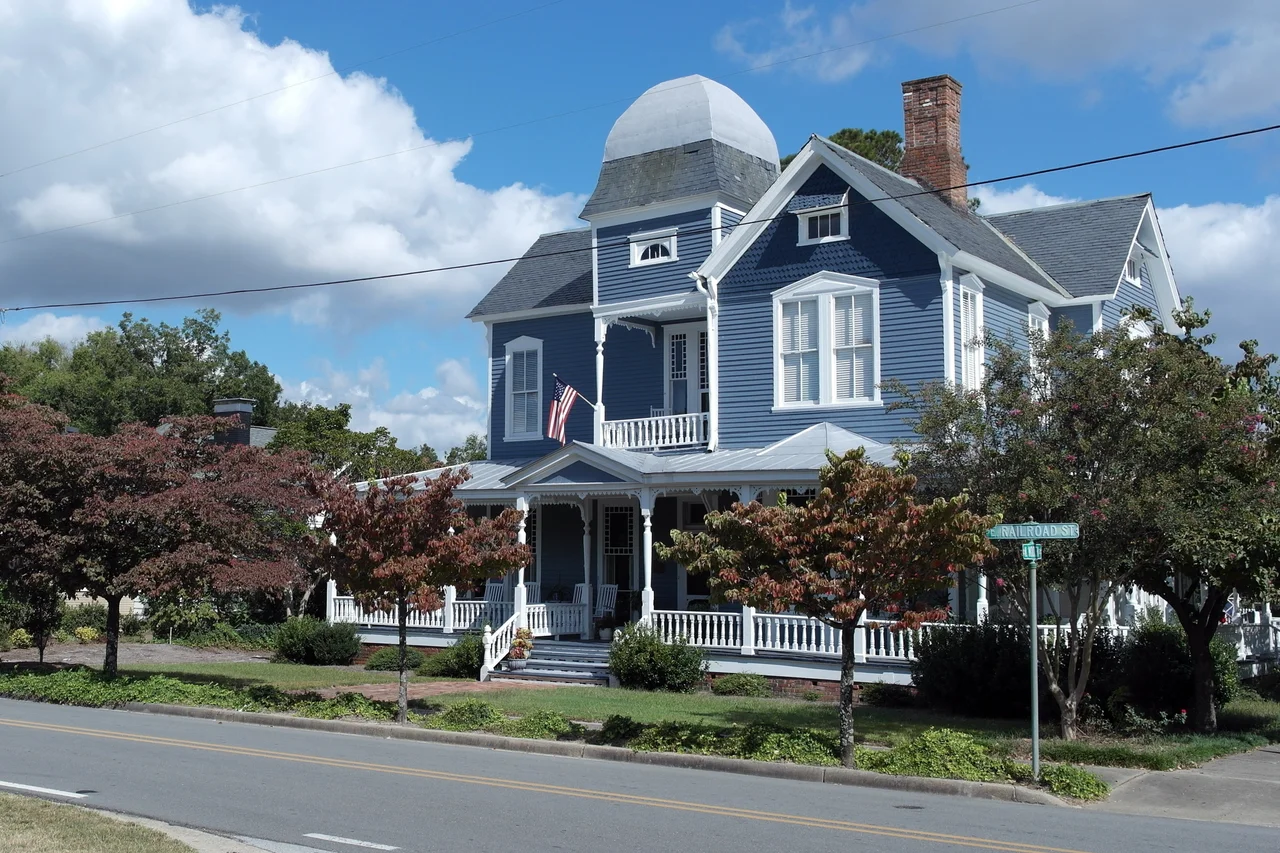

La Grange Historic District (North Carolina)
In 1889, the Davis School in La Grange shut its doors midway through the year after a meningitis outbreak swept through the students and staff. The school never reopened. The only surviving building from that lost block, the Colonel A. C. Davis House, still stands on East Railroad Street — a stately 1887 home that was once the headmaster's residence. The La Grange Historic District is full of such surviving fragments: 225 buildings dating between the 1850s and the 1940s, organized along the rail line that gave the town its livelihood, telling the rise and slow contraction of a Lenoir County tobacco-market town that once had reason to build itself in Gothic Revival and Queen Anne.
The Town the Railroad Built
The Atlantic and North Carolina Railroad ran through La Grange and made it a market for the surrounding farmland. South Caswell Street became the commercial center: a single block of one- and two-story brick storefronts, mostly built in the 1910s, where tobacco buyers, jewelers, hardware merchants, and grocers transacted the business of a working town. The Rouse Banking Company Building, completed in 1908, broke the skyline with a neoclassical facade and the implicit confidence of a town that expected to keep growing. Most prominent houses lined East and West Railroad Street, close enough to hear the freight trains pass, far enough back to avoid the cinders.
Four Churches and a Garden Club
The historic district contains four contributing church buildings, each from a different era of La Grange's growth. First Missionary Baptist Church at 201 North Caswell Street dates to 1860, expanded in 1888. The former Free Will Baptist Church at 114 North Caswell Street rose in 1895, Gothic Revival in style, with the steep pitched roof and pointed arched windows the style demanded. La Grange United Methodist at 213 South Caswell came later, completed in 1944. The former Bear Creek Primitive Baptist Church at 210 West Washington Street, built in 1857, is now home to the La Grange Garden Club — a quiet repurposing that suits a building old enough to remember the years before the war. The separately listed La Grange Presbyterian Church anchors another corner of the district.
What Survives and What Is Gone
The historic district was added to the National Register of Historic Places in May 2000, and like many small-town districts it has weathered the years unevenly. La Grange Elementary School, a 1928 Colonial Revival design by the prolific North Carolina school architect Leslie Boney, was demolished in 2006 — a contributing property to the district lost to a newer facility. The Hardy-Newsome Industrial Complex on West Railroad Street, a cluster of buildings tied to La Grange's brief industrial period, came down in the 2010s. Some of the commercial buildings on South Caswell Street are vacant; some need serious repair. The town's growth slowed long ago. What remains is a working catalog of what a Carolina market town looked like when its tobacco-and-railroad economy was strong.
Caswell, Railroad, and the Lots in Between
The district's boundary follows an idiosyncratic shape — Caswell, James, Carey, Washington, Caswell, and Forbes Streets — designed to capture the buildings that still tell the story without reaching too far into territory that has lost its character. The most prominent houses sit along Railroad Street, where the trees have grown into the kind of canopy that Southern small towns are known for. The Sutton-Kinsey House, dating to roughly 1898, sits among them. So does the Sutton-Fields House from around 1850, perhaps the oldest contributing residence. The Walter Pace House follows from around 1900. Together they bracket fifty years of architectural style — from late Greek Revival through Queen Anne and into Craftsman bungalows — preserved as a single coherent place because the people who lived here cared enough, when 2000 came, to ask Washington to put their town on the list.
From the Air
Located at 35.31N, 77.79W in Lenoir County, in the coastal plain between Kinston (8 miles east) and Goldsboro (15 miles west). The town is bisected by the modern CSX railroad that runs east-west. Nearest airports are Kinston Regional Jetport (KISO), 12 miles east, and Seymour Johnson AFB (KGSB), 17 miles west. US 70 passes just south of town.
Nearby Stories
- Duplin County, North Carolina 7 km away
- Southern National Motorsports Park 21 km away
- Tar River 24 km away
- Battle of Averasborough 25 km away
- Bryan-Bell Farm 29 km away
- 2009 ConAgra Foods Plant Explosion 29 km away
- Swansboro 38 km away
- The Robesonian Takeover 67 km away