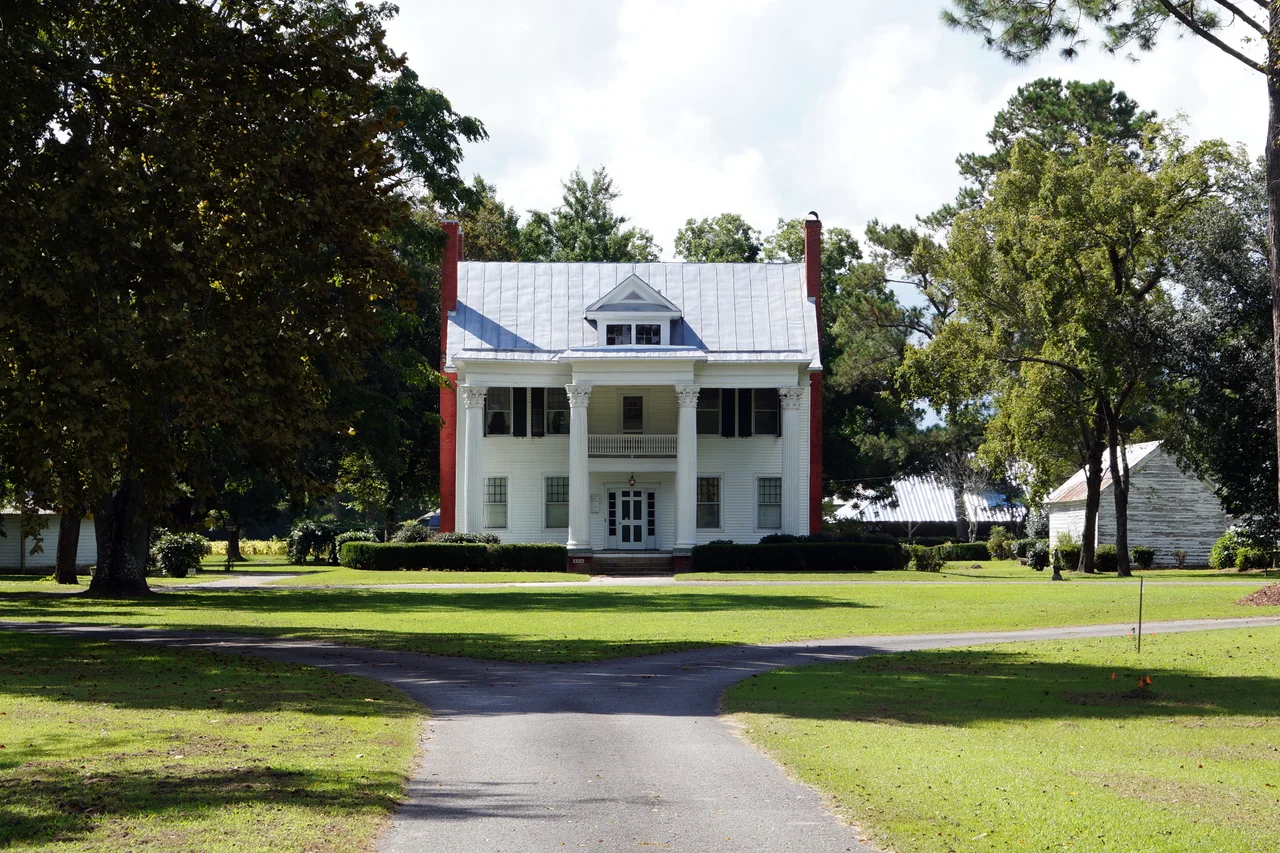

Bryan-Bell Farm
Count the buildings: twenty-five of them, scattered across seven distinct areas of farmland near Pollocksville. A main house from 1844. A barn from around 1840. Seven pack houses from the 1920s. Two tobacco barns. Two chicken houses. A log barn from 1890. An I-house from 1880. A metal silo, an equipment shed, a hay barn, a stable. A 19th-century graveyard. The Bryan-Bell Farm - also called Oakview Plantation - is not so much a single building as a working farm preserved in slow motion, each generation having added something without tearing down what came before.
Two Houses in One
The main residence was built around 1844 in the Federal style - the restrained, classical aesthetic that had dominated American building since the early republic. Then, in 1920, the house was renovated in the Classical Revival idiom that was sweeping the South in the wake of plantation nostalgia. The Federal house gained a monumental portico supported by Corinthian columns, transforming a sober five-bay residence into something that looked, from the road, like the Old South of postcards. Inside, the bones of the older house remained. From the air, the long portico is the most distinctive feature: a deep shadow stretching across the front of a white frame house, with farm buildings radiating outward in every direction.
The Forced Labor That Built the First House
Plantation is the older name for this place, and it carries the weight that word should carry. The 1844 main house was built in coastal North Carolina at the height of the cotton and tobacco economy. Like most plantations of its size and era, Oakview was almost certainly built and worked by enslaved people whose names rarely entered the property deeds and whose graves may lie unmarked nearby. The 1989 National Register nomination notes a 19th-century graveyard on the property, though it does not document who is buried there. After emancipation, the farm's labor pattern shifted to sharecropping and tenant farming - systems that, in the Jones County of the 1880s and beyond, often perpetuated the inequalities the plantation had codified. Reading the farm's twenty-five buildings without acknowledging that labor history would be reading half the story.
Tobacco, Chickens, and the 20th-Century Farm
The earliest outbuildings - the barn from around 1840, the log barn from 1890, the I-house from 1880 - belong to the antebellum and Reconstruction-era farm. Most of the rest belong to the 20th century. Seven pack houses from the 1920s hint at the eastern North Carolina tobacco boom, when flue-cured leaf was the cash crop and pack houses were where bundles of cured tobacco were graded and stored before going to auction in Kinston or Wilson. Two tobacco barns - tall, narrow, vented for the slow fire-curing that gave Carolina tobacco its character - confirm the same story. Two chicken houses from about 1923, a metal silo from around 1930, and a hay barn from 1932 add poultry, grain, and feed crops to the mix. The carriage house from 1920 and the two garages from the 1930s mark the moment the family traded horses for cars.
A Working Landscape, Preserved
On December 21, 1989, the National Register of Historic Places added the Bryan-Bell Farm as a historic district covering 25 contributing buildings, 2 contributing sites, and 2 contributing structures across seven separate areas of the property. That sprawling delineation is unusual on the Register, which tends to focus on single buildings. The point, in this case, was that no single building tells the story. The story is the whole farmscape, evolving from Federal-style plantation to tenant farm to mechanized 20th-century operation, with every era leaving its mark on a barn, a shed, a house, or a fenceline. From the air, the farm reads as a cluster of weathered roofs around a white-portico'd centerpiece, set into the flat, river-laced country of Jones County, North Carolina.
From the Air
Bryan-Bell Farm at 34.998 N, 77.256 W, near Pollocksville in Jones County, about 15 nm south-southwest of New Bern. Set in the flat coastal plain along the Trent River drainage. Best viewed from 2,000 to 3,500 feet AGL. Closest airports: Coastal Carolina Regional (KEWN) 15 nm NNE, KMRH (Beaufort) 35 nm east, KISO (Kinston) 25 nm WNW. The farm's monumental portico and clustered outbuildings stand out among the pine plantations and tobacco fields of the surrounding countryside.
Nearby Stories
- Swansboro 13 km away
- Harkers Island, North Carolina 15 km away
- Beulaville, North Carolina 18 km away
- 1961 Goldsboro B-52 Crash 23 km away
- Battle of Washington 26 km away
- Pender County, North Carolina 37 km away
- Crystal Coast 43 km away
- Lake Mattamuskeet 45 km away