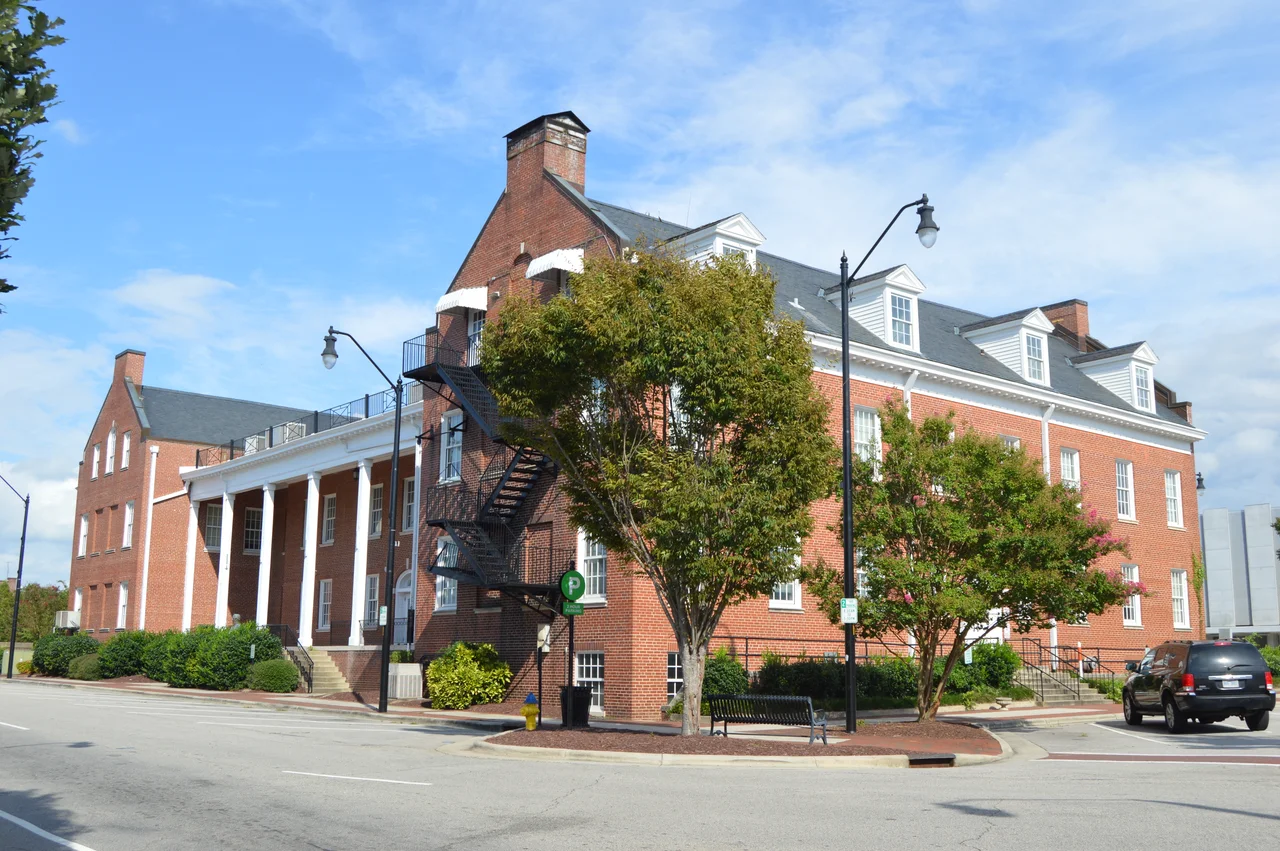

Sampson County, North Carolina
Two million hogs. That is not a typo. Sampson County, which covers 947 square miles of southeastern North Carolina farmland, is home to roughly two million pigs - second in North Carolina only to neighboring Duplin County, and one of the highest concentrations of swine in the United States. The pigs do not register in the census numbers; the human population in 2020 was 59,036. They do register in just about everything else: the smell on a humid August evening downwind of a confinement barn, the lagoons of waste visible from the air, the tankers of feed and the trailers of finishing animals moving along Highway 421 toward processing plants. Sampson is also North Carolina's largest producer of turkeys, hay, and flue-cured tobacco. It is, in every sense, an agricultural county.
Born in 1784, Named for John Sampson
The North Carolina General Assembly created Sampson County in April 1784, six months after the Treaty of Paris closed out the Revolutionary War. The new county was carved from Duplin to its east and would later annex land from Wayne and New Hanover. The man pushing for it was Colonel Richard Clinton, a Revolutionary War officer who had helped defend Wilmington from the British. Clinton wanted to honor his stepfather, John Sampson, a Scots-Irish settler who had served as the first Register of Deeds for Duplin County, risen to lieutenant general in the militia, and been elected the first mayor of Wilmington. Sampson had brought Clinton up from boyhood. Clinton proposed the name. The Assembly agreed. The county seat, Clinton, took its founder's name a few years later.
The Coharie
The Coharie are a state-recognized tribe whose ancestors lived in eastern North Carolina long before John Sampson or any European settler arrived. The 2000 census recorded 1,029 enrolled members of the Coharie Intra-tribal Council, headquartered in Clinton. The tribe's heritage center, the Coharie Cultural Center, sits in the western part of the county. In the early 20th century a Clinton attorney named George Edwin Butler published a book claiming that the Coharie - whom he called Croatan - were descended from English settlers of the lost Roanoke colony, citing supposed gray eyes and antiquated English speech. The claim made Butler influential in his time. Modern historians have found no documentary or DNA evidence supporting it. The Coharie identify, as they always have, as Native people, not as the descendants of Walter Raleigh's lost colonists.
The Marion Butler Anomaly
For most of the late 19th and early 20th centuries, the South was Democratic - what historians called the Solid South. Sampson County was not. It was one of seven North Carolina counties that voted for Wendell Willkie over Franklin Roosevelt in 1940, and one of fourteen that backed Thomas Dewey over Roosevelt in 1944. The reason ran back to the 1890s, when Sampson was the heartland of North Carolina's Populist Party under the leadership of Marion Butler, born in Sampson County in 1863. Butler served as U.S. senator from 1895 to 1901 on the Populist ticket. After the party collapsed, his followers did not migrate into the dominant Southern Democratic Party - they went to the Republicans. The political memory ran deep enough to keep Sampson voting Republican when almost every other rural Southern county was solidly Democratic, an anomaly that still shows in election maps today.
Hogs and Hay and Heritage
Agriculture has been the spine of the Sampson economy from the beginning. The earliest industries were naval stores - tar, pitch, turpentine - tapped from longleaf pine forests by enslaved African Americans whose labor built the antebellum economy. After the Civil War the naval stores collapsed and the county shifted to row crops and livestock. Today fully half the land area is in active agriculture. Tobacco, hay, and corn cover the long flat fields. The county leads North Carolina in turkey production. The hog industry, concentrated in confinement operations along the Black River and South River basins, has been controversial - lagoons of waste have at times overflowed during hurricanes, particularly during Floyd in 1999 and Florence in 2018. The county and its farmers continue working through what sustainable agriculture means at this scale. The Black River itself, partly in adjacent Bladen County but draining much of Sampson, holds the oldest documented bald cypress in eastern North America - one tree, by tree-ring dating, more than 2,600 years old.
People Who Came From Here
The list of Sampson natives reads like a strange American almanac. Micajah Autry, a Sampson-born merchant and poet, died at the Alamo in 1836. William Rufus King, born in Sampson in 1786, was elected the thirteenth U.S. vice president in 1852 on a ticket with Franklin Pierce; he died of tuberculosis six weeks after taking the oath in Cuba and never lived to assume office in Washington. John Merrick, born enslaved in Clinton in 1859, moved to Durham and co-founded the North Carolina Mutual Life Insurance Company - for much of the 20th century the largest Black-owned business in the United States. Rufus G. Herring, born in Roseboro, received the Medal of Honor for his actions as a naval reserve officer at Iwo Jima. Lauch Faircloth, born in 1928, served as U.S. senator from 1993 to 1999. Willie Weeks, born in Salemburg in 1947, became one of the most-recorded session bass players in popular music - if you have heard a James Taylor or Eric Clapton album, you have heard Willie Weeks.
From the Air
Sampson County is centered near 34.99N, 78.37W, about fifty miles inland from the North Carolina coast. From the air the county is unmistakable as a vast checkerboard of agricultural fields, pine plantations, and the brown lagoons of hog operations. Clinton-Sampson County Airport (KCTZ) sits two nautical miles southwest of Clinton. Larger nearby fields include Fayetteville Regional (KFAY) to the west and Wilmington International (KILM) to the southeast. The Black River and South River drain south through the county. Year-round visibility is generally good; afternoon thunderstorms are common in summer.
Nearby Stories
- Cumberland County, North Carolina 7.6 km away
- Cherry Hospital 19 km away
- Battle of Wyse Fork 23 km away
- Marine Corps Air Station New River 26 km away
- Skylight Inn BBQ 29 km away
- The Robesonian Takeover 29 km away
- Haw River 40 km away
- Pender County, North Carolina 45 km away