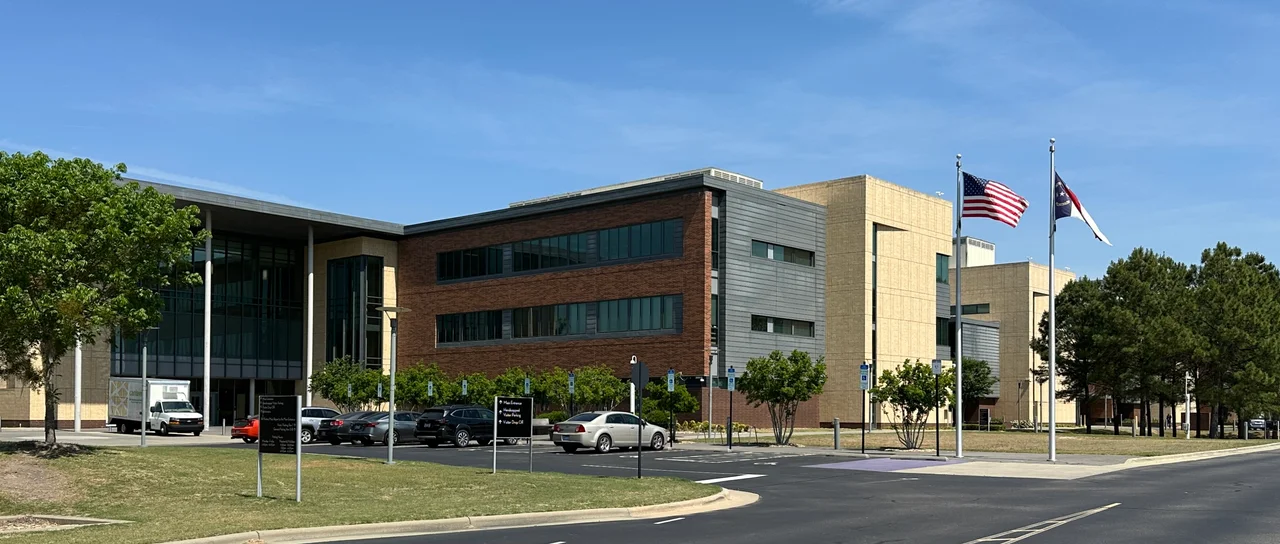

Cherry Hospital
On August 1, 1880, a single patient was admitted to a new facility outside Goldsboro that the state called, in the language of the era, the Asylum for Colored Insane. By Christmas of that year, more than a hundred people were crowded into a building meant for seventy-six. For the next eighty-five years, this institution was the only psychiatric hospital in North Carolina that would admit Black patients — the entire African American population of the state, in any kind of mental distress, sent to one place. About three thousand of them never left. Their bodies are buried in two cemeteries on the old campus, roughly seven hundred graves marked with upright brass crosses bearing names and dates, the rest unmarked. A memorial monument was dedicated to them on June 3, 2004, more than a century after the first burial.
The Acres Outside Goldsboro
In 1877, the North Carolina General Assembly appointed a committee to select a site for a hospital that would, in the racially segregated psychiatric care of the era, serve the state's Black population. On April 11, 1878, the state purchased 171 acres of land two miles west of Goldsboro. Governor Zebulon Baird Vance described the site as ideal — well-elevated, in good cultivation, central to the population it was designated to receive. The hospital opened two years later. It would acquire many names over the following decades: the Eastern North Carolina Insane Asylum, Eastern Hospital, State Hospital at Goldsboro. The current name, Cherry Hospital, came in 1959, honoring Governor R. Gregg Cherry, who had worked to expand North Carolina's mental health services.
Lives Inside the Walls
The early treatment was custodial. Patients who could work were sent to the hospital farm — Cherry Farm grew to 2,300 acres by 1960, producing nearly all the institution's milk, eggs, and pork. In 1884, an early electrical battery was purchased on the theory that electricity might benefit treatment of insanity. Through the 1930s and 1940s, the standard pharmacopeia was laxatives, castor oil, salts, aspirin, and sedatives. Hydrotherapy was tried and abandoned. Seclusion came in the form of six-by-nine-foot steel cages, used until 1956. There were no chapel services until the early 1950s; before that, attendants escorted selected patients to churches in Goldsboro. A separate building for tuberculosis patients was built. Another, for patients deemed criminally insane, opened in 1924. The story of Cherry's first eighty years is the story of people whose mental illness was treated, in conditions that ranged from inadequate to actively cruel, by an institution that had to do everything the rest of the state would not do.
The Patients Buried on the Grounds
Two cemeteries sit on the old campus. The first, behind the Chase Laundry Building, holds patients interred between 1905 and 1928. The second, behind the McFarland Building, dates from at least 1927. Together they contain approximately three thousand graves. Around seven hundred are marked with brass crosses bearing names and dates. The remainder are not. On June 3, 2004, the hospital dedicated a memorial monument to all of the patients buried on the old campus — an explicit acknowledgment that the institution that admitted them, for most of its history, did not have the resources, the will, or the cultural framework to honor their lives in any other way. The memorial does not solve anything. It does the smallest possible thing: it names the existence of the people who lived and died inside these walls.
Integration, 1965
The Civil Rights Act of 1964 ended the legal architecture of segregation in public facilities. In 1965, Cherry began admitting white patients from the thirty-three eastern counties newly assigned to its catchment area, and began transferring Black patients to facilities in their geographic regions. The transition was administrative — what the state was doing was not creating equality but redistributing the populations it had previously divided. Even so, the change was real. After eighty-five years of serving exclusively African American patients, Cherry Hospital became simply the eastern North Carolina psychiatric facility, serving all races. By 1955, the introduction of tranquilizing medications had already begun to remake patient treatment. Discharges rose. Length of stay fell. During its first hundred years of operation, Cherry served 91,045 patients.
The New Building
On August 30, 2016, then-Governor Pat McCrory cut the ribbon on a new Cherry Hospital. The facility had been planned for years. Perkins+Will of Durham designed the 410,000-square-foot building. It cost $138 million. The old buildings, with their century of accumulated grief, were closed. The new hospital has anti-ligature fixtures, private and semi-private rooms with their own bathrooms, courtyards, a treatment mall called the Hope and Wellness Center, a library with computers, exercise space. A 300-bed facility now serves 38 eastern North Carolina counties. The old campus museum closed in January 2017 after Hurricane Matthew flooding made the Special Services House unsafe. Its artifacts moved to storage. A Founders Gallery exhibit in the new building's first-floor lobby honors Dorothea Dix, whose 1848 address to the North Carolina General Assembly first pushed the state toward humane treatment of mental illness. The memorial to the three thousand buried on the old grounds remains where it was placed in 2004.
From the Air
Located at 35.39N, 78.03W in Goldsboro. The new Cherry Hospital sits at 1401 West Ash Street, half a mile from the old campus at 201 Stevens Mill Road. Nearest airport is Seymour Johnson AFB (KGSB), about 4 miles east. The hospital occupies a 171-acre tract on the west side of Goldsboro, set back from US 70.
Nearby Stories
- Wilson, North Carolina 7.4 km away
- 2009 ConAgra Foods Plant Explosion 18 km away
- Bryan-Bell Farm 19 km away
- Duplin County, North Carolina 25 km away
- Tar River 28 km away
- Battle of Averasborough 30 km away
- Cumberland County, North Carolina 41 km away
- Bertie County, North Carolina 54 km away