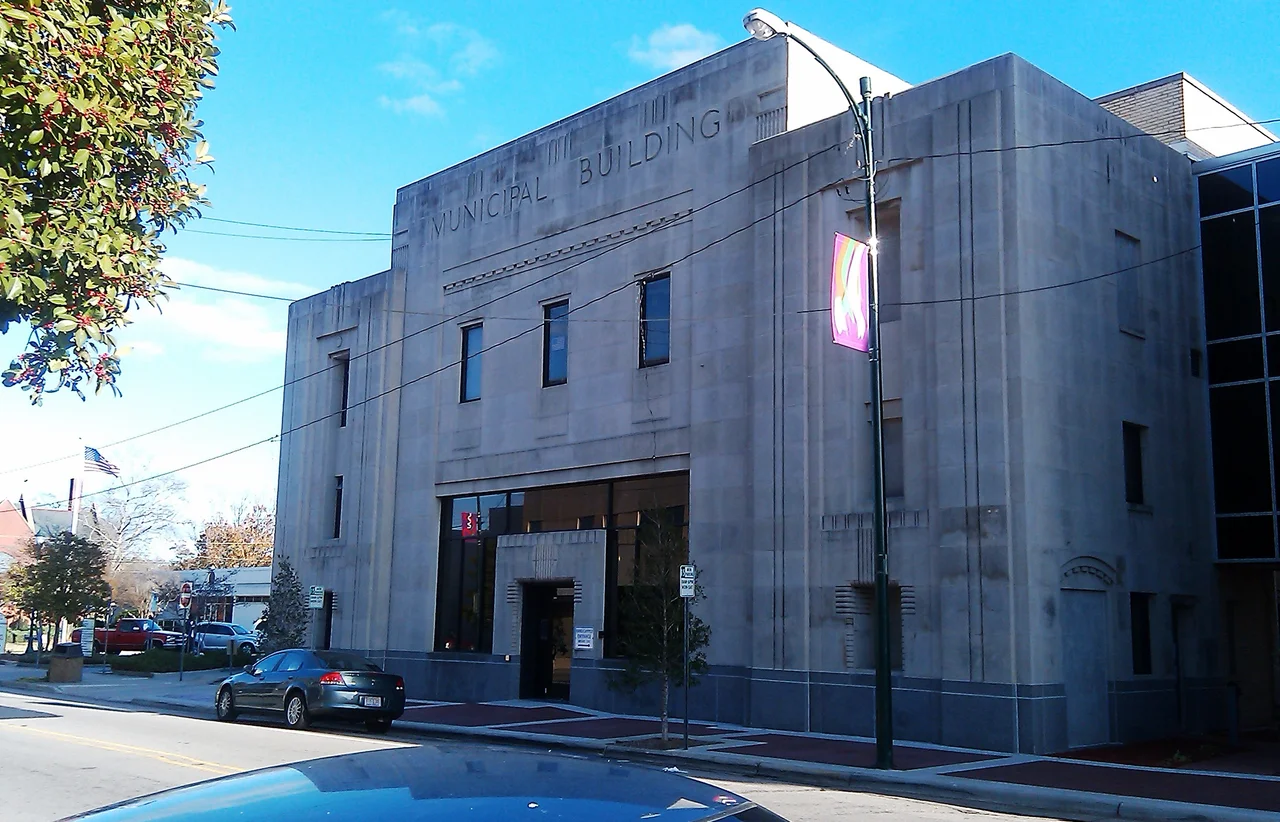

Wilson, North Carolina
Vollis Simpson built his first whirligig from a Liberator bomber's wind generator while stationed on Saipan during World War II. He spent the rest of his life in Wilson making bigger ones - towering kinetic sculptures hammered together from salvaged street signs, washing machine drums, and bicycle reflectors that catch the headlights of passing cars. After his death in 2013, the town moved thirty of his largest works downtown and built a park around them. Now, in the same flat coastal-plain city that once called itself the World's Greatest Tobacco Market, the wind does the work that auctioneers used to.
The Bright Leaf Capital
For most of the twentieth century, Wilson's identity arrived on flatbed trucks each fall - tied bundles of cured bright leaf tobacco rolling in from farms across the eastern Piedmont. Auctioneers chanted in the long warehouses of what is now the Wilson Central Business-Tobacco Warehouse Historic District, selling crop by crop in a singsong that locals could decode and outsiders could only marvel at. The town minted its boast on signs and stationery: the World's Greatest Tobacco Market. Today the warehouses still stand, repurposed but unmistakable - low brick blocks with clerestory windows angled to catch the northern light buyers needed to judge the color of the leaf. Wilson grew up around that trade, and the wealth it generated paid for the courthouse, the historic districts, and the streetcar-era neighborhoods that still define the older parts of town.
Whirligig Park
Vollis Simpson worked as a mechanic and house mover in nearby Lucama for most of his life. In a field behind his shop, beginning in the 1980s, he assembled enormous kinetic sculptures from scrap metal - tractor seats, highway signs, ceiling fans, anything that could be cut and bolted into a moving figure. The American Visionary Art Museum in Baltimore commissioned a 55-foot whirligig for its 1995 opening, and Simpson became the rare outsider artist with major-museum credentials. When the Wilson community decided to preserve his legacy, conservators dismantled, restored, and re-erected thirty of his largest works on a two-acre downtown lot. Whirligig Park opened in late 2017. On clear afternoons the sculptures spin together, mirrors and reflectors throwing scattered light across the brick of the old tobacco district.
The Diverse Twenty-First Century
Wilson's population shifted significantly in the late twentieth century. By the early 2010s, the U.S. Census estimated about 48 percent of residents identified as African American and 43 percent as white, with growing Latino, Vietnamese, Chinese, and Indian communities filling out the remainder. Many of the newer arrivals came for work at the Bridgestone tire plant, which employs more than 1,800 people making run-flat passenger tires, or for jobs at the Smithfield pork plant, Sandoz pharmaceuticals, or Merck. The historic East Wilson Historic District - a Black neighborhood that thrived during segregation, with its own commercial corridor and churches - is now protected on the National Register. The city's municipal broadband network, Greenlight, made Wilson the first North Carolina city to offer gigabit internet, in 2013.
Voices from Wilson
Wilson has produced an unusual concentration of talent for a city its size. Julius Peppers, inducted into the Pro Football Hall of Fame in 2024, grew up here and went on to play for the Carolina Panthers. Pitmaster Ed Mitchell built his reputation on whole-hog barbecue cooked the way Eastern North Carolina has always cooked it, and brought the technique into national kitchens. James B. Hunt Jr. served four terms as governor of North Carolina - a record - and shaped state education policy for a generation. Jamareo Artist tours the world as bassist for Bruno Mars. Martha Hunt walks Paris runways. The same town that once moved tobacco by the auction-truck load now exports musicians, athletes, novelists, and barbecue, with the Vollis Simpson whirligigs spinning over downtown as quiet evidence that something else was always going on here.
From the Air
Located at 35.73°N, 77.93°W on the flat coastal plain about 40 miles east of Raleigh. Wilson sits at the interchange of Interstate 95 and U.S. 264, with Interstate 795 running south toward Goldsboro. From cruise altitude the city reads as a grid in the open farmland, with the old tobacco warehouse district visible as long rectangular roofs near downtown. Rocky Mount-Wilson Regional Airport (KRWI) lies about 7 miles southwest; Wilson Industrial Air Center (KW03) sits north of town. Raleigh-Durham International (KRDU) is 45 minutes west, and Seymour Johnson Air Force Base (KGSB) sits 20 miles south.
Nearby Stories
- 1961 Goldsboro B-52 Crash 2 km away
- 2009 ConAgra Foods Plant Explosion 18 km away
- North Carolina Tornado Outbreak of April 2014 20 km away
- Campbell University 33 km away
- Hope Plantation 33 km away
- Tar River 34 km away
- Granville County, North Carolina 38 km away
- Beaufort County, North Carolina 46 km away