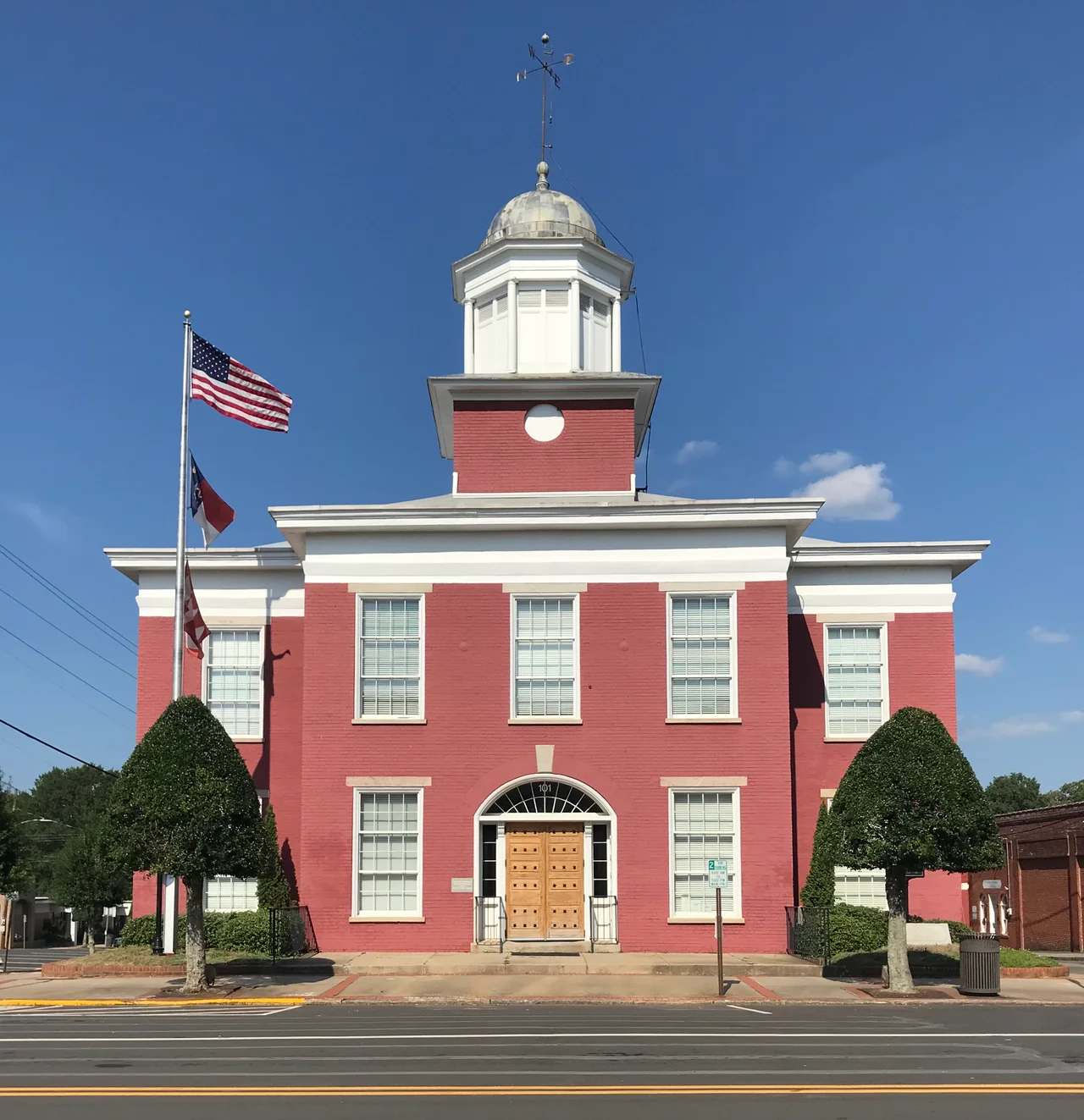

Granville County, North Carolina
By the start of the Civil War, more than 10,000 enslaved people worked the tobacco fields of Granville County - in a county whose total population was 23,396. The math means almost half the people who lived here were the unpaid laborers whose work sustained the wealth of the bright-leaf trade. Their descendants remained after emancipation; many had been free people of color before the war, often the descendants of unions between free white women and African or African-American men in the colonial era. They stayed in Oxford, the county seat, and helped build the new tobacco economy of the late nineteenth century. Some of their stories survived. Some did not. The county's documentary record is full of tobacco prices and railroad tonnage. The human cost shows up only in glimpses.
The Bright Leaf Years
Granville County was carved out of Edgecombe in 1746, named for John Carteret, 2nd Earl Granville - heir to one of the eight original Lords Proprietors of the Province of Carolina, who retained an eighth of the colony's land when the other proprietors sold their shares to the Crown in 1729. Virginia farmers settled the region after the Tuscarora War, bringing tobacco with them. The county's sandy soil proved exceptional for a new technique called flue-curing, which produced the golden-yellow bright leaf that cigarette manufacturers wanted. By the late nineteenth century, contracts ran from Granville farms to the American Tobacco Company, Lorillard, Brown & Williamson, and Liggett. Oxford became a thriving town with new industries, schools, literary institutions, and orphanages. Historian William S. Powell records that Granville has remained a top tobacco-producing county in North Carolina for decades. The economic engine that drove all of it - first slavery, then sharecropping, then mechanized agriculture - shaped every corner of county life.
Six Lynchings
Between the late 1800s and the early 1900s, white mobs in Granville County lynched six African Americans. That number ties Granville for the second-highest county total in North Carolina. Most of the killings clustered around the turn of the century, during the same years that the state legislature was disfranchising Black voters through a new constitution. One incident, on December 1, 1881, took place at the county jail in Oxford. An armed and masked mob forced the jailer to give up his keys, took out John Brodie and Shadrack Hester - two Black men accused of killing a local white man - and hanged them from a tree near where the death had taken place. Brodie and Hester never stood trial. The men who killed them were not prosecuted. The historical marker that the Equal Justice Initiative placed to document these murders is one of the few public acknowledgments of what happened on that December night.
Camp Butner and the Erased Farms
In August 1941, the federal government started planning a military training facility in southern Granville County, drawn by a nearby rail line. After Pearl Harbor in December, the planning accelerated. In January 1942, the government began telling local farmers to vacate. Between 400 and 500 families were evicted. Most of their homes and outbuildings were razed to make way for Camp Butner, which opened in August 1942 and trained thousands of soldiers for overseas service, including German prisoners of war held in a stockade. The camp closed in 1947. Its land was divided among the War Assets Administration, the North Carolina National Guard, the state, and some of the dispossessed farmers. The state turned the military infirmary into a psychiatric hospital, and a civilian town - Butner - grew up around the hospital workforce. The families whose farms had been seized rarely got their old lives back.
Granville Today
Sixty-one thousand people live in Granville County now, spread across Oxford and Creedmoor and Butner and Stem and Stovall, plus a long list of unincorporated communities with names that read like a Piedmont gazetteer - Tally Ho, Shoofly, Shake Rag, Grassy Creek, Kinton Fork. Kerr Lake and Falls Lake offer access to recreation. The Granville County Courthouse in Oxford, a Greek Revival building completed in 1840, was added to the National Register in 1979. The county sends notable people out into the world - Tiny Broadwick, the first female parachutist, was born here. So was civil rights leader Benjamin Chavis. So was James E. Webb, the NASA administrator whose name now rides on the most powerful space telescope ever built, peering at galaxies that formed near the dawn of the universe.
From the Air
Located at 36.30°N, 78.66°W on the Virginia border, north of the Research Triangle. The county stretches from Falls Lake in the south to Kerr Lake on the Virginia line. Henderson-Oxford Airport (KHNZ) sits near the county seat. Raleigh-Durham International (KRDU) is about 30 miles south, and from cruise altitude the bright-leaf farms still read as small rectangular fields cut from the hardwood forest, with Falls Lake and Kerr Lake visible as the dominant water bodies on either end of the county.
Nearby Stories
- Purefoy-Dunn Plantation 9.1 km away
- North Carolina Tornado Outbreak of April 2014 14 km away
- Staunton River State Park 18 km away
- Fort Christanna 23 km away
- Rocky Mount, North Carolina 24 km away
- Caswell County, North Carolina 25 km away
- Danville, Virginia 26 km away
- Battle of Lindley's Mill 27 km away