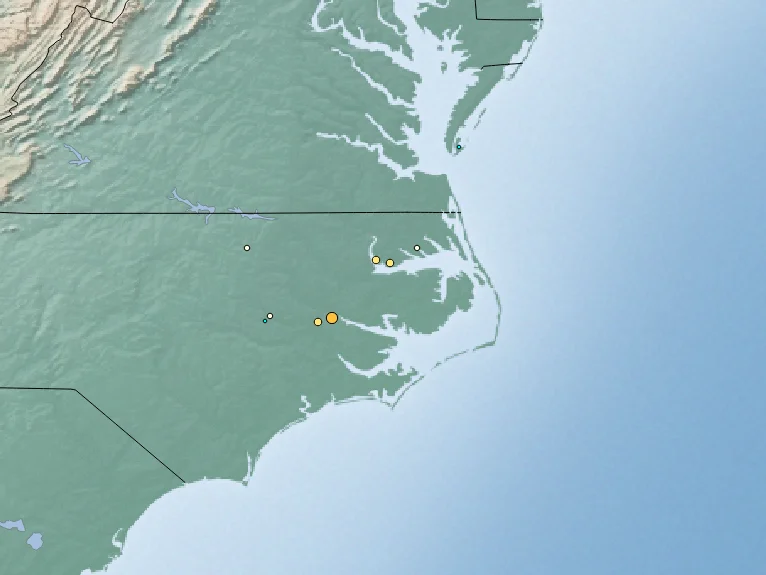

North Carolina Tornado Outbreak of April 2014
By April 25, 2014, the United States had gone the longest stretch in 99 years without a tornado death - almost four months. Meteorologists noted it with the wary optimism that anyone who watches the weather reserves for streaks like that. The streak ended in Beaufort County, North Carolina, when an EF2 tornado near Elizabeth City killed one person. A separate EF3 tornado tracked through the Whichards Beach area, damaging or destroying 100 homes and injuring 16 people. The same compact shortwave trough that had been moving across the country for four days finally reached eastern North Carolina with just enough moisture and shear to produce a brief, vicious outbreak.
The Long Quiet
The first months of 2014 had been remarkable for tornadoes mostly by their absence. The continental U.S. had run nearly the whole way through April with no tornado-related deaths - the longest such start to any calendar year in 99 years of record-keeping. The Storm Prediction Center had tracked an upper-level trough across the central and southern Plains for several days, watching it produce hail and straight-line winds but only a few weak tornadoes. By April 24 the system had shifted into a shortwave trough over the Central Plains with a cold front stretching down to the Gulf. Forecasters expected severe weather in eastern North Carolina the next day, but there was some question about whether the morning's elevated thunderstorms would suppress daytime heating enough to limit the afternoon's tornado potential. It did not.
April 25, Beaufort County
Late in the afternoon, an EF3 tornado tracked through the Whichards Beach area of Beaufort County - a low, marshy stretch along the Pamlico River south of Washington, North Carolina. The funnel damaged or destroyed 100 homes and injured 16 people. Of the 327 homes damaged or destroyed across four eastern counties that day, 60 percent were in Beaufort County. This was the first EF3-or-stronger tornado of the calendar year in the United States. The latest first-EF3 of any year on record. Survivors described the experience the way survivors usually do - a roar, a few seconds of disbelief, then the realization that the house was no longer around them. People who had lived for decades in mobile homes and frame houses on the river suddenly found themselves standing in fields of debris.
The Fatality Near Elizabeth City
A separate supercell circulation farther north produced multiple tornadoes near Elizabeth City, including two rated EF2. One of the EF2 tornadoes killed Bryan Tornblom, a Beaufort County resident, ending the tornado-death-free streak of 2014 at 99 years and a few months. Twenty-seven people across North Carolina were injured during the outbreak. In Franklin County, near Louisburg, straight-line winds estimated at 75 mph destroyed an outbuilding and damaged a barn. The damage track was unusually concentrated. Four counties - Beaufort, Perquimans, Chowan, and Pasquotank - bore almost all of the loss, and the Pasquotank-Perquimans area near Elizabeth City absorbed the EF2s while the EF3 hit Beaufort County alone.
The Disaster Declaration That Didn't Come
Governor Pat McCrory declared a state of emergency for Beaufort, Perquimans, Chowan, and Pasquotank Counties and opened two public shelters in Beaufort County. On May 2, he asked the Federal Emergency Management Agency for federal disaster assistance. On May 9, FEMA denied the request, ruling that the scale of damage was not severe enough to warrant a federal declaration. McCrory could have appealed the decision to President Obama. He declined to do so, saying he wanted to focus on getting immediate aid to affected residents. Two days after FEMA's denial, the Small Business Administration approved local disaster aid for residents in three of the four counties - Beaufort, Pasquotank, and Perquimans. It was less than what the state had asked for. For the families in Whichards Beach whose houses were gone, and for Bryan Tornblom's family, the administrative distinction between major and not-quite-major federal disaster was a thin comfort. Two days later, an even larger tornado outbreak began across the southern and central United States, killing 35 people.
From the Air
The April 25, 2014 outbreak struck four counties in eastern North Carolina, with primary damage concentrated in Beaufort County around Whichards Beach (35.50°N, 77.04°W, southeast of Washington, NC) and in Pasquotank/Perquimans Counties near Elizabeth City (36.30°N, 76.22°W). From cruise altitude this region reads as flat coastal plain cut by the Pamlico, Albemarle, and Pasquotank Sound systems. Local airports include Washington-Warren (KOCW) near the EF3 track, Elizabeth City Coast Guard Air Station (KECG) near the fatality site, and Pitt-Greenville (KPGV) inland. The Albemarle-Pamlico estuary system dominates the regional topography.
Nearby Stories
- Lake Gaston 14 km away
- Wilson, North Carolina 15 km away
- Raleigh Speedway 19 km away
- Purefoy-Dunn Plantation 22 km away
- Chowan University 23 km away
- Hope Plantation 30 km away
- Tar River 41 km away
- Staunton River State Park 43 km away