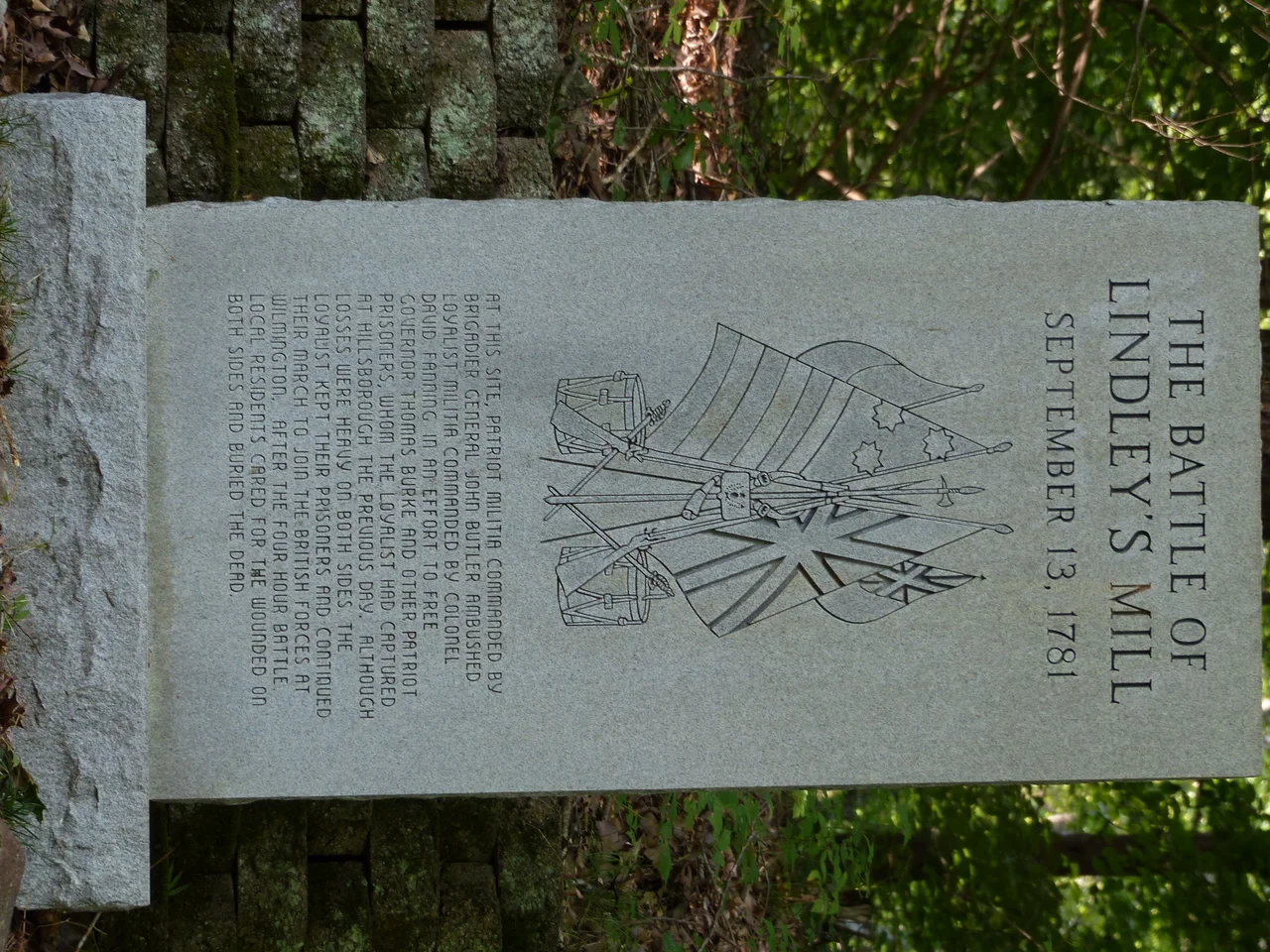

Battle of Lindley's Mill
Hillsborough, the temporary capital of North Carolina, was raided in broad daylight on September 12, 1781. Loyalist militia under Colonel David Fanning and the elderly Colonel Hector McNeill rode straight into town, seized Governor Thomas Burke and thirteen high-ranking Whig officials, and turned south for the long ride to Wilmington, where the British army was waiting to take custody. Word of the kidnapping ran ahead of the column. Brigadier General John Butler of the Hillsborough District Brigade lived nearby. By the following morning, September 13, he had 300 Patriot militiamen waiting in ambush at a gristmill on Cane Creek - Lindley's Mill, owned by the Quaker family who had built it.
The Ambush at the Mill
Cane Creek is a tributary of the Haw River, and at Lindley's Mill it ran through a small valley with a plateau on the far side. Butler put his men on the plateau, hidden in the trees overlooking the creek crossing, and waited. When Fanning's column came down the road with its prisoners, the Patriot militia opened fire from above. The first volley caught the Loyalists in the worst possible position - strung out and forced to ford the creek to make any kind of assault. Colonel McNeill, leading a unit of Highland Scots loyal to the Crown, was cut down early as he tried to bring his vanguard across. For a long stretch the Patriots held the high ground and the Loyalist attack stalled in the creek bed.
Four Hours and a Flanking Column
Fanning was a tougher and more inventive commander than the situation might suggest. While the Patriot fire pinned his vanguard, he took a larger company and forded the creek upstream from Butler's position, climbed the same plateau the Patriots were defending, and turned to attack their flank. The battle stretched out to four hours. Butler had set a careful trap, but Fanning had broken its angle. The casualties mounted on both sides until Butler concluded he could not afford another hour of it and ordered a retreat. A stubborn group of Patriots tried to hold their ground after the order; Fanning eventually dislodged them too.
Two Bullets, Two Men
Among the dead was Colonel Hector McNeill, the elderly Highlander, killed early when he led the vanguard across the ford. Among the Patriots, Major John Nall fell in single combat with another Loyalist officer in one of the war's improbable moments. Different accounts give the exchange to different men, but the scene as it has come down is the same: two officers facing each other at close range, both firing at the same instant, neither shot missing. McNeill's ball struck Nall near the heart. Nall's ball struck McNeill in the forehead. Both men were dead before they hit the ground. Between 200 and 250 men were killed or wounded across the four hours of fighting.
The Wounded Surgeon
Fanning himself was seriously wounded in the action and had to be hidden in the woods when his column moved on with the prisoners. Among the other wounded was Dr. John Pyle, who had commanded the ill-fated Loyalist regiment massacred at Pyle's Massacre earlier that year and who carried that history into the next fight. As he recovered, Pyle did something the rest of the war's record does not have many examples of: he nursed wounded men back to health on both sides - Patriots and Loyalists alike - in the small farms and Quaker homes around Cane Creek. Governor Alexander Martin would later pardon Pyle's Loyalist activities specifically because of this. Governor Burke and the other Hillsborough prisoners did not get back. They were turned over to the British at Wilmington, as Fanning had planned. The Patriots had failed to rescue them. They had also bled the Loyalist column badly enough that Fanning would not raise another force of comparable size again. Four monuments now stand at or near the battlefield, one dedicated in 1915, one in 2002, one in an unknown year, and a fourth in the cemetery across from Spring Hill Friends Meeting - a Quaker meeting house old enough to have heard the gunfire on the September morning of the battle.
Flight Context
The battlefield sits at 35.8897N, 79.3472W, in southern Alamance County (then part of Orange County), about midway between Hillsborough and Saxapahaw, near the modern community of Snow Camp. From the air look for the small valley of Cane Creek cutting through wooded farmland, the present-day Lindley Mills operation still on the creek, and the cluster of historical markers near the road junctions. Raleigh-Durham International (KRDU) is about 32 nm ENE; Piedmont Triad International (KGSO) about 30 nm WNW.
From the Air
Coordinates 35.8897N, 79.3472W; recommended viewing altitude 3,000-5,000 feet AGL. Visual landmarks include Cane Creek's wooded valley, the modern Lindley Mills facility (still operating where the original mill stood), and the surrounding patchwork of Quaker-settled farmland in southern Alamance County. Nearest airports: Raleigh-Durham International (KRDU) ~32 nm ENE; Piedmont Triad International (KGSO) ~30 nm WNW; Horace Williams (KIGX) at Chapel Hill ~13 nm ENE; Burlington-Alamance Regional (KBUY) ~15 nm NW.
Nearby Stories
- North Carolina Aviation Museum 8.9 km away
- William B. Umstead State Park 10 km away
- First Horizon Coliseum 13 km away
- Granville County, North Carolina 13 km away
- Deep River Camelback Truss Bridge 13 km away
- Caswell County, North Carolina 21 km away
- Campbell University 31 km away
- Hanging Rock State Park 46 km away