
Hanging Rock State Park
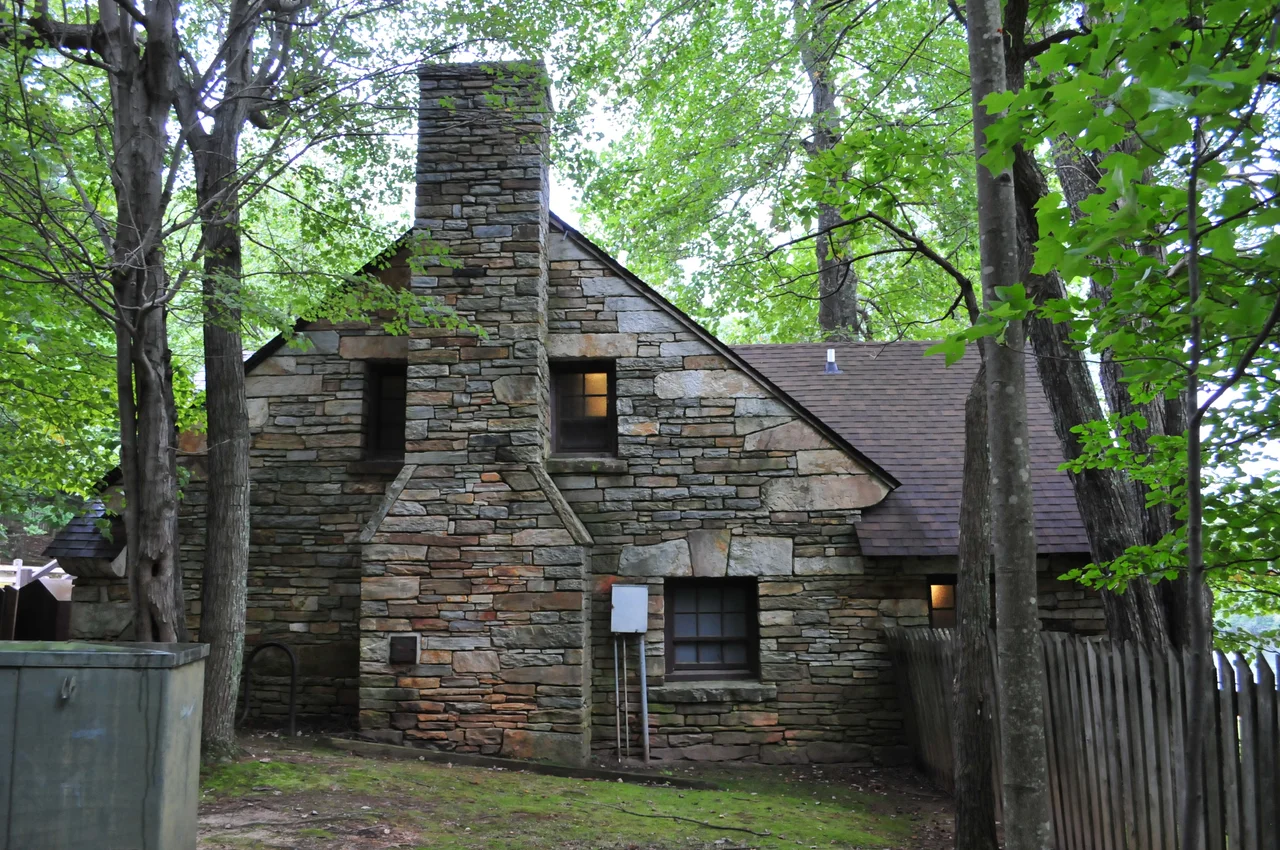
The mountain resort never happened. Private investors had picked out the cliffs and waterfalls of the Sauratown Mountains, north of Winston-Salem, as the perfect place for a getaway hotel - until the Great Depression killed the financing. What the developers had to sell, the Winston-Salem Foundation and the Stokes County Committee for Hanging Rock bought. They donated the land to the state. Between 1935 and 1942 the Civilian Conservation Corps - the New Deal's army of young men with shovels - built a 12-acre lake, a stone bathhouse, a sand beach, picnic shelters, the park road and the parking lots. Almost a century later the lake is still there, the bathhouse still stands, and the rhododendron tunnels still echo with the voices of swimmers who paid six dollars for a day pass.
The Sauratown Range
Hanging Rock is part of a monadnock range called the Sauratowns, named for the Saura people - the Cheraw, a Siouan-speaking nation - who lived in the river valleys below. The peaks aren't tall by mountain standards (800 to 1,700 feet, or 244 to 518 meters), but they rise abruptly out of the rolling Piedmont below, and ecologically they belong with the Appalachians, not with the lowland forest around them. Oak and hickory dominate the canopy. Rhododendron and mountain laurel fill the understory, blooming in May and June. Wild azalea splashes pink across rocky slopes in spring. Peregrine falcons nest in the cliffs above Moore's Wall and Cook's Wall, their nests reclaimed in the 1980s and 1990s after DDT nearly drove the birds extinct. Two venomous snakes - copperhead and timber rattlesnake - live here, both of them mostly looking to be left alone. White-tailed deer thread through the laurel. Wild turkey scratch the trails.
What the CCC Left
Between 1935 and 1942, three Civilian Conservation Corps companies worked Hanging Rock. The CCC was Franklin Roosevelt's idea - put unemployed young men into the woods, pay them thirty dollars a month with twenty-five sent home to their families, give them tents and shovels and good American food, and let them build the public infrastructure that the country had never built. At Hanging Rock they impounded Cascade Creek to make the lake. They cut and laid the stone for the bathhouse, the picnic shelters, the steps along the hiking trails. They cleared the road in, dug the parking, built the visitor facilities. Most of those stone-and-timber structures are still standing because the CCC built them to last. The 12-acre lake still holds water, the swimming beach still operates from late spring to early fall, the boats still rent for seven dollars an hour - two-person canoes and three-person rowboats only, no private craft permitted.
Twenty Miles of Trails
More than twenty miles of hiking trails fan out from the visitor center. The signature trail is the 1.8-mile out-and-back to Hanging Rock itself - a stone overhang that gives the park its name, balanced on a cliff edge with a view over the Dan River valley that on a clear day reaches into Virginia. The 4.7-mile Moore's Wall Loop is harder and better. Walk it clockwise: the ascent is gradual that way, and at the summit you reach a raised observation platform - the trail guides call it the Observation Tower - that gives an unobstructed 360-degree view of the Piedmont rolling away for miles. The Dan River Access at the north end of the park lets paddlers put in for a long float. There are 73 tent and trailer sites, five group camping areas, and a row of CCC-era vacation cabins available by reservation through the North Carolina state park system. Backcountry camping is not permitted. Climbing and rappelling require a free activity permit from the park office.
Going Home Through Pilot Mountain
From Winston-Salem, the drive in is about an hour and a half: up US-52 to NC-66 north, then west on Moore Spring Road to the entrance. There is no entry fee. Swimming and boat rentals carry small day-use fees ($6 adult, $4 child for the pool; $7 per hour for boats). The cafe near the Moore's Wall trailhead sells cold drinks and snacks. Most visitors do the Hanging Rock Trail in the morning, swim or picnic at the lake at noon, and either drive home or stay at the campground. Thirty minutes farther down NC-52 sits another CCC park, Pilot Mountain State Park, with its distinctive quartzite knob visible for fifty miles in every direction. The Sauratowns hold both peaks. The developers who wanted to build a private resort here lost their gamble in 1929. Generations of North Carolinians have benefited from their failure.
From the Air
Hanging Rock State Park sits at 36.39 degrees N, 80.27 degrees W in Stokes County, North Carolina, with peaks ranging from 800 to 1,700 feet AGL (244 to 518 meters) above the surrounding Piedmont. The Sauratown range is visible for many miles as a knot of forested hills rising from rolling farmland. Nearest airports: Mount Airy/Surry County (KMWK) 13 nm northwest; Smith Reynolds (KINT) 25 nm south near Winston-Salem; Piedmont Triad International (KGSO) 32 nm south. Recommended viewing altitude 4,500-6,000 feet AGL to take in the whole Sauratown range and Pilot Mountain's distinctive quartzite knob 25 miles southwest. The Dan River curls along the north side of the park. Watch for soaring birds - peregrines and red-tailed hawks - working the updraft along Moore's Wall and Cook's Wall.
Nearby Stories
- Mebane's Bridge 5.3 km away
- Bethabara Historic District 7 km away
- Battle of Wetzell's Mill 15 km away
- North Wilkesboro Speedway 21 km away
- Galax, Virginia 22 km away
- Floyd County, Virginia 23 km away
- Wytheville, Virginia 31 km away
- Pittsylvania County, Virginia 37 km away