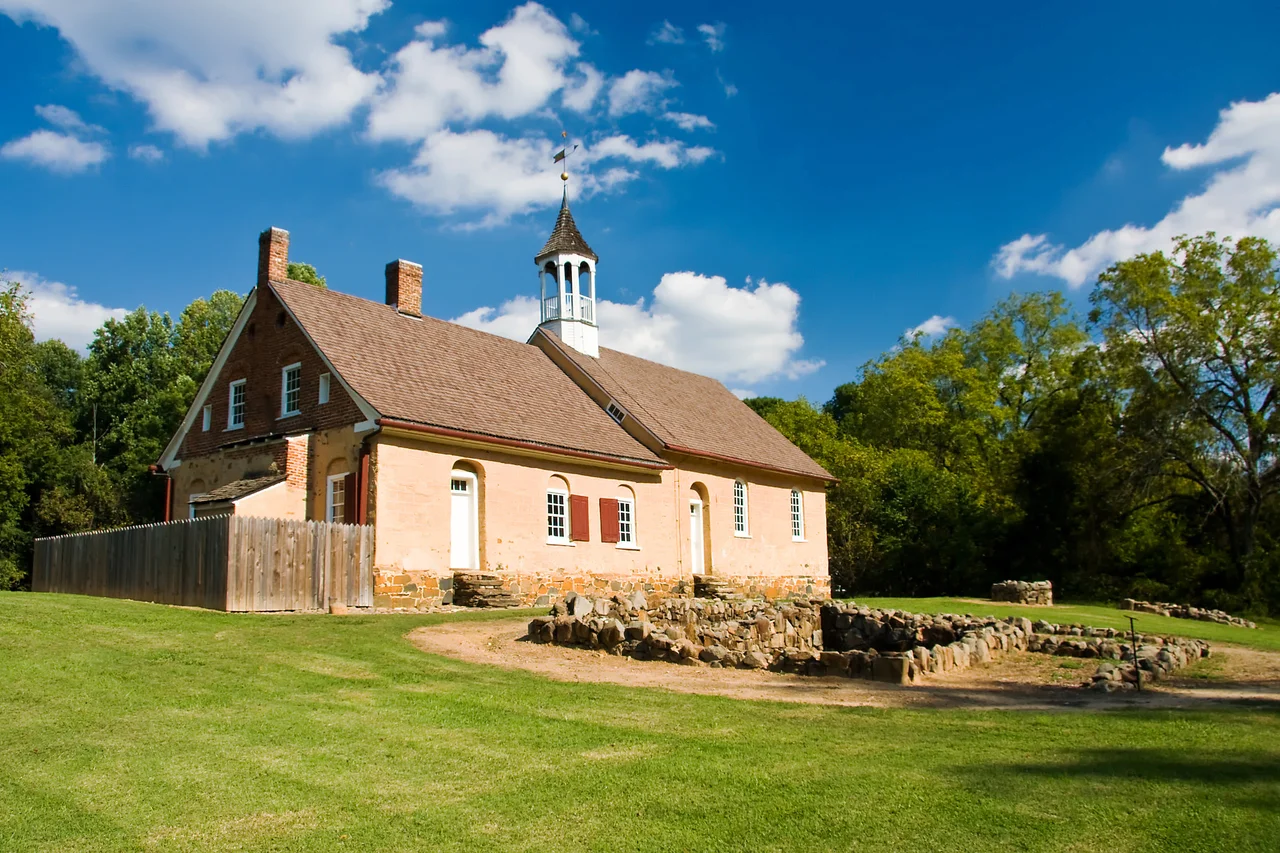

Bethabara Historic District
The name means House of Passage. The Moravians chose it from a Hebrew word for the traditional site of the baptism of Jesus, and they pronounced it beth-AB-bra. They never intended to stay long. Fifteen men arrived in November 1753 to occupy an abandoned cabin on a 100,000-acre tract their church had purchased from Lord Granville and named Wachovia. The land they walked onto was not empty. It was claimed and used by the Saponi, Tutelo, and Cherokee peoples and their neighbors, whose dispossession by colonial land grants is the unspoken first chapter of every place name on this part of the Yadkin River. The Moravians meant Bethabara as a way station, somewhere to wait until a central town could be built. They stayed eighteen years.
The Medicine Garden
What set early Bethabara apart in colonial North Carolina was less its theology than its agricultural practice. Moravian settlers were noted for advanced farming techniques, and especially for their medicine garden, which grew more than fifty kinds of herbs. In a colony where serious illness usually meant whatever a backcountry doctor could improvise, a working pharmacopeia was a rare resource. The garden was both Moravian piety made practical and a kind of regional public service. The reconstructed gardens at Historic Bethabara Park today follow the period plans, with beds laid out by purpose, so visitors can see what was grown to ease fever, to dress a wound, to thin the blood, to flavor an evening meal.
A House for Refugees
Six months after the Moravians arrived, the Seven Years' War, known on this continent as the French and Indian War, broke out in western Pennsylvania. The violence spread south. By 1758 it had reached western North Carolina. Bethabara hardened. A palisade was raised, and the small village became a refuge: not only for the Moravians themselves but for backcountry settlers whose isolated cabins offered no defense. Bethabara hosted a steady population of refugees until 1761. The plan to build a central town was suspended for thirteen years, while every newcomer and every neighbor needed somewhere safer to sleep. By the time the war ended, the temporary village had become indispensable, and the Moravians had to dismantle it before they could move on.
Becoming Old Salem
In 1766 it was finally judged safe enough to begin construction of the central town. Salem, a few miles to the south, would be the new seat of Moravian Wachovia. Many of the buildings in Bethabara were taken down and reused for the new structures in Salem. Root cellars were pushed in and filled. Salem was finished in 1771. The official seat of government transferred there in the same year, and most of Bethabara's residents moved with it. A few remained, and Bethabara became a working farm community supplying food and pottery to the other Moravian towns. In 1788, an enslaved man known as Johann Samuel was made superintendent of the farm. He was freed in 1801, after fifty years of servitude to the Moravians. The arithmetic is brutal: a man whose work made the farm successful had to wait until he was old before his labor was finally his own.
Reading the Ground
The Gemeinhaus, the Bethabara Moravian Church, still stands. So does an 1815 to 1816 log house and the reconstructed palisade. What is most striking, though, is what was found in the dirt. In the 1960s the archaeologist Stanley South excavated the site, reading whole vanished foundations out of the soil and identifying which root cellars had been filled in 1771, which buildings had stood where, which artifacts traced to which trades. His work transformed Bethabara from a footnote in Moravian history into one of the most carefully documented colonial archaeological sites in the American Southeast. The excavated foundations remain visible today as low stone outlines, ghosts of the houses the Moravians dismantled when they walked away.
A Park in a City
Historic Bethabara Park covers 183 acres on the northern edge of Winston-Salem, a wildlife preserve and open-air museum operated by the City of Winston-Salem Recreation and Parks Department. Twenty miles of nature trails thread the site. Reenactments and festivals come through on weekends, the largest being the Independence Weekend Celebration. The Gemeinhaus was listed on the National Register of Historic Places in 1971, and the larger site was designated a National Historic Landmark in 1999. The 100,000-acre Wachovia Tract is long gone from the maps. What remains, on the slope above Mill Creek, is the place where the Moravians first stopped to wait, planted a herb garden, built a palisade, and ended up staying just long enough to leave permanent foundations in the ground.
From the Air
Located at 36.15 degrees north, 80.30 degrees west, on the northern edge of Winston-Salem, North Carolina, between U.S. 52 and the Reynolda area. The 183-acre park is visible from the air as a wooded patch with the reconstructed palisade outline near the Bethabara Moravian Church. Best viewed below 3,000 feet AGL. Nearest tower-served airport is Smith Reynolds (KINT) at Winston-Salem, only about 4 miles east-southeast; arrivals and departures often pass within sight. Piedmont Triad International (KGSO) at Greensboro lies about 22 miles east. Class D under KINT's Class D shelf; obtain clearance before low overflight.
Nearby Stories
- Battle of Wetzell's Mill 5 km away
- Hanging Rock State Park 5.9 km away
- Mebane's Bridge 11 km away
- 2025 North Carolina Cessna Citation II Crash 13 km away
- Wil-Cox Bridge 16 km away
- North Wilkesboro Speedway 19 km away
- Galax, Virginia 31 km away
- Deep River Camelback Truss Bridge 60 km away