_(1-26-2025).jpg)
2025 North Carolina Cessna Citation II Crash
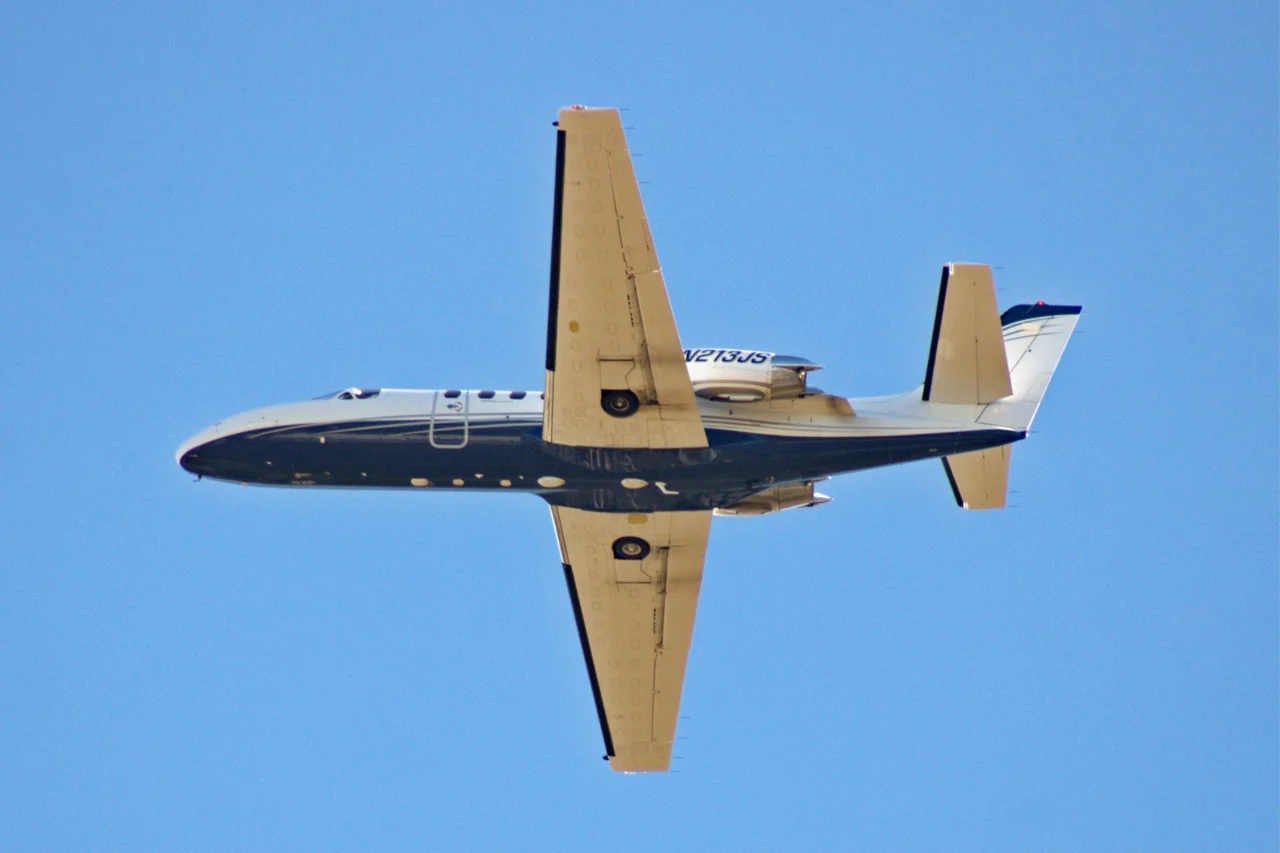
On the morning of December 18, 2025, a Cessna 550 Citation II business jet, tail number N257BW, was returning to Statesville Regional Airport in north-central North Carolina. The clouds were low. The rain was light. Visibility was less than three miles. Aboard the airplane were seven people: retired NASCAR Cup Series driver Greg Biffle, his wife Cristina, their daughter Emma and son Ryder, family friend Craig Wadsworth, pilot Dennis Dutton, and Dutton's son Jack. Between 10:15 and 10:20 a.m. local time, the airplane struck approach lighting short of the runway, then trees, then came to rest in the runway overrun area. The fuselage was largely consumed by fire. There were no survivors.
The Aircraft and the Field
The Citation II was a 1981 airframe owned by GB Aviation Leasing LLC, a company controlled by Greg Biffle. The maximum altitude the airplane reached during the accident sequence was 4,300 feet. Statesville Regional Airport, about 45 miles north of Charlotte, is a small regional field with no control tower - what pilots call non-towered, where traffic separation happens by radio coordination and visual scanning rather than by ground-based controllers. The Cessna 550 is a twin-engine corporate jet typically flown by a single pilot, although it can be flown two-up. On this flight, the captain was acting as pilot flying. A right-seat occupant was acting as pilot monitoring - handling radio calls and checklists from the copilot seat.
The Preliminary Report
The National Transportation Safety Board released its preliminary report on January 30, 2026. The Citation 550 was not equipped with a flight data recorder, so investigators reconstructed the sequence from the cockpit voice recorder and from data captured by the airplane's Garmin G750 navigation display. The picture that emerged was of an aircraft and a cockpit that were not quite right from before takeoff. The left engine failed to start on the first attempt. The captain and the right-seat pilot-passenger discussed a malfunctioning thrust reverser indicator, though the reversers themselves appeared functional. The pilot-passenger reported temperature reading discrepancies between the two engines. The issue was not pursued. The flight took off anyway. The airplane reached 4,300 feet and then began to lose altitude.
The Garmin Goes Dark
On the way back to the airport, the captain reported problems with the Garmin's altimeter. The display then stopped recording altitude data, and a short time later stopped recording heading data as well. The pilot-passenger took the controls momentarily before the captain resumed control, turned back toward Statesville, and called for flaps and landing gear. The flap and landing gear indicator lights did not illuminate. A non-flying passenger asked whether the alternator was working - asking the right question for the wrong airplane, since the Cessna 550 does not have an alternator. The captain answered that this was the 'problem.' The Garmin resumed functioning immediately afterward. The cockpit had been chasing electrical anomalies that may or may not have been there. Airspeed and altitude continued to fall.
The People Aboard
The investigation will run for another year, maybe two. The NTSB found no evidence of structural failure. The engines remained attached to the airframe. Fan-blade damage was consistent with the engines turning at impact, not seized. What the agency has documented so far, without yet determining a cause, is a sequence of small electrical malfunctions and the crew's attempts to diagnose them during an approach to a non-towered field in low visibility. None of this brings back the family aboard. Greg Biffle won 19 Cup Series races over his NASCAR career; he was 55 when he died. His wife Cristina and their children Emma and Ryder were with him. Dennis Dutton was the pilot. His son Jack was with him. Craig Wadsworth was the seventh. Seven people, one airplane, the last twenty minutes of a flight that ended a thousand feet short of the runway it was trying to reach.
From the Air
Crash site at approximately 35.764 N, 80.939 W, in the runway overrun area at Statesville Regional Airport (KSVH). Field elevation 967 feet. KSVH is a non-towered general aviation airport with a single 7,003-foot runway (10/28). Located about 45 miles north of Charlotte (KCLT), 35 miles east of Hickory (KHKY). The accident has raised questions about cockpit electrical anomalies, crew coordination during instrument approach, and the accident exposure of pilot-flying / pilot-monitoring operations in single-pilot-certified business jets when the second seat is occupied by a pilot-passenger rather than a fully briefed crewmember - issues the NTSB's continuing investigation has yet to resolve.
Nearby Stories
- Tucker's Grove Camp Meeting Ground 6.3 km away
- Catawba College 9.2 km away
- Blue Ridge Parkway 11 km away
- North Wilkesboro Speedway 12 km away
- Blowing Rock 15 km away
- Joara 17 km away
- Reed Gold Mine 25 km away
- Gardner-Webb University 31 km away