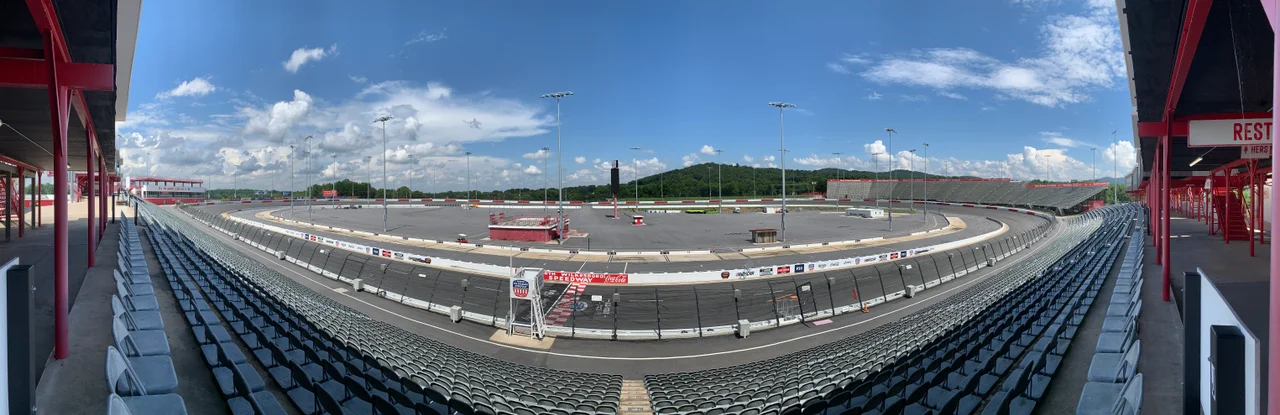

North Wilkesboro Speedway
Enoch Staley ran out of money building the track, which is why one straightaway runs downhill and the other runs uphill - a constructional accident that became the most distinctive feature of any NASCAR oval ever built. North Wilkesboro Speedway opened on May 18, 1947, with about ten thousand spectators watching Fonty Flock win a modified feature race. Staley had been to one stock car race in his life, in Spartanburg in 1945, and walked away in love with it. He partnered with Lawson Curry, John Mastin, the Combs brothers, and NASCAR founder Bill France Sr. to build a 0.625-mile dirt oval in the foothills near the Brushy Mountains. The dirt was treated with fourteen tons of calcium chloride and salt to keep down dust. Nobody, including Staley himself, expected the track to last more than a year.
Moonshine Runners Christen the Track
Before Bill France Sr. brought his sanctioned race to the new track in May 1947, local moonshiners ran unofficial races there. NASCAR personality Junior Johnson - a North Wilkesboro native and former moonshine runner who became one of the sport's defining figures - confirmed those stories years later. The connection was not metaphorical. The drivers who built the early NASCAR Cup Series were largely the same men who had spent the 1930s and 1940s running corn liquor across the back roads of Wilkes County in souped-up sedans, outrunning federal revenue agents on highways they knew like their own driveways. North Wilkesboro Speedway was the place where that subculture stepped into legitimacy. In 1965, Tom Wolfe wrote about Junior Johnson and the track in Esquire magazine, an article credited with introducing NASCAR to readers far outside the Southeast. The piece, titled The Last American Hero Is Junior Johnson. Yes!, became a touchstone of New Journalism and a kind of founding document of NASCAR's national identity.
Enoch's Death and the Texas Move
Enoch Staley died in 1995. NASCAR was exploding in popularity. Bruton Smith of Speedway Motorsports Inc. was building Texas Motor Speedway and needed dates on the Cup schedule. Bob Bahre owned New Hampshire International Raceway and wanted Cup dates too. Together they bought out the Staley and Combs families - Smith paying $6.05 million for the Combs' half, Bahre paying $8 million for the Staley half. Both buyers then refused to work with each other. The 1996 season finished with two final races at North Wilkesboro; the September 29, 1996 Tyson Holly Farms 400 was the last points-paying Cup race held there for twenty-seven years. NASCAR confirmed in July 1996 that the spring race would move to Texas and the fall race to New Hampshire. Many in the industry accepted the move as part of NASCAR's necessary expansion into broader markets. Wilkes County took it differently. The track had been the economic anchor of a financially struggling rural county, and its loss began a long decline.
Paul Call, Caretaker
On January 3, 1997, the Winston-Salem Journal reported that the facility had been officially closed and all employees laid off. There was one exception. Paul Call, a longtime employee, had begged Bruton Smith and Bob Bahre for a deal that would let him live on the property. They agreed. For nearly two decades, Call was the only person who worked at the track - mowing grass, keeping caretaker hours, watching the grandstands collapse around him. He occasionally let curious tourists in and acted as informal tour guide. By 2015, buildings on the site had completely caved in. The Junior Johnson grandstands collapsed. Suites were damaged beyond repair. The asphalt cracked. Paul Call kept mowing. The facility had been declared so far gone that a 2019 writer said it was closer to being condemned than restored, and the cost of bringing it back to standards would run into hundreds of millions of dollars.
The iRacing Revival
In September 2019, Dale Earnhardt Jr. approached Marcus Smith - Bruton's son and successor at SMI - about digitally preserving the track. Three months later, Earnhardt organized a cleanup so that the racing simulator iRacing could laser-scan what remained. The scan was added to the simulator by May 2020. Drivers raced virtual cars on a virtual North Wilkesboro and remembered what made the place special. The COVID-19 pandemic then handed Wilkes County a financial lifeline: Governor Roy Cooper considered using federal relief money for the track. By August 2021 the amount under discussion was $20 million; the final number from the General Assembly came to $18 million. Construction started almost immediately. SMI demolished the dilapidated buildings, repaved the track, added SAFER barriers, installed lighting and modern drainage, and preserved as much of the old-school aesthetic as possible. In May 2023, Cup cars returned for the NASCAR All-Star Race - the first NASCAR Cup-level race at North Wilkesboro in twenty-seven years. The track that had been left for dead was running again.
Uphill, Downhill, Asymmetrical
The track that returned is fundamentally the same one Enoch Staley built with his friends in 1947. The frontstretch still runs downhill, the backstretch still runs uphill, the turns are still asymmetrical because Staley ran out of money before he could make them symmetrical. The 13 degrees of banking in the turns and 3 degrees on the straightaways have been the same since the early paving. Capacity now sits at 25,000, down from a peak of 55,000 in the mid-1990s. The Window World 450 and Window World 250 hold the Cup and Truck Series dates. In 2024, crews discovered a sinkhole beneath a grandstand. Some claimed it might be a moonshine cave from the 1940s, which would have been fitting; others noted that the track had always had poor drainage and the cave story was probably a Wilkes County tall tale. Either way, the sport that started here came home. Junior Johnson, who died in 2019, did not live to see it. Paul Call, who kept the grass mowed through the long abandonment, did.
From the Air
North Wilkesboro Speedway sits at 36.14 N, 81.07 W in North Wilkesboro, NC near the foothills of the Brushy Mountains. From the air, the asymmetric 0.625-mile oval is clearly visible with its downhill frontstretch and uphill backstretch. North Wilkesboro Airport (KUKF) is just a couple miles east. Hickory Regional (KHKY) lies about 25 miles south. Recommended viewing altitude 2,500 to 4,000 feet AGL.
Nearby Stories
- Blue Ridge Parkway 7.7 km away
- Blowing Rock 10 km away
- 2025 North Carolina Cessna Citation II Crash 14 km away
- Joara 16 km away
- Wil-Cox Bridge 19 km away
- Hanging Rock State Park 22 km away
- Galax, Virginia 33 km away
- Emory and Henry University 49 km away