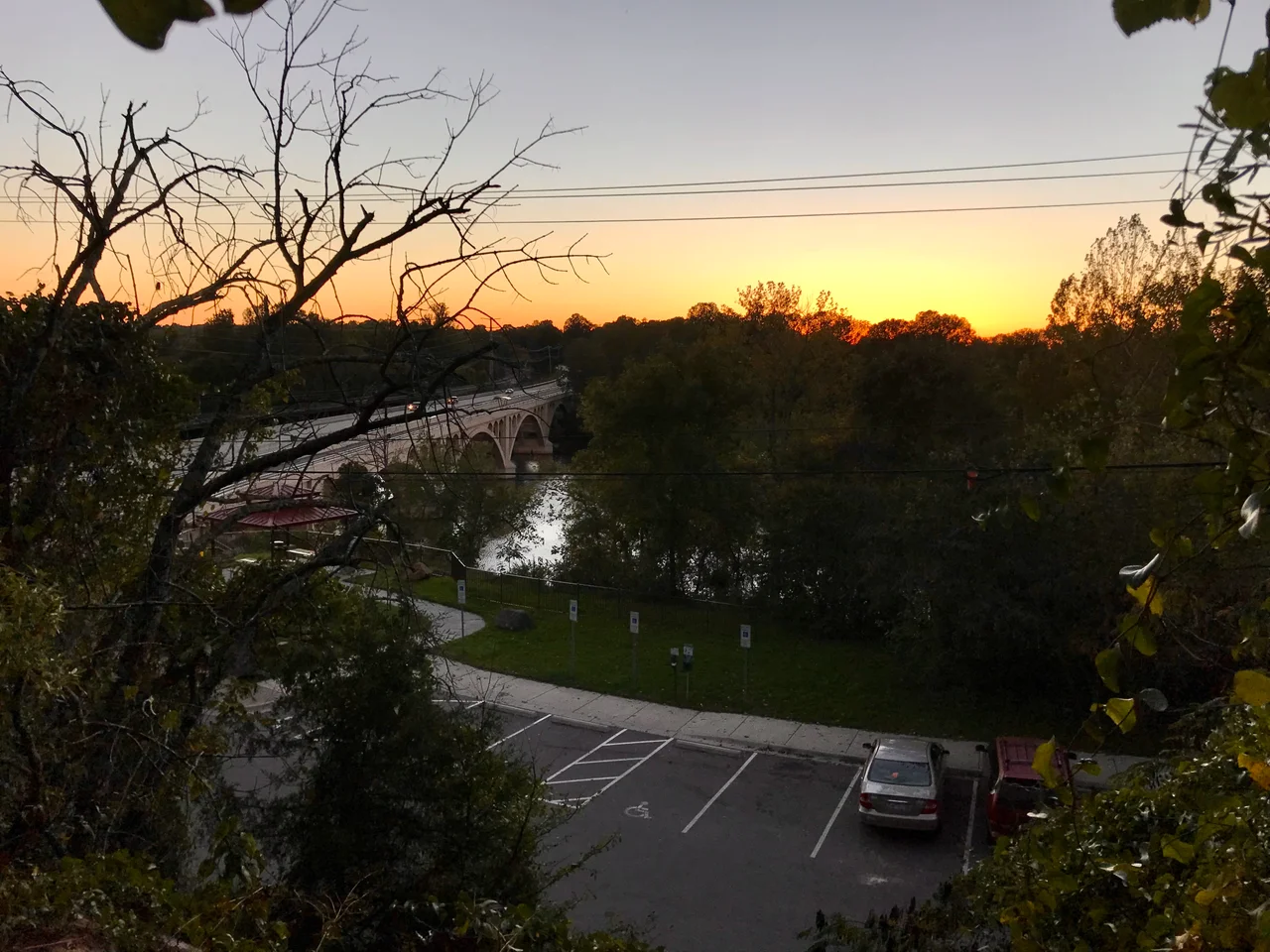

Wil-Cox Bridge
Louis Beard built the first bridge over the Yadkin at Trading Ford in 1818 - a toll bridge serving the mail route between Washington, D.C. and New Orleans. A second toll bridge went up in 1899 on the same piers. The bridge that stands there today, the Wil-Cox, opened in 1924 and carried U.S. 29, U.S. 70, and NC 150 across the river between Rowan and Davidson counties for nearly nine decades before retiring into pedestrian service. Seven open-spandrel concrete arches - each 150 feet long, the full span nearly 1,300 feet - cross the Yadkin, named for two highway commissioners - W.E. Wilkinson of Charlotte and Elwood Cox of High Point - whose surnames were spliced into a hybrid most people now pronounce without thinking about the men behind it.
Trading Ford, Long Before the Bridge
The location where the Wil-Cox crosses the Yadkin was a trading path for centuries before any European thought to span the river with timber and stone. Native peoples used the ford to cross between the Piedmont uplands and the river valleys to the east. The colonial mail route from Washington, D.C. to New Orleans used the same crossing, which made the ford a strategic node in the early American transportation network. When Beard built his 1818 toll bridge, he was monetizing a route that had been free and well-traveled for hundreds of years. The 1899 toll bridge reused his piers. The 1924 Wil-Cox added the open-spandrel concrete arches that became its visual signature - seven of them, each spanning 150 feet, lifting the road well above the river's seasonal floods.
Stoneman's Defeat at Fort York
Just upstream from the bridge sits the bluff where Confederate forces built Camp Yadkin, also called Fort York, in the closing months of the Civil War. On April 12, 1865 - three days after Lee surrendered at Appomattox - Union Major General George Stoneman attempted to destroy the railroad bridge across the Yadkin as part of his sweep through the Carolinas. Confederate forces at Fort York repulsed him. It was the last Confederate victory in North Carolina, and one of the final military actions of the war anywhere. The war was effectively over, Stoneman's raid had already devastated towns across the region, and yet the men dug into the bluff above the Yadkin held their position long enough to keep the railroad bridge intact. The bluff overlooks where the Wil-Cox would rise sixty years later. Visitors walking the bridge today are walking over ground that mattered to the war's last weeks.
Almost Demolished
By the late 1990s, the Wil-Cox was tired. Bigger highways had replaced its role, and the steel girder companion bridge built in 1951 was carrying most of the north and east-bound traffic. The state considered demolishing the Wil-Cox once the new I-85 bridges were complete. Salisbury wanted it preserved. Preservationists wanted it saved as a pedestrian bridge, a regional historical artifact for a planned greenway. The argument went on through the 2000s. In April 2010, NCDOT closed the bridge after inspectors found serious deterioration. Then the I-85 bridge project ran behind schedule, and the state suddenly needed the Wil-Cox back in service as a detour. Three million dollars in shotcrete repairs revived it. By September 2011, the work was complete. The 1951 steel girder bridge closed in April 2012, the new I-85 bridges took over, and the Wil-Cox - which had nearly been blown up - became part of the Davidson County Greenway system and Yadkin River Park.
The Park Around the Bridge
By the early 2020s, Yadkin River Park was drawing six hundred visitors a day on the Davidson County side. In March 2021, Davidson County and Friends of Rowan announced a combined $150,000 gift for improvements - dog park, sidewalks, parking. Several million more dollars were needed for a visitor center, a playground, possibly a museum. The town of Spencer planned a trail with benches on the Rowan County side. The North Carolina Department of Transportation agreed to provide unneeded right-of-way for the project. Across the river in Rowan County, the former North Carolina Finishing site - purchased by Waterford Funding the year before and needing $3.5 million in cleanup - was slated for additional park development. The Wil-Cox had become not just a preserved bridge but the anchor of a multi-county park system.
A Century of Concrete
The Wil-Cox turned one hundred years old in 2024. The Salisbury Post ran a piece marking the centennial as the surrounding parks continued to grow. The 1818 toll bridge and the 1899 toll bridge are long gone. The 1951 steel girder bridge has been demolished. The new I-85 bridges - the Yadkin River Veterans Memorial Bridges - now carry most of the traffic between Rowan and Davidson counties. But the seven concrete arches built in 1924, named for two long-forgotten highway commissioners, still cross the Yadkin at the same spot where mail riders forded the river two centuries ago. The bridge that almost got demolished is now part of the Daniel Boone Heritage Canoe Trail, the Carolina Thread Trail, and an expanding greenway connecting to Boone's Cave Park. Sometimes the slowest preservation argument wins.
From the Air
Wil-Cox Bridge sits at 35.72 N, 80.39 W spanning the Yadkin River between Rowan and Davidson counties just east of Spencer, NC. From the air, look for the distinctive seven-arch concrete span paralleling the larger I-85 Yadkin River Veterans Memorial Bridges. The Norfolk Southern Warren deck-truss rail bridges run close by. Mid-Carolina Regional Airport (KRUQ) is about 5 miles west. Davidson County Airport (KEXX) is to the east. Recommended viewing altitude 1,500 to 3,000 feet AGL for best look at the arches.
Nearby Stories
- Greensboro, North Carolina 4.1 km away
- 2025 North Carolina Cessna Citation II Crash 7.2 km away
- R. J. Reynolds Memorial Auditorium 9.5 km away
- Battle of Cowan's Ford 12 km away
- North Wilkesboro Speedway 23 km away
- Concord, North Carolina 27 km away
- Tobacco Road 30 km away
- Carthage Nursing Home Shooting 40 km away