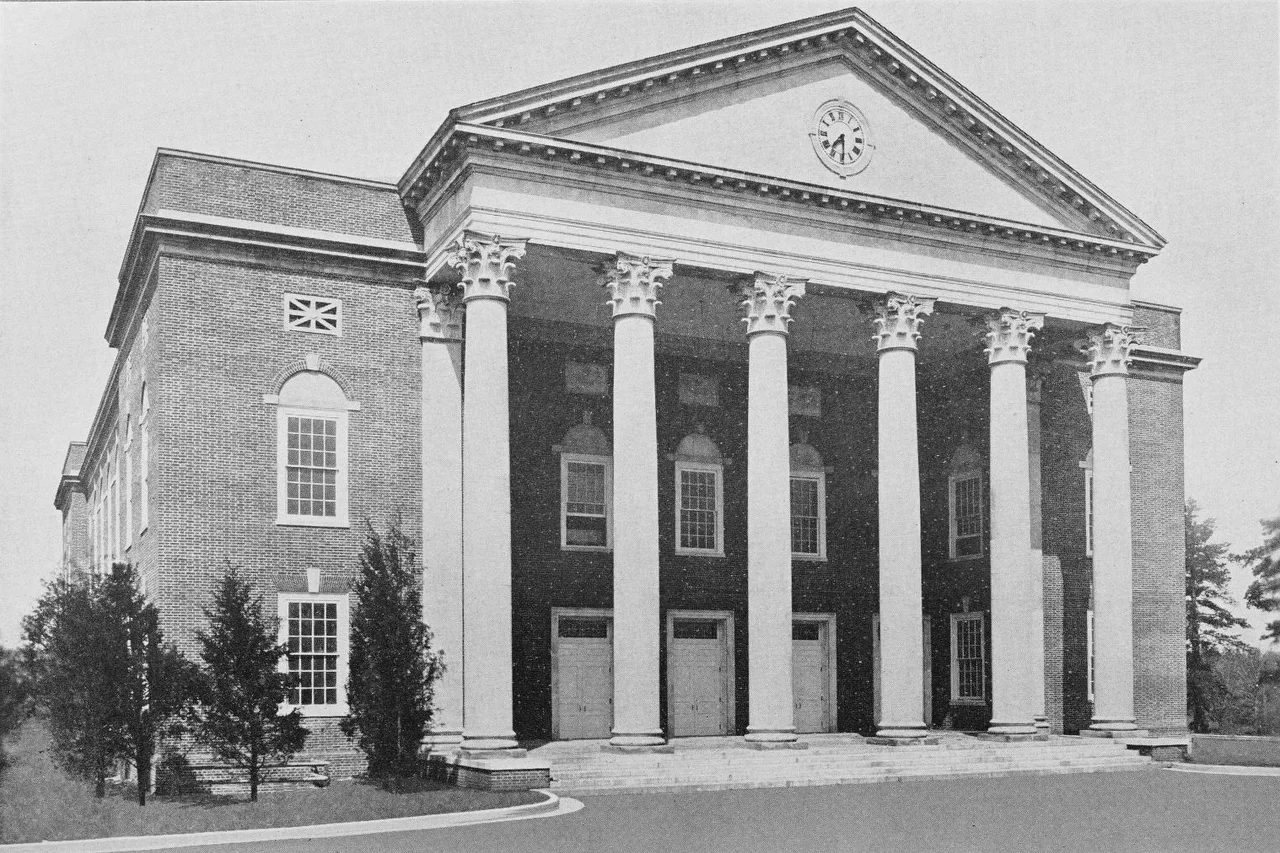

R. J. Reynolds Memorial Auditorium
Katharine Smith Reynolds never saw a single performance in the auditorium she built. The dedication ceremony fell on May 8, 1924. She was hospitalized that day with a difficult pregnancy. She died on May 23, fifteen days after the ribbon was cut on the building she had spent five years willing into existence as a memorial to her first husband, R. J. Reynolds. The R. J. Reynolds Memorial Auditorium has stood on Silver Hill in Winston-Salem ever since, its three-story portico facing downtown, its columns echoing in the school song that students still sing under them.
Silver Hill
In 1919, the year after R. J. Reynolds died, his widow Katharine donated a large tract of land then known as Silver Hill to the City of Winston-Salem. The plan she developed was unusual for a memorial. Rather than a single monument, she wanted an entire civic complex: a grand high school for the city's children and an adjoining auditorium that would belong to the entire community. The 28-acre tract she gave eventually included not only the school and the auditorium but Hanes Park, named for Hanes Hosiery Mills founder and later mayor James G. Hanes, the Calvin H. Wiley Middle School, and the Winston-Salem Central YMCA. The hill itself came to be known as Society Hill, less for its donors than for the procession of school events that filled it.
The Architect Who Designed Reynolda
Katharine Reynolds hired Charles Barton Keen, the Philadelphia-trained architect who had designed the Reynolds family estate, Reynolda House, a few miles to the west. Keen took on both the high school and the auditorium, and the two buildings share a deliberate Georgian Revival vocabulary. Construction began in 1919 and lasted five years. The auditorium can comfortably seat 1,898 people, with 857 seats on the main orchestra level and 1,041 on the mezzanine and balcony. The portico and columns face the downtown skyline at three stories tall. To Reynolds parents over the decades, those columns are simply the first thing their children walked beneath the first day of high school. To the school song, written in 1949 by Olive Thomasina ("Tommye") Ring, they are "Her Portals Tall and Wide."
Houdini in November
A few weeks after the dedication, the first commencement of Richard J. Reynolds High School was held inside the auditorium that had been built before its students ever needed it. On November 24, 1924, the building hosted its first famous guest: Harry Houdini, then in the final stretch of his life. He had less than two years to live. The auditorium hosted a steady procession of performers in the century that followed, including the singer-songwriter Jim Croce in the early 1970s, not long before his death in a plane crash, and pianist Peter Nero around the same time. A 100th anniversary celebration was held in 2024, a hundred years after Katharine never made it through the doors.
The Grand Lobby
Walk in from Reynolda Road and the Grand Lobby holds two large portraits, one of R. J. Reynolds and one of Katharine Smith Reynolds. Both were painted by Joe King, a Reynolds High graduate who later painted Queen Elizabeth II. Three marble statues, duplicates of famous Italian works, were sculpted in Italy and shipped to North Carolina specifically for the auditorium. Inside the main orchestra level hangs a portrait of R. J. Reynolds III, whose family funded a major restoration from 2000 to 2002. Before that renovation, a piece of carpet at the middle doors carried a large tobacco leaf in honor of the Reynolds Tobacco Company. It was removed and never replaced, with the money used instead to upgrade the sound system.
Amid the Pines
The traditions that Reynolds High students carry through the auditorium are unmistakably of a place. Before every performance, members of the student-run technical crew place roses under Katharine's portrait, in honor of her gift and, depending on which student you ask, to keep her ghost from finding the building too lonely. The current alma mater, officially titled "Amid the Pines," describes the school standing among the pine trees that still cover Society Hill. Tradition holds that during the line ending with "dear Old Reynolds High," the assembly does not stomp their feet, because to do so is considered disrespectful. Generations of Reynolds children, including some of the Reynolds family's own descendants and U.S. Senator Richard Burr, class of 1974, have stood under those columns. The performing arts center is still managed today by Trevor Anderson and Robert Kratz and remains, by intent, the city's arts venue rather than only its school's.
From the Air
Located at 36.10 degrees north, 80.27 degrees west, on Silver Hill in Winston-Salem, North Carolina, west of downtown and immediately adjacent to Reynolds High School and Hanes Park. The Georgian Revival portico of the auditorium faces downtown; from the air it appears as a long brick building with a prominent columned facade. Best viewed below 3,000 feet AGL. Nearest tower-served airport is Smith Reynolds (KINT) at Winston-Salem, about 3 miles east; most low overflights will be inside Class D. Piedmont Triad International (KGSO) at Greensboro is about 22 miles east-northeast. Contact KINT tower for low overflight.
Nearby Stories
- Battle of Wetzell's Mill 5 km away
- Hanging Rock State Park 5.9 km away
- Mebane's Bridge 11 km away
- 2025 North Carolina Cessna Citation II Crash 13 km away
- Wil-Cox Bridge 16 km away
- North Wilkesboro Speedway 19 km away
- Galax, Virginia 31 km away
- Deep River Camelback Truss Bridge 60 km away