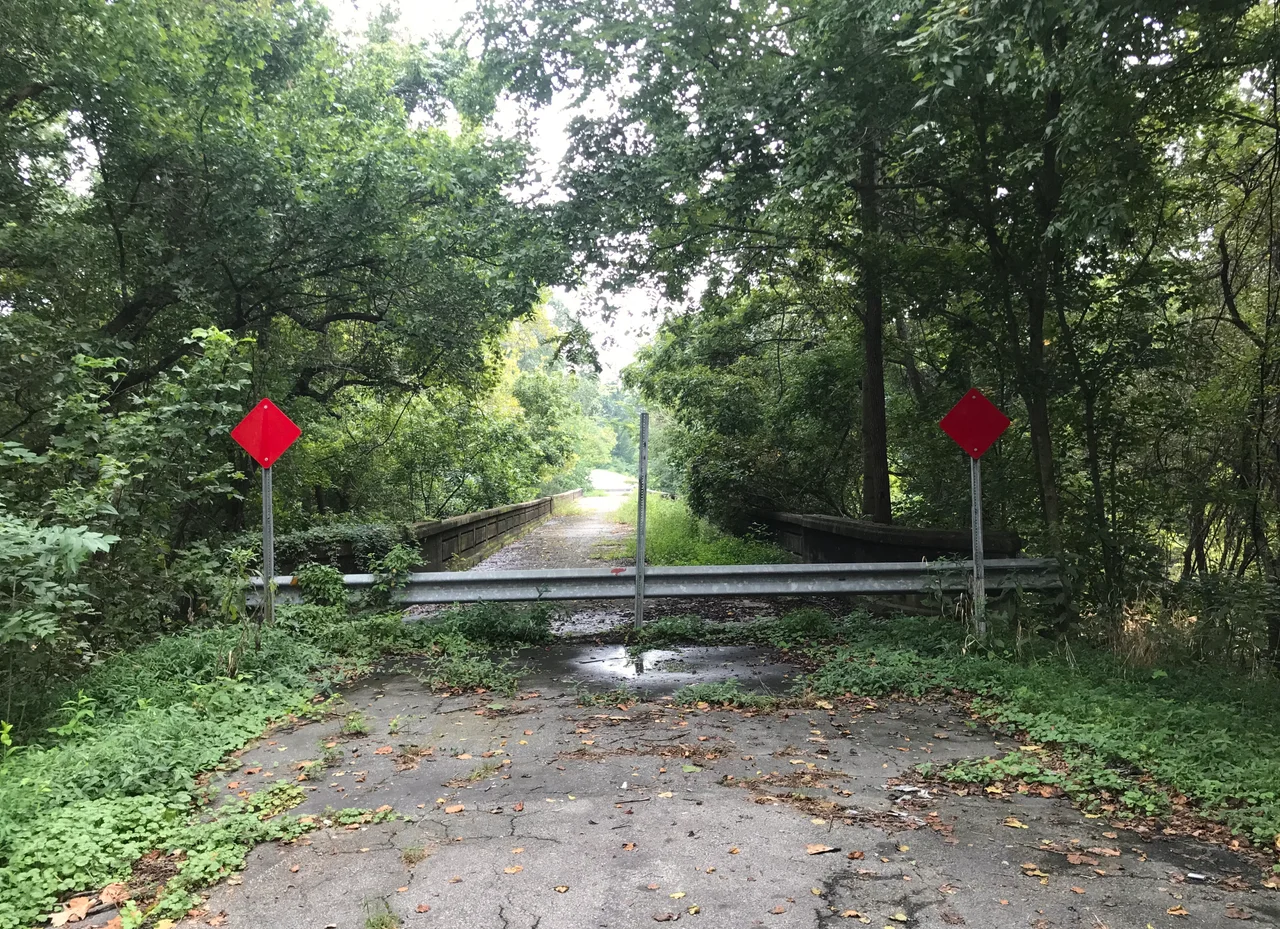

Mebane's Bridge
If you study contract law in an American law school, there is a good chance you have read about this bridge without knowing where it actually stands. The case is Rockingham County v. The Luten Bridge Co., decided in 1929 by the Fourth Circuit Court of Appeals, and it appears in casebooks under the heading "duty to mitigate damages." The bridge itself - three white concrete arches spanning 105 feet each, a single 18-foot lane across the Dan River where Fishing Creek joins it just outside Eden, North Carolina - was the literal pile of evidence over which the doctrine was argued. It still stands. The road that was supposed to use it never quite did.
The Industrialist's Bridge
Benjamin Franklin "Frank" Mebane Jr. ran textile mills in northern Rockingham County in the late 1800s and early 1900s, and by the early 1920s he had a new ambition. He owned a large tract called "the Meadows" between Spray and Draper, cut off from those towns by the Dan River, and he wanted to put a chemical plant there. The only modern crossing nearby was the North Carolina Highway 87 bridge, due in 1924, but it was a mile and a half upstream from his property. Mebane decided he wanted his own crossing. He also believed - this is the public-spirited version he offered - that a bridge there would broadly help industrial growth in the county. He thought the county should pay for it.
Three Hand-Picked Commissioners
In 1922 Mebane found three men to back his proposal: a small merchant named Josiah Ferre McCollum and two farmers, Thomas Ruffin Pratt and William Franklin Pruitt. Local newspapers later reported that Mebane entertained the trio at his mansion to talk them into running. Mebane himself was a Republican in a Democrat-dominated county; he quietly helped his three men get elected to the five-seat Rockingham County Board of Commissioners as Democrats. By March 1923, with a three-vote majority, the new commission formally declared the Fishing Creek crossing a "public necessity" and authorized up to 50,000 dollars to build it. They also voted 250,000 dollars to pave a road from Madison to Settle's Bridge - the western part of the county, where Pratt happened to live. To pay for it all, they raised the county tax rate from 0.95 to 1.35 percent and issued high-interest bonds that grew the county's debt by nearly a third.
Lawyers, Injunctions, and a Citizens Committee
Voters were furious. A group of lawyers went to North Carolina's 11th District Court and asked for an injunction. The injunction was denied on appeal. Opponents then organized as the "Citizens Committee" and packed the Rockingham County Courthouse for three mass meetings to denounce the plan. Speakers called the bridge a waste of money and a sign that special interests had captured the commission. One pro-bridge commissioner, R.B. Chance, resigned; he was replaced by an anti-bridge commissioner named George E. Barber. Discussion faded. Many residents went home assuming the unpopularity of the project would be enough to kill it. They were wrong. On January 7, 1924, Mebane's three commissioners voted to contract the Luten Bridge Company of Knoxville, Tennessee, for 39,670 dollars to build the crossing.
Rockingham County v. The Luten Bridge Co.
Soon after Luten began work, the commission - now under new pressure and a changing membership - voted that it would not honor the contract. Mebane urged Luten to keep building. Luten kept building, completed the bridge by November 3, 1924, and then sued Rockingham County for the full contract amount. The Fourth Circuit ruled in 1929 that Luten had a duty to mitigate damages once the county breached the contract; by continuing to pile up costs after the breach, the company had limited what it could recover. The case became a teaching staple - the textbook example of why an injured party cannot simply ignore the breach and run the bill. The bridge meanwhile sat marooned over the Dan for about a decade with no road on either end, occasionally used by groups of youths for picnics and parties. In 1935 the highway department graded dirt routes to it. In 1968 those roads were paved, and the structure was officially renamed Mebane's Bridge - sometimes Mebane's Folly. A sewage line was later strung across it. On November 23 and 24, 2003, the state closed the bridge to road traffic, and there it sits, three white arches and a contract-law footnote spanning the river it was never quite finished to cross.
Flight Context
Mebane's Bridge stands at 36.4717N, 79.7453W, on the Dan River near the confluence with Fishing Creek, in the western Eden, North Carolina, area of Rockingham County. From the air the three white arches read clearly against the dark river surface, and the original alignment of dirt-then-paved approach roads is still visible cutting across the wooded floodplain. The Dan River Steam Station coal-ash spill site lies about 1.5 nm east. Smith Reynolds (KINT) is about 35 nm WSW; Piedmont Triad International (KGSO) about 32 nm SW.
From the Air
Coordinates 36.4717N, 79.7453W; recommended viewing altitude 2,000-3,500 feet AGL to see the arch geometry. Visual landmarks: three white concrete arches across the Dan River at Fishing Creek confluence; closed to traffic; surrounding farmland and pine forest. Nearest airports: Smith Reynolds (KINT) ~35 nm WSW; Piedmont Triad International (KGSO) ~32 nm SW; Danville Regional (KDAN) ~16 nm ENE. The Dan River Steam Station and 2014 coal ash spill site lie just downstream and are visible in the same pass.
Nearby Stories
- Smith Reynolds Airport 10 km away
- Hanging Rock State Park 14 km away
- Occoneechee Speedway 16 km away
- World War Memorial Stadium 20 km away
- Pittsylvania County, Virginia 22 km away
- Floyd County, Virginia 29 km away
- Orange County Speedway 30 km away
- Red Hill Patrick Henry National Memorial 37 km away