
Occoneechee Speedway
Bill France was flying over Orange County, North Carolina in the late 1940s when he looked down and saw what he needed: a half-mile horse-racing oval cut into the red clay of an old farm, surrounded by enough flat ground to park a few thousand cars. France was building a new sport out of bootleggers and back-road brawlers, and he needed venues. The track had been laid down by Julian S. Carr, a textile magnate who raced horses on his Occoneechee Farm, but Carr's silks gave way to coveralls and the thoroughbreds gave way to flathead Fords. On the dirt half-mile that Carr had bulldozed for his horses, NASCAR ran one of its first races in 1949 — the third event of the inaugural season. Seventy-six years later, it is the only dirt track from that inaugural season still standing.
The Crown Jewel and Its Drivers
For most of its working life, the Occoneechee Speedway was a crown jewel of the early Grand National circuit, drawing the names that built NASCAR before NASCAR built itself a public mythology. Fireball Roberts won here. Junior Johnson, who had learned to drive running moonshine over the Brushy Mountains, raced here. Ned Jarrett, the quiet, deeply religious driver who would later become the voice of the sport on television, raced here. And Richard Petty - The King, then in his twenties, his cowboy hat and number 43 just beginning to become national shorthand - won the final race ever held at the track on September 15, 1968. By that time the speedway had been renamed Orange Speedway, the name change a small concession to a town that had grown weary of its Sunday racing. Hillsborough's Baptist and Methodist congregations had pushed back hard. Stock car racing on the Sabbath was, to a certain kind of churchgoer, exactly the wrong way to spend an afternoon.
The Sunday Problem
The campaign against Sunday racing was a grassroots affair, organized through pulpits and bulletin boards rather than through any organized political body, and Bill France understood what it meant. The town would not be moved. NASCAR could either schedule around the local opposition or move on. France moved on. He spent the next year looking for somewhere larger, faster, less hemmed in by congregations that did not want him there. He found his answer 350 miles to the southwest in Alabama, where the state government was happy to take federal money and clear pine forest for a 2.66-mile tri-oval that could hold 100,000 spectators. Talladega Superspeedway opened in September 1969, exactly one year after Petty's farewell at Occoneechee, and took the Hillsborough date on the schedule. The era of the small dirt half-mile was effectively over.
Returning to Forest
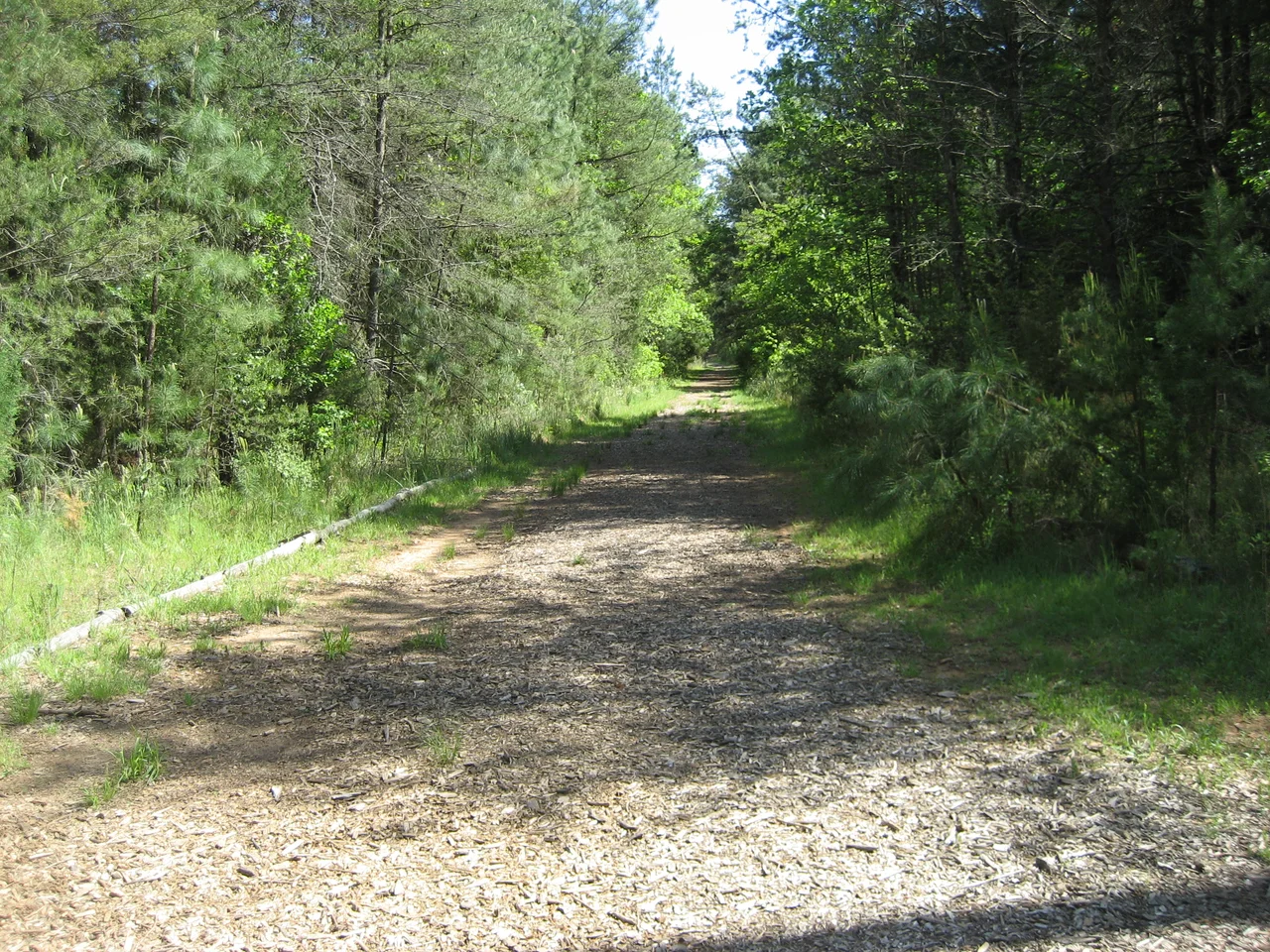
What happened next to Occoneechee is what happens to almost any built structure in the North Carolina Piedmont if you stop maintaining it. The pines moved in first, fast-growing loblollies sending up dense stands across the infield. Sycamores took the wetter ground near the Eno River, which curves along the eastern edge of the property. Within a decade the grandstands were furred with vines and the press box was missing its windows. The track itself - a mile oval after expansion in the early 1950s - remained legible as a long flat clearing under the canopy, but only barely. Today the site is 44 acres of trail and woodland, listed on the National Register of Historic Places since 2002, with the bones of the speedway still visible if you know how to look. The concession stand foundations are there. The ticket office is there. The lights are still mounted, rusted now, on poles tall enough to clear a long-vanished crowd. Visitors who walk the loop can read the geometry of a 1949 racetrack in the gentle banking and the placement of the turns.
The Track That Cars 3 Remembered
Pixar's animation team based the fictional Thomasville Speedway in Cars 3 partly on Occoneechee and partly on North Wilkesboro Speedway, two of NASCAR's lost dirt cathedrals. Richard Petty - in the role of Strip Weathers - voices a retired champion whose old track has been left to fall apart. The movie was released in 2017. The next year, NASCAR Hall of Famer Dale Earnhardt Jr. and Matthew Dillner began filming Lost Speedways for the Peacock streaming service, walking through Occoneechee with the people who still remember the smell of high-octane and the sound of Junior Johnson's Oldsmobile carving the turns. The Historic Speedway Group still hosts an annual car show on the grounds. For one weekend a year, engines run again on the old dirt, and the trail walkers stay home.
From the Air
Occoneechee Speedway sits on the Eno River just south of Hillsborough at 36.07°N, 79.09°W, on a flat terrace at about 500 feet elevation. From altitude the oval is hard to spot now under tree cover, but the surrounding terrain - the curve of the Eno, the I-85/I-40 interchange three miles north, and the urban edge of Hillsborough - make a recognizable signature. Recommended viewing altitude is 2,500 to 4,000 feet AGL. Nearest airports: Horace Williams Airport (KIGX) in Chapel Hill nine miles southeast, Raleigh-Durham International (KRDU) twenty miles east, and Burlington-Alamance Regional (KBUY) twenty miles west. Watch for the Class B shelf from RDU above 4,000 feet.
Nearby Stories
- Soul City, North Carolina 12 km away
- Alamance Battleground 14 km away
- Cary, North Carolina 14 km away
- 2014 Dan River Coal Ash Spill 26 km away
- Virginia International Raceway 32 km away
- Cherry Hill Plantation 32 km away
- Johnston County, North Carolina 38 km away
- North Carolina Aviation Museum 46 km away