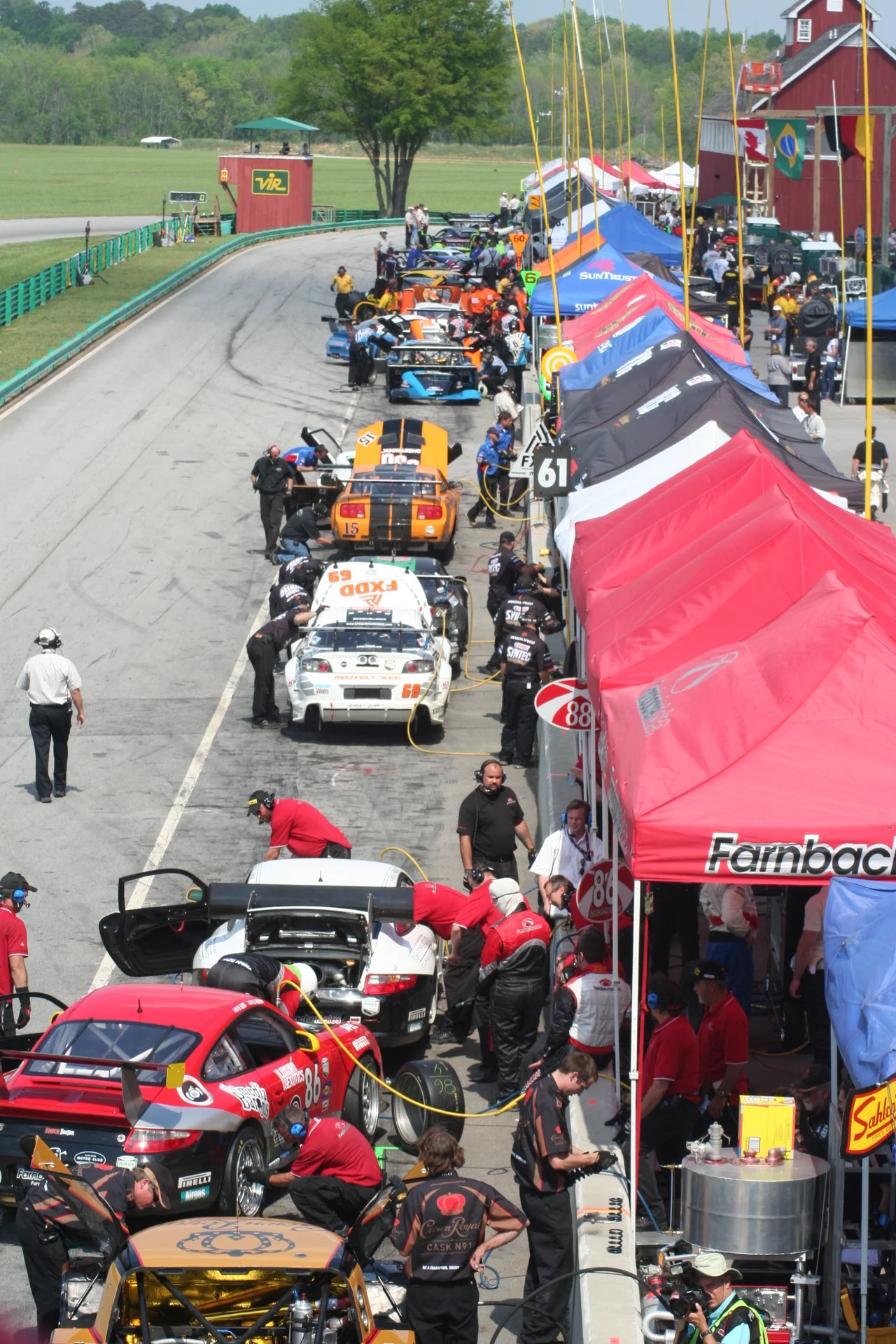

Virginia International Raceway
Carroll Shelby won the first feature race at Virginia International Raceway in August 1957, driving a Maserati 450S that had cost a private buyer the equivalent of a small town's annual budget. The track had been graded over the preceding summer by a small group of men with a single bulldozer, working a parcel of red-clay bottomland along the Dan River where the North Carolina line bites into Virginia at Alton. Seventeen years later, in 1974, VIR closed. The bulldozer crew had built something the local economy could not sustain, and the track sat overgrown for twenty-six years before two outsiders - Harvey Siegel from New York and Connie Nyholm - reopened it in 2000 as something American motorsport had never quite seen before: a road course you could buy a membership to.
Shelby and the First Era
The list of drivers who raced at VIR between 1957 and 1974 reads like a roster of mid-century American sports car racing: Briggs Cunningham, Walt Hansgen, Roger Penske, Mark Donohue, Dan Gurney, Parnelli Jones, Peter Revson, Janet Guthrie, Denise McCluggage, Wendell Scott. The Sports Car Club of America's National Sports Car Championship ran here from the opening through 1964, and the IMSA GT Championship visited briefly in 1971 and 1972. The track itself was unusual for its time, a fast and technical road course with serious elevation change in an era when most American road racing happened on converted airfields. The Climbing Esses - three quick direction changes uphill, each cresting at the apex and dropping into the next - punished drivers who arrived overspeed and rewarded those who could read a blind summit. The corner called NASCAR Bend got its name in 1966, when Richard Petty, David Pearson, and Wendell Scott all struggled with it during a Trans Am race. Scott was the first Black driver to win a NASCAR Grand National race; his presence at VIR is one piece of the racing history the track now markets carefully.
The Country Club Model
Siegel and Nyholm did not just rebuild the track when they bought the property in the late 1990s. They reconceived it. VIR Club memberships gave dues-paying drivers their own track days, garage space, lodging in cottages and a converted plantation house, and a pit lane that does not look like the average regional racing facility. Other tracks across the United States have since followed the model, but VIR was first, and the timing was right. The American boom in high-performance street cars - the 911 GT3s and Corvette Z06s and BMW M cars that came of age in the 2000s - created a class of owners who wanted somewhere to use them. Car and Driver magazine has held its annual Lightning Lap test at VIR since 2006, running the cars on a 4.1-mile variant called the Grand West Course and publishing lap times that have become the de facto benchmark for measuring how fast a street car actually is. The Lightning Lap leaderboard now functions, for one slice of the automotive press, the way the Nürburgring leaderboard functions for another.
The Course Itself
VIR offers six track configurations, of which two can be run simultaneously on opposite sides of the property. The Full Course is the most common - a flowing 3.27-mile loop with 17 named corners and roughly 130 feet of elevation change. Oak Tree, named for an actual tree that stood at the corner for decades before disease forced its removal in 2015, is the signature passing zone. Hog Pen leads onto the front straight, where the fastest cars touch close to 180 miles per hour. Roller Coaster is the small downhill flick that Americans like to call a scaled-down Corkscrew, after the famous corner at Laguna Seca. There is also a corner called The Bitch, which appears on no signage but which every track instructor will tell you about. The IMSA WeatherTech SportsCar Championship returned in 2014 with its GT-only race at VIR, the Michelin GT Challenge, and the American Le Mans Series held its inaugural race here in September 2012, where Klaus Graf set a track record in the Muscle Milk LMP1 car. The first-generation Le Mans prototypes that touched 200 miles per hour down the back straight are gone now, replaced by GT3 cars that feel almost as fast and look better doing it.
Tragedy and Continuance
There have been at least four deaths in VIR's history, three of them since the reopening. The most recent was in August 2008, when fourteen-year-old Toriano Wilson was killed in a US Rookie Cup motorcycle race. He had been the kind of teenager who turned up to junior club races on borrowed bikes and finished consistently on the podium. The track held a memorial. Motorsport reckons with these losses the way it always has - with safety improvements that come too late for the person who needed them, and with the next race scheduled for the following weekend. Top Gear filmed an episode at VIR in 2010. Patrick Dempsey and Caitlyn Jenner raced there in 2013. Reba McEntire showed up in 2012 to watch her son race. The track now exists in two registers at once: a serious professional venue for the IMSA championship and a country club where retired surgeons drive their Porsches in the afternoon sun while the Dan River runs by, quiet, at the foot of the climbing esses.
From the Air
Virginia International Raceway sits on the Dan River at 36.56°N, 79.20°W, about a half-mile north of the North Carolina line near Milton. From altitude the 3.27-mile road course is visible as a complex serpentine cut through wooded river bottom; the long back straight runs roughly east-west. Recommended viewing altitude 3,000 to 5,000 feet AGL. Surrounding terrain is rolling Piedmont farmland at 500-700 feet elevation. Nearest airports: Danville Regional (KDAN) 10 miles north, Person County Airport (KTDF) 18 miles south, and the private airstrip at VIR itself for arriving competitors. Be alert for race weekend traffic and TFRs during the IMSA event in August.
Nearby Stories
- Battle of Guilford Court House 9.5 km away
- Pittsylvania County, Virginia 14 km away
- Martinsville Speedway 18 km away
- Granville County, North Carolina 21 km away
- Alamance County, North Carolina 22 km away
- Ferrum College 29 km away
- Purefoy-Dunn Plantation 34 km away
- Appomattox-Buckingham State Forest 73 km away