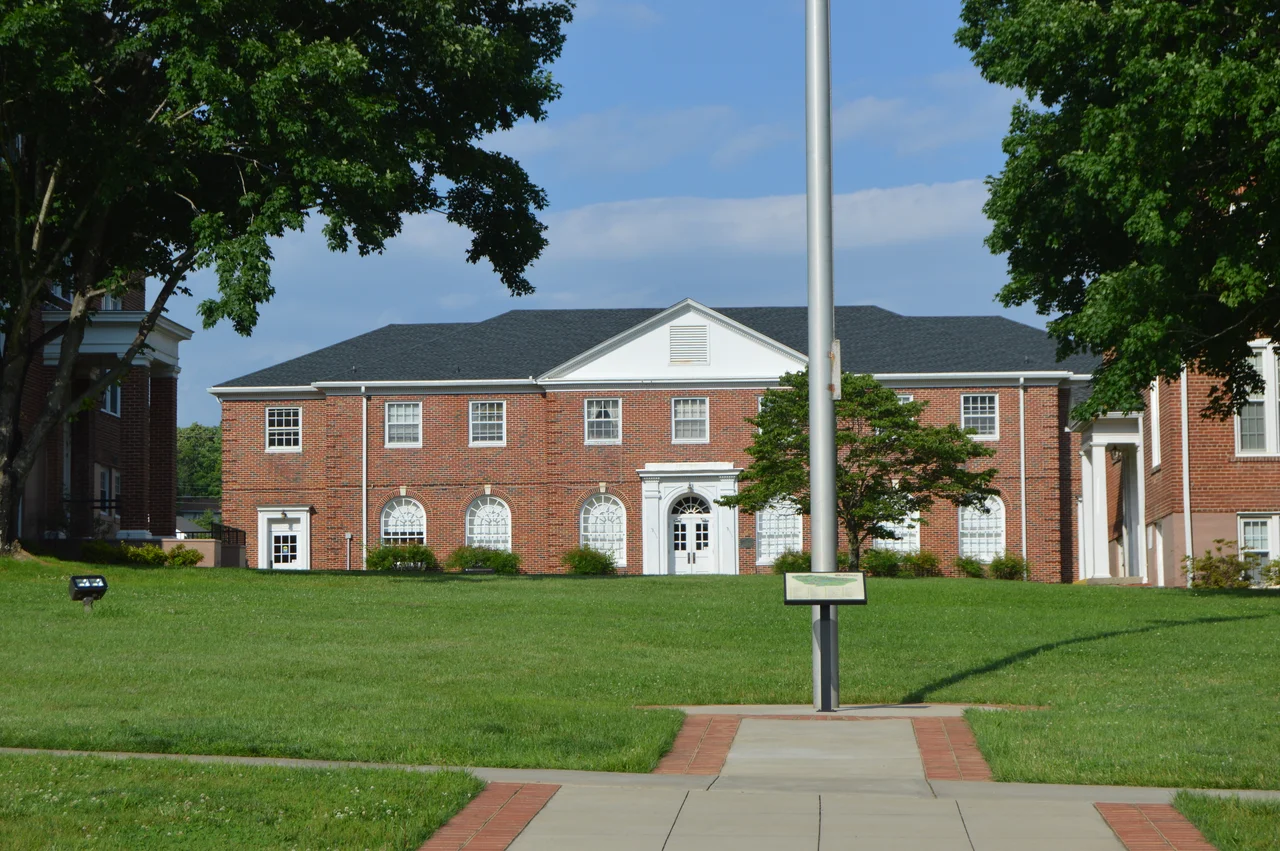

Ferrum College
In 1909, a Methodist missionary named Mrs. Lee Britt had already gathered $1,200 - a real sum in 1909 dollars - toward starting a school somewhere in southern Virginia for the children of rural mountain families who could not get any other kind of education. She just needed a place to put it. In 1911 the Norfolk and Western Railway chose a small village called Ferrum, between Roanoke and Winston-Salem, as the location for a new train depot. That decision settled the matter. A local farmer named George Goode sold the trustees eighty acres; the villagers donated another fifty. In the fall of 1914 the first section of John Wesley Hall opened with one classroom, one term, and a presiding elder named Benjamin Beckham who had moved his entire family to the site to make the school go. In 1917 the school graduated its first student: Berta Thompson, born in 1897 in these mountains, who left Ferrum to become a public school teacher. Ferrum College today enrolls around 800 students, offers 54 majors plus four graduate programs, and still stands on the same ridge where Berta Thompson collected her diploma.
A Mountain Mission School
The Virginia Conference Woman's Home Missionary Society of the Methodist Episcopal Church started Ferrum Training School in 1913 to serve children of underprivileged mountain families in the Blue Ridge foothills. The phrase mountain mission school was completely literal: the school existed because no public schools served these rural hollows. The railroad helped. Norfolk and Western built a cinder road from the Ferrum Depot up to the school, making it easier for families to deliver children for the first term. Construction began in 1914 with John Wesley Hall, a brick building large enough for classrooms and student housing. The trustees added 96 acres in 1916. By 1917 Berta Thompson - whose name and dates, 1897 to 1975, are preserved in the college history - became the first diploma recipient. Most of the early students came from no further than a wagon's day of travel. The mission was not abstract. It was for these children, on this ridge, who otherwise would not be educated.
From Training School to Junior College
By 1926 the trustees had decided to push Ferrum upward. Local public schools were beginning to serve elementary education in the surrounding villages, including a new elementary school in Ferrum itself in 1928. Between 1926 and 1935 the institution moved gradually away from primary instruction and toward post-secondary work, adding occasional religious training courses for older students. President James A. Chapman began accreditation efforts after 1935. In 1940 the institution renamed itself Ferrum Training School - Ferrum Junior College, a hybrid name reflecting the hybrid mission. By the late 1940s the secondary high school division was winding down; it closed completely in 1955. The school was now formally Ferrum Junior College, focused on two-year degrees and preparation for transfer to four-year institutions. The Methodist Episcopal Church merger in 1939 - healing the 1844 split over the moral status of slavery - had brought the church and the school into a new national configuration as well.
The Arthur Years
C. Ralph Arthur became president in 1954, and the school's growth under his leadership was remarkable. Arthur pressed the Methodist Church for stronger financial support, replaced under-credentialed faculty with professionally trained college instructors, and convinced the trustees to build housing on campus so the new faculty would actually live there. Student population jumped from 238 in 1958 to 646 in 1962 - more than two and a half times in four years. By the 50th anniversary celebrated in 1963-1964, Ferrum had 799 students and 50 full-time faculty. Hank Norton joined as an athletic coach in 1960 and built the foundation of Ferrum's later football and wrestling traditions across more than three decades of work. Arthur died of cancer in 1970; his funeral was held in the new Vaughn Chapel, classes were suspended, and all students gathered to pay respects. He is interred in a vault beneath the chapel bell tower - the only college president buried inside the building he helped raise.
Integration and the United Methodist Church
In 1963 the Methodist Church Annual Conference recommended that its Virginia schools enroll students without regard to race. In 1967 Ferrum welcomed its first four African American students: Alice Baker and Fred Dunnings of nearby Rocky Mount, Jerry Venable from Staunton, and Allen White from Philadelphia. The Methodist mergers of 1968 created the United Methodist Church as we know it now, and Ferrum continued under its auspices. The school made the move from junior college to four-year college, adopting the name Ferrum College in 1971 and awarding its first bachelor's degrees in 1976. Today the affiliation with the Virginia Annual Conference of the United Methodist Church continues - one of the longest-running such relationships in American higher education - and the religious heritage shapes the campus culture even as the curriculum has broadened well past its founding focus. The school continues to serve Appalachian Virginia, drawing a high percentage of first-generation college students from the surrounding region.
The Panthers and the Campus
Ferrum's athletic teams compete as the Panthers in NCAA Division II in Conference Carolinas - 11 men's teams and 14 women's teams. The football team is informally called the Black Hats. The campus itself is listed on both the National Register of Historic Places and the Virginia Landmarks Register, a recognition not just of John Wesley Hall but of the larger architectural ensemble that the trustees built over more than a century. The campus sits in the Blue Ridge foothills near Rocky Mount in Franklin County - the moonshine country immortalized in Matt Bondurant's novel The Wettest County in the World and in the 2012 film Lawless. Berta Thompson would still recognize the ridge. The buildings have multiplied. The mission - educating children of the Blue Ridge who would not otherwise be educated - has aged into something more complex but not less essential. Eight hundred students walk the same paths each fall, looking out over the same mountains.
From the Air
Ferrum College sits at 36.927 north, 80.024 west, at about 1,300 feet elevation in the Blue Ridge foothills of Franklin County, southern Virginia. The campus is near the small village of Ferrum, between Roanoke and Rocky Mount. Blue Ridge Airport (KMTV) at Martinsville is about 30 miles southeast. Roanoke-Blacksburg Regional Airport (KROA) is about 30 miles north and provides commercial service. From cruising altitude look for the small cluster of campus buildings on a ridge, with the Blue Ridge mountains rising to the west and the Smith Mountain Lake area to the northeast.
Nearby Stories
- Norwich Historic District 0.6 km away
- Martinsville, Virginia 12 km away
- Radford, Virginia 15 km away
- Wreck of the Old 97 17 km away
- Poplar Forest 19 km away
- Hargrave Military Academy 20 km away
- Draper's Meadow Massacre 23 km away
- Chang and Eng Bunker 33 km away