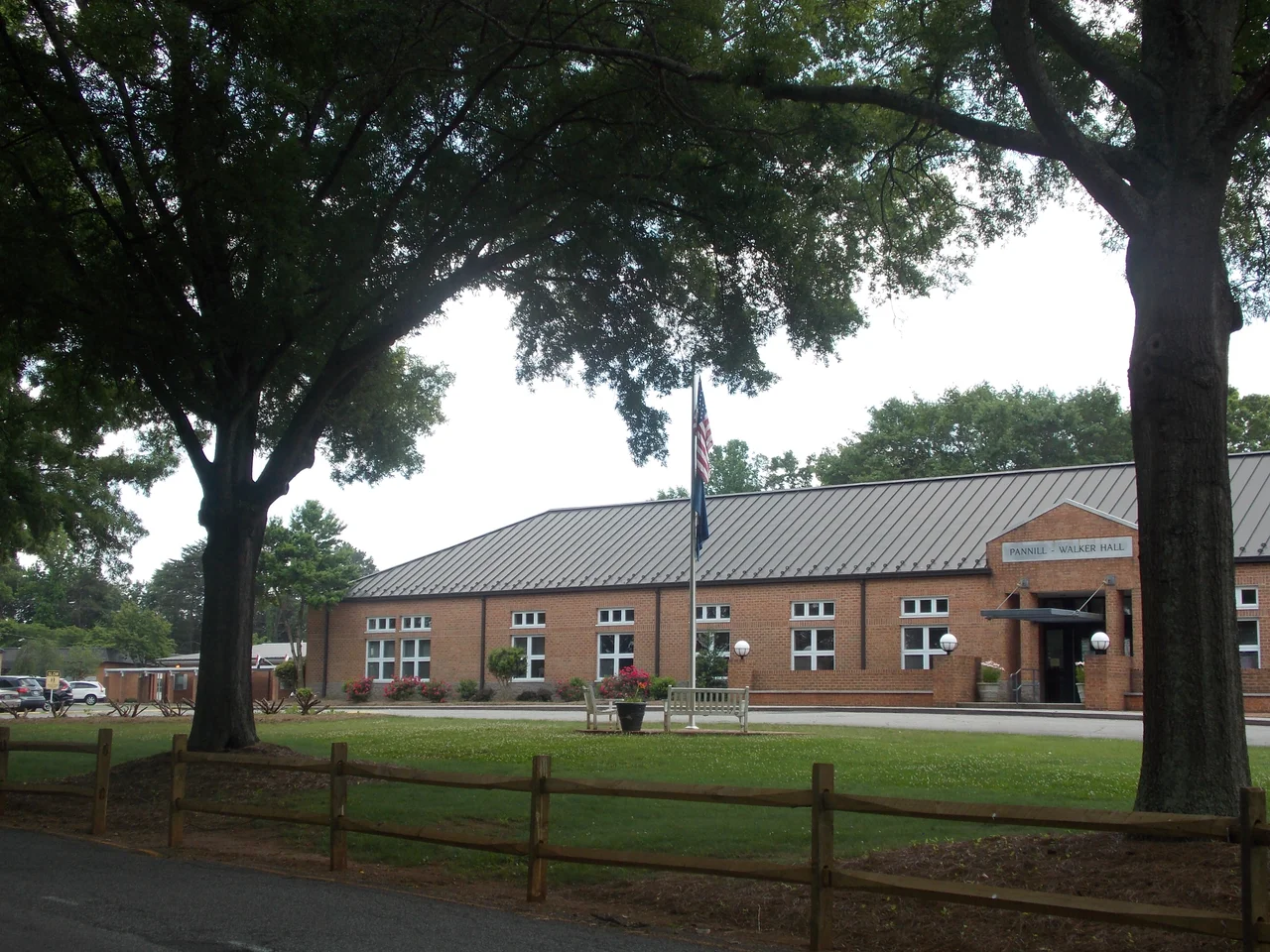

Martinsville, Virginia
In the 1980s, Martinsville quietly claimed something extraordinary: more millionaires per capita than any city in America. The wealth came from sweatshirts. From nylon, knit textiles, and the chair-and-bedroom-set furniture business. From the DuPont plant that opened in 1941 to make nylon filament for parachutes and ended up making the fabric for half a generation's American hoodies. Then the 1990s came, and the trade treaties came, and the factories went. Thousands of jobs moved offshore. The Sweatshirt Capital of the World became something nobody had bothered to coin a phrase for: a small Virginia city - 13,485 people in the 2020 census - that had once been very rich, and now wasn't. Martinsville today is the kind of place where Berkshire Hathaway owns the daily newspaper, where the NASCAR speedway just outside town still draws sellout crowds twice a year, and where a 2019 city council voted unanimously to give up city status entirely - then reversed itself in 2023 and chose to stay.
Joseph Martin's Plantation
The city is named for Joseph Martin, a Revolutionary War general, Native American agent, and frontier explorer born in Albemarle County. Martin built his Scuffle Hill plantation on the Smith River near the present-day southern city limits and lived there until his death in 1808. His friend Patrick Henry, who lived briefly at Leatherwood Plantation a few miles away during his time as governor, often visited. Like every plantation of the era, Scuffle Hill ran on the unpaid work of enslaved African Americans whose names mostly do not survive in the public record. The man the town was named for negotiated with the Cherokee on behalf of the new American government while running a slave-worked tobacco farm at home - a combination that fits awkwardly together but that was, in its time, completely routine. The town that grew around the plantation took his surname. Scuffle Hill is gone. The Smith River still flows past.
Plug Tobacco, Then Furniture, Then DuPont
For decades after the Civil War, Martinsville's main business was the manufacture of plug chewing tobacco. The Henry County area became known as the Plug Tobacco Capital of the World. Local families - the Spencers, the Gravelys, the Ruckers, the Wittens, the Lesters, the Browns - founded firms, profited handsomely, and then watched the rising tobacco trusts of R.J. Reynolds and James Buchanan Duke buy out their companies in the early twentieth century and, in many cases, simply shut them down. The lawsuit against American Tobacco Company that broke up the trust was driven in part by exactly those tactics. Furniture replaced tobacco as the city's industry. Then DuPont arrived in 1941, built a large nylon filament plant, and seeded a textile boom that ran for fifty years. The Cold War listed Martinsville as a Soviet strategic-bombing target, a detail townspeople have lived with quietly ever since.
The Martinsville Seven
In January 1949, seven African American men were arrested in Martinsville and charged with the rape of a white woman. All seven were convicted by all-white juries in trials that took place under enormous pressure for swift conviction. All seven were executed in Virginia's electric chair on February 2 and 5, 1951 - the largest mass execution for rape in twentieth-century American history. The cases became a national civil rights cause. NAACP lawyers argued that the death penalty was being applied to Black defendants and never to white ones charged with the same crime. The Supreme Court declined to hear the appeals. In August 2021, Governor Ralph Northam issued posthumous absolute pardons to all seven men - Frank Hairston Jr., Howard Hairston, James Luther Hairston, Joe Henry Hampton, Booker T. Millner, Francis DeSales Grayson, and John Clabon Taylor. The pardons did not undo anything. They at least named what had been done.
Whitney Shumate and the Mill Town Houses
Through the mid-twentieth century, business leader Whitney Shumate organized a private effort to clear and rebuild a section of Martinsville called Mill Town - substandard rental housing originally built for nineteenth-century cotton mill workers. Shumate and his associates bought about fifty houses in North Martinsville and rebuilt them with sound materials and full city services, making it possible for middle-class Black residents to buy homes for the first time. The local newspaper's editorial after his death credited him with redeveloping what was once known as Martinsville Cotton Mill Village using private capital rather than federal aid. The Fayette Street Historic District, listed on the National Register, captures part of the African American community that lived through those changes. The Mill Town story is one of the more interesting in a city full of complicated history: a private effort, in the segregated South, that did not solve segregation but did improve specific people's specific houses.
The City That Almost Stopped Being One
Virginia's independent cities are unusual in American government: they are entirely separate from the surrounding county. Martinsville became independent in 1928, taking itself out of Henry County's jurisdiction. By the late 2010s the math of running a small independent city had grown punishing. Population had fallen below 14,000. The tax base had eroded. On December 10, 2019, the Martinsville city council voted unanimously to begin reverting from a city to a town - a process that would have folded Martinsville back into Henry County. The reversion required approval by a three-judge panel. It dragged on. On January 10, 2023, the city council voted 3-2 to end the process and stay independent. Martinsville is still a city. The arrangement remains odd: Martinsville is officially the county seat of Henry County, but Henry County's actual offices are in Collinsville. The county wraps around the city like a doughnut. The relationship continues, complicated and persistent, the way relationships do.
From the Air
Martinsville sits at 36.686 north, 79.869 west, in the southern Virginia Piedmont near the North Carolina state line. Blue Ridge Airport (KMTV) is nine miles outside the city for general aviation. The two commercial airports are Roanoke-Blacksburg (KROA) about 51 miles north and Piedmont Triad International (KGSO) about 48 miles south at Greensboro NC. The distinctive paperclip-shaped Martinsville Speedway lies just outside the city at Ridgeway, the easiest landmark from cruising altitude. US-58 and US-220 cross at Martinsville.
Nearby Stories
- Ferrum College 4.1 km away
- Wreck of the Old 97 8 km away
- Pulaski County, Virginia 24 km away
- Chang and Eng Bunker 24 km away
- Chinqua Penn Plantation 25 km away
- Battle of Shallow Ford 34 km away
- Pyle's Massacre 37 km away
- Red Hill Patrick Henry National Memorial 51 km away