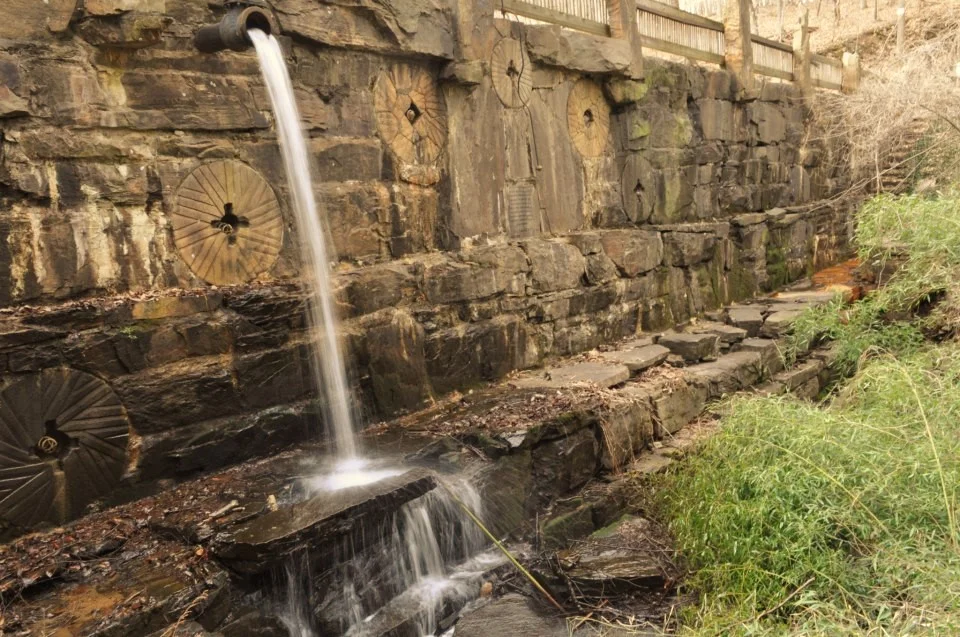

Chinqua Penn Plantation
The name reads like a misspelling and is in fact a pun. Chinqua Penn - the manor Thomas Jefferson "Jeff" Penn and Margaret "Betsy" Schoellkopf Penn built in the 1920s on a Rockingham County hillside about 25 miles north of Greensboro - splices the family name onto chinquapin, a small dwarf chestnut that once grew in clouds across the Carolina Piedmont before blight took the American chestnuts down. The Penn fortune that paid for the manor came from a less wholesome native crop. Jeff Penn was the heir to the Penn family tobacco interests, the same Penn Tobacco Company that American Tobacco - the Duke combine that pressed out Lucky Strike - absorbed in 1911.
Tobacco Money, Carolina Soil
Jeff and Betsy left Penn's Store in Patrick County, Virginia, when they came south. Betsy was a Schoellkopf - her father Arthur chaired the Niagara Falls Power Company and served as mayor of Niagara Falls, New York - and money from Niagara power flowed alongside money from Carolina tobacco into the brick walls, the picture window with its joined coats of arms, the gardens and the furnishings drawn from thirty countries. Jeff doubled the fortune in stocks and bonds through the Depression, ran a dairy of Holstein cattle, and later raised Black Angus. The tobacco that started it all was grown, picked, cured, and stripped by generations of laborers - enslaved people through 1865, then sharecroppers and tenant farmers in the long shadow of emancipation. The Penn manor is what tobacco bought. The fields and the people who worked them are what made the money. Both parts belong to the story.
Forty Years of Touring
Betsy outlived Jeff by nearly two decades. She turned increasingly to philanthropy and community work, founding the Betsy-Jeff Penn 4-H Educational Center on part of the estate. In 1959 the Penns gave the house, its outbuildings, and ultimately its furnishings into the trusteeship of the University of North Carolina System. For decades visitors paid admission and walked through rooms unchanged since the 1940s - the picture window with the Penn and Spencer crests, the inlaid floors, the art objects from every continent. The thirty-country art collection became a small civic identity for Reidsville. Then the costs caught up to the academic institution, and N.C. State closed the site to tours.
The Phelps Era
In August 2006, Calvin Phelps - founder of Renegade Tobacco Company - bought the estate from N.C. State. He said he planned to build a replica in Davie County, keep Chinqua Penn as a second home, and run the original as a tourist attraction. The plan ran on tobacco money that worked only as long as Renegade stayed outside the 1998 Master Settlement Agreement and could undersell the cigarette companies that had to pay the per-carton surcharge. When the government began requiring exempt tobacco companies to pay escrow fees, the model wavered. Phelps mortgaged the estate to cover debt. Bank of Granite cut off his credit. Federal agents seized the property on September 28, 2010, as part of bankruptcy proceedings.
The April 2012 Auction
On April 25 and 26, 2012, the contents of Chinqua Penn went under the gavel at the Greensboro Coliseum Complex - eight decades of Penn-family collecting dispersed across two days by Leland Little Auction and Iron Horse Auction. The sale raised roughly 3.4 million dollars. The Museum and Archives of Rockingham County opened that August with certain auction pieces on display, but the house itself sat empty. In September 2013 Chinqua Penn went into foreclosure. SunTrust Bank bought it for 1.4 million dollars and resold it - SunTrust had wanted 1.9 million - to a private buyer for considerably less. It is a private residence today, closed to the public since the last tour day on March 17, 2012. Farmland adjoining the property still operates as a North Carolina State experimental agricultural station.
Flight Context
Chinqua Penn sits at 36.3844N, 79.70W, in northern Rockingham County a short distance west-southwest of Reidsville. From cruise the estate reads as a compound of formal gardens and a manor block set in pastureland, with the surrounding farmland still in cattle and row crops. Piedmont Triad International (KGSO) lies about 28 nm SSW, and Smith Reynolds (KINT) at Winston-Salem about 35 nm WSW.
From the Air
Coordinates 36.3844N, 79.70W; recommended viewing altitude 3,000-5,500 feet AGL. Visual landmarks include the manor and its formal-garden geometry standing out against the surrounding pasture and woodlot, plus the cattle paddocks to the west. Nearest airports: Piedmont Triad International (KGSO) ~28 nm SSW; Smith Reynolds (KINT) ~35 nm WSW; Danville Regional (KDAN) ~18 nm N; Raleigh-Durham (KRDU) ~70 nm ESE. The site is closed to the public - this is a flyover, not a visit.
Nearby Stories
- Alamance Battleground 10 km away
- Bennett Place 11 km away
- Hanging Rock State Park 14 km away
- Orange County Speedway 15 km away
- 2004 Hendrick Motorsports Aircraft Crash 16 km away
- Richard Childress Racing Museum 17 km away
- Danville, Virginia 21 km away
- Staunton River State Park 40 km away