.jpg)
Richard Childress Racing Museum
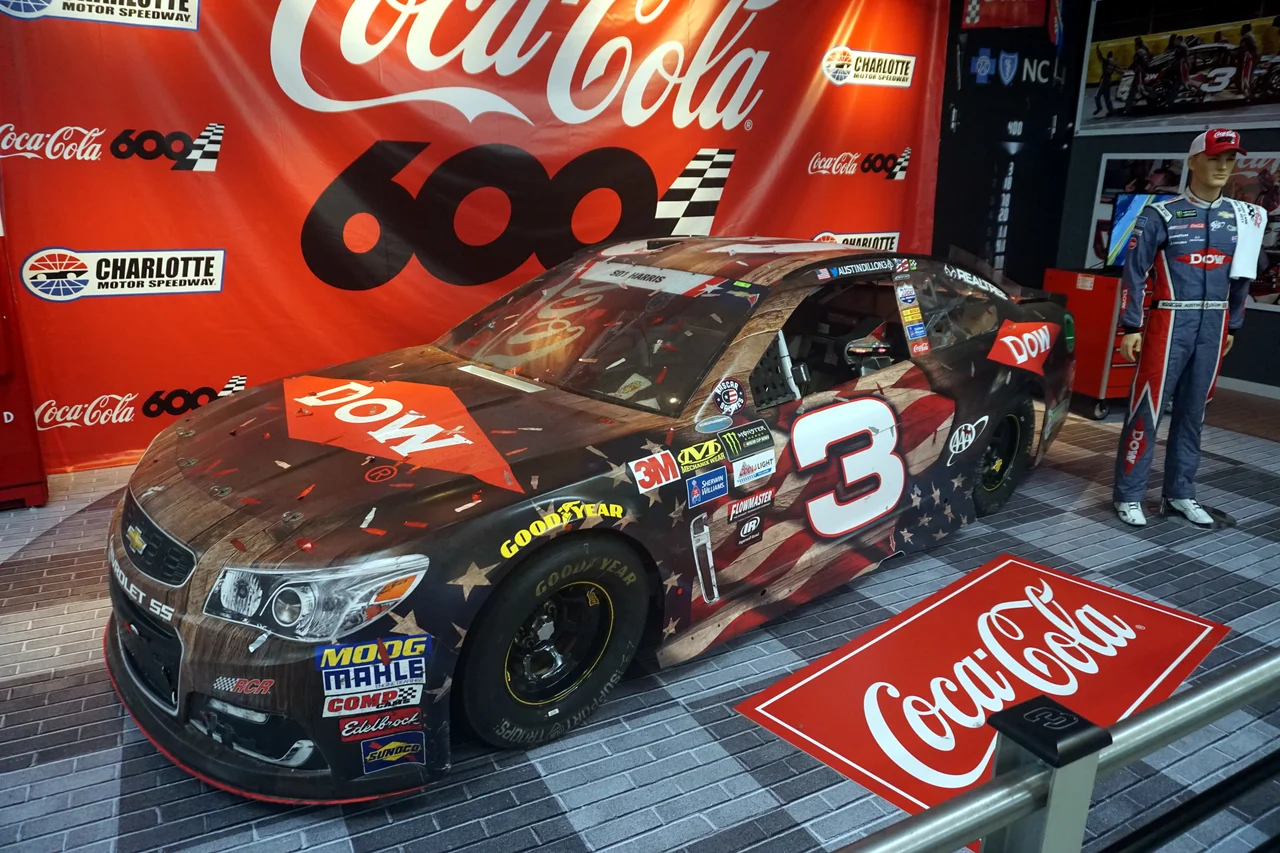
There is one number in NASCAR that you do not have to explain. Three. Block letters, white outline, black quarter panel. The car that won the 1998 Daytona 500 in its twentieth attempt sits inside a former engine workshop in Welcome, North Carolina, and most of the other cars around it are versions of the same car, because Dale Earnhardt drove a lot of laps for Richard Childress and Richard Childress kept them. The Richard Childress Racing Museum opened in May 2003. It contains the largest collection of Earnhardt's black GM Goodwrench Chevrolets anywhere in the world.
The Building Was the Team
The galleries are not retrofitted exhibition halls. They were the engine workshop, the fabrication room, and the research and development bay where the cars were actually built. Richard Childress's own office has been preserved as part of the museum. Walking through is closer to walking through a working race shop frozen mid-thought than visiting a curated display. The team did not vacate so the museum could move in; the museum is what the team left behind when it expanded into newer facilities elsewhere on the Welcome, North Carolina, campus. Covering 47,000 square feet, the building still feels like somewhere work used to get done at three in the morning.
Fifty Cars and an Operating Engine
The museum holds more than fifty stock cars. More than half were driven by Earnhardt. The famous black No. 3 cars dominate, including the 1998 Daytona 500 winner and the 1995 Brickyard 400 winner, along with the brightly colored cars Earnhardt drove in NASCAR All-Star Races between 1995 and 2000 when sponsors briefly took over the paint scheme. Beyond Earnhardt, there are cars driven by Childress himself, Austin Dillon, Robby Gordon, and Kevin Harvick, plus a truck campaigned by Mike Skinner. One of the cars carries particular weight: Harvick's first NASCAR Cup Series winner, taken to victory lane at Atlanta Motor Speedway in 2001, the race that came shortly after Earnhardt's death at Daytona. As of 2004, every car in the museum still had an operational engine.
Beyond Cup
The museum is not only about Cup Series glory. It displays cars from the NASCAR Xfinity Series, the NASCAR Camping World Truck Series, and the ARCA Racing Series, the rungs that drivers and teams use to develop talent before reaching the top tier. One of Earnhardt's car haulers, the enormous transporter rigs that move cars from shop to track, is parked among them. For anyone who has only ever seen a race car through a television frame, the scale and the engineering up close are startling: the seam welds, the rolled aluminum bodies, the sponsor decals layered like sediment over older liveries.
The Conservation Gallery
Past the racing displays is a hunting and conservation gallery that surprises some visitors. It holds mounted animals taken by Childress on hunting trips, including brown bears, a cougar, a Cape buffalo, elk, a polar bear, and white-tailed deer. The juxtaposition is part of the story RCR has always told about itself: this is a country team in a country sport. The gallery is framed as conservation rather than trophy display, and in 2003 the museum donated one dollar of every admission ticket to a group of conservation organizations that included Ducks Unlimited, the National Wild Turkey Foundation, the North Carolina Wildlife Habitat Foundation, and the Rocky Mountain Elk Foundation. Visitors of more than one mind on the ethics can take both halves of the museum on their own terms.
Why Welcome
The town is named Welcome, and that is not a tourist board's invention. It sits just off Interstate 85 in Davidson County, between Lexington and Winston-Salem, in the foothills where stock car racing grew out of moonshine running and Sunday-afternoon county-fair tracks. NASCAR's modern factory shops have largely consolidated into a corridor between Mooresville and Concord, but Childress kept RCR's headquarters here, on family land, near where he grew up. The museum makes the geography explicit. You leave the interstate, drive a few minutes through rolling fields, and arrive at a low brick complex that looks less like Daytona than like the place Daytona winners were made.
From the Air
Located at 35.91 degrees north, 80.25 degrees west, in Welcome, North Carolina, in Davidson County, about 15 miles south-southwest of Winston-Salem and just west of Interstate 85. The site lies in the Piedmont foothills; in clear weather the campus complex is visible as a cluster of low industrial-style buildings against rolling agricultural land. Best viewed below 3,000 feet AGL. Nearest tower-served airports are Smith Reynolds (KINT) at Winston-Salem about 18 miles north and Piedmont Triad International (KGSO) at Greensboro about 30 miles east. Davidson County Airport (KEXX) at Lexington is unattended and lies a few miles south. Watch for general aviation traffic along the I-85 corridor.
Nearby Stories
- High Rock Lake 9.5 km away
- Greensboro Massacre 14 km away
- Lake Norman 17 km away
- Hanging Rock State Park 21 km away
- Chinqua Penn Plantation 22 km away
- 2025 North Carolina Cessna Citation II Crash 22 km away
- Galax, Virginia 51 km away
- Deep River Camelback Truss Bridge 53 km away