
2004 Hendrick Motorsports Aircraft Crash
Jimmie Johnson won the race that afternoon and didn't celebrate. He couldn't, because by the time the checkered flag fell at Martinsville Speedway on October 24, 2004, word had reached NASCAR's mobile operations trailer that a Beechcraft King Air 200 belonging to Hendrick Motorsports — the team Johnson drove for — had not landed at the Blue Ridge Airport that morning. The plane carried ten people. Among them were the team president, his twin daughters, the team owner's only son, the team's chief engine builder, an executive from a sponsor, another driver's pilot, and the two crew members who had been flying the King Air. Wreckage was eventually located on Bull Mountain in Patrick County. None of the ten had survived.
The Manifest
It is right to name them. John Hendrick, 53, the president of Hendrick Motorsports and the older brother of team owner Rick Hendrick. Ricky Hendrick, 24, Rick's only son, a former Busch Series driver and the heir who was just stepping into the management side of the company. Kimberly and Jennifer Hendrick, 22, John's twin daughters. Jeff Turner, 47, the team's general manager. Randy Dorton, 51, the chief engine builder whose engines had won championships for Jeff Gordon and Terry Labonte. Joe Jackson, 50, an executive at DuPont — Gordon's longtime sponsor — and Scott Lathram, 38, a pilot who flew for Tony Stewart and was riding along that morning. The flight crew were Captain Richard Tracy, 56, and First Officer Elizabeth Morrison, 32. They were going to a race.
The Flight
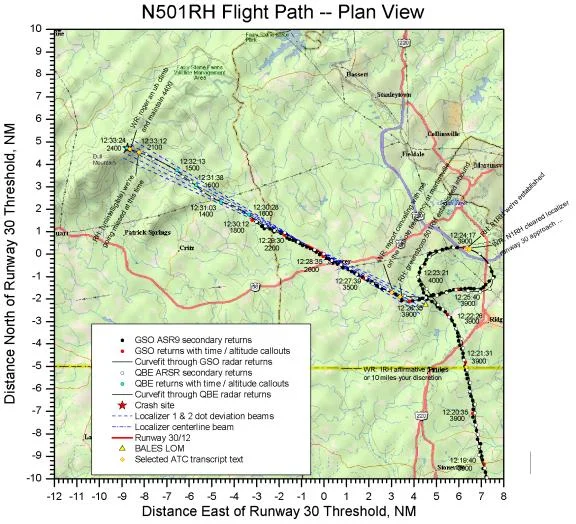
The King Air left Concord, North Carolina, at 11:57 a.m. EST. Foggy low-overcast conditions blanketed the Blue Ridge that morning, the kind of weather pilots curse but fly through every day with the help of instrument approaches. The destination was Blue Ridge Airport (KMTV) near Martinsville, Virginia, where Hendrick Motorsports personnel routinely flew in for the NASCAR race weekends. The pilots planned the localizer 30 approach. Due to traffic ahead, they entered a hold over the initial approach fix called BALES at 4,000 feet. Air traffic control then cleared them down to 2,600 feet for the approach. The King Air flew over BALES at the old altitude and didn't begin descending until two miles past it. It overflew the airport, descended below the minimum descent altitude, and was four miles past the runway when the pilots radioed at 12:33 p.m. that they were going missed.
Bull Mountain
Nine seconds after the missed-approach call, the plane disappeared from radar. The King Air had not climbed. According to the NTSB's eventual report, it had descended to 1,800 feet and struck Bull Mountain near Stuart, Virginia — about 30 miles southwest of the destination airport, deep in Patrick County's Blue Ridge foothills. The Civil Air Patrol search team that finally found the wreckage that night reported a scar of moved earth on the mountainside, suggesting the airplane struck the slope and the impact propelled debris upward to the summit. The bodies of the ten were recovered at 11:05 p.m. The NTSB ultimately ruled pilot error: the crew had failed to execute the instrument approach properly and had failed to use available navigation aids to confirm the airplane's position.
The Race That Did Not Stop
The Subway 500 was halfway run when NASCAR officials at the speedway began hearing the first reports. They chose not to red-flag the race. Drivers were not told. The Hendrick crew — Jeff Gordon, Jimmie Johnson, Terry Labonte, Brian Vickers — were in their cars, running. Jimmie Johnson took the checkered flag at 4:33 p.m. and was directed not to victory lane but to NASCAR's mobile operations trailer, where Rick Hendrick and Mike Helton were waiting with the news. There was no victory celebration. There was no champagne. There was Rick Hendrick, who had buried his brother and his only child — Ricky was engaged to be married to Emily Maynard at the time of his death — all within the same hour. The 300 people who gathered for a candlelight vigil at the Hendrick museum in Concord, North Carolina, the next night was the beginning of a grief the sport had never managed before in quite this concentrated a form.
What They Left Behind
The week after, the Atlanta Motor Speedway lowered its flags to half staff before both NASCAR races. All four Hendrick cars carried tribute hoods. The number 0 car that Ward Burton drove for Hendrick-affiliated Haas CNC Racing carried one too. When Jimmie Johnson won at Atlanta, he and his crew turned their caps backward in victory lane because Ricky Hendrick used to wear his cap backward. Every Hendrick driver who has won a race since has turned the cap backward at the finish, a small ritual that has now outlasted some of the drivers who started it. The Randy Dorton Trophy is awarded annually to the winner of the Mahle Engine Builders Challenge. Marshall Carlson, Rick Hendrick's son-in-law, became general manager four months after the crash. Rick Hendrick kept the team running. He says the people he lost would have wanted nothing else. The 2004 King Air crash is one of the few moments in modern professional sports where an entire executive layer of an organization vanished in a single morning. The race went on. The team went on. The grief, in some quiet form, never quite did.
From the Air
The crash site is on Bull Mountain near Stuart, Virginia, at approximately 36.706 N, 80.192 W, in the Blue Ridge foothills of northern Patrick County. The intended destination was Blue Ridge Airport (KMTV) near Martinsville, Virginia, 30 nm northeast. The departure airport was Concord-Padgett Regional (KJQF), 80 nm south in North Carolina. From cruising altitude on a clear day, look for the wooded ridge of Bull Mountain rising to 2,800 feet above the surrounding terrain. Mountain Empire Airport (KMKJ) at Rural Retreat, Va., serves the general aviation traffic in the upper Blue Ridge. The crash is remembered each October at Martinsville Speedway with a moment of silence.
Nearby Stories
- Floyd County, Virginia 3.8 km away
- Galax, Virginia 5.7 km away
- Chinqua Penn Plantation 9.4 km away
- 2014 Dan River Coal Ash Spill 20 km away
- Wytheville, Virginia 21 km away
- Bethabara Historic District 26 km away
- Smith Mountain Lake 28 km away
- North Wilkesboro Speedway 33 km away