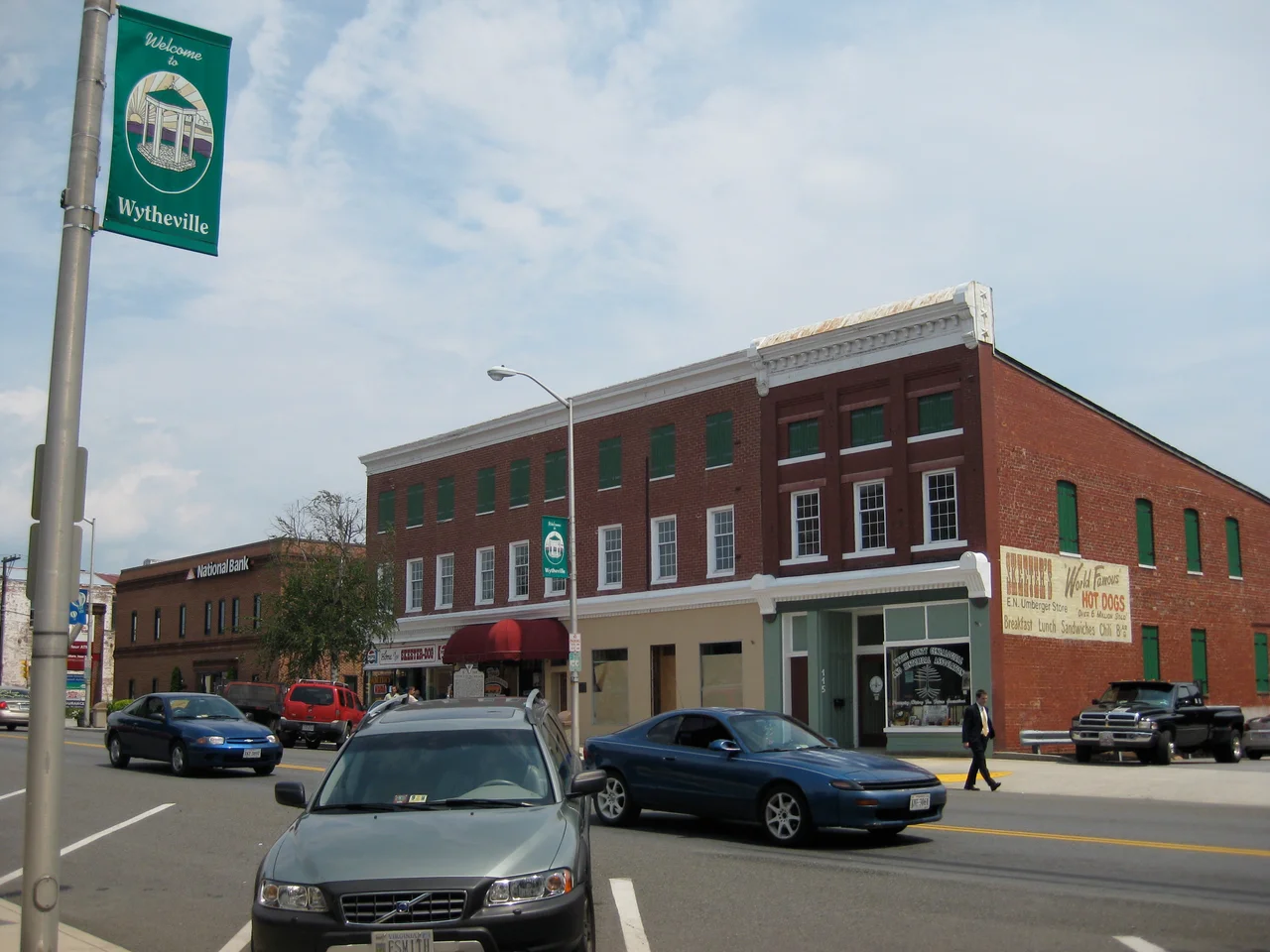

Wytheville, Virginia
On Interstate 77 northbound through Wytheville, the road signs tell drivers they're also heading south on Interstate 81. Both are correct. For four miles through downtown Wytheville, the two interstates share the same pavement but travel in officially opposite directions — a phenomenon engineers call a wrong-way concurrency, and one of the most unusual in the United States. It is fitting that a town named for a man who taught Thomas Jefferson the law of contradictions should also be the place where the highway system itself enters paradox. Welcome to Wytheville, where the future First Lady was born, where civilians fired on Union cavalry from their own bedroom windows, and where the water tower is painted with hot air balloons.
The Founder's Tutor
George Wythe was Virginia's first law professor, a signer of the Declaration of Independence, a Continental Congressman, and the man Thomas Jefferson called his second father. He tutored Jefferson in law in the 1760s in Williamsburg, taught John Marshall and Henry Clay, and was poisoned in 1806 by a grand-nephew who wanted his inheritance. The county created in 1789 honored him by name, and when the town and county seat was laid out the next year on land donated by Chris Simmerman, Robert Williams II, and John Davis, it took the name too. Wytheville's population stood at 8,264 at the 2020 census, larger than it has been in most of its history, sustained today not by the lead mines or the railroad but by the interstate junction that put it on every Atlanta-to-Detroit truck driver's overnight stop list.
Edith Bolling, Pocahontas's Descendant
She was born on October 15, 1872, in a house above her father's dry-goods store at 145 East Main Street. Edith Bolling — descended on her mother's side from Pocahontas, by some accounts — left Wytheville as a young woman, married a Washington jeweler named Norman Galt, was widowed, and in 1915 married a widowed President Woodrow Wilson. After Wilson's debilitating stroke in October 1919, Edith effectively ran the White House for the last 17 months of his administration, screening who saw the president, deciding what papers reached him, signing his name when necessary. Historians have debated for a century whether she was a stewardship or a quiet coup. The Edith Bolling Wilson Birthplace Museum is still on Main Street.
The Lynching of Raymond Byrd
In August 1926, Wytheville hosted the last documented lynching in Virginia. Raymond Byrd, a Black man, had been accused of assaulting the minor daughter of his employer Grover Grubb; his older daughters, both adults, had borne Byrd's children and testified the relationships had been consensual — but it was the accusation involving the youngest that put Byrd in the local jail. A mob of masked men entered the jail, shot Byrd in his cell, dragged his body for miles behind a truck, and then hanged him from a tree near St. Paul Lutheran Church on Charley Brown's land. The murder drew national newspaper coverage and outrage. No one was ever convicted. Byrd's lynching is now memorialized as part of the Equal Justice Initiative's effort to mark every confirmed lynching site in America.
Polio Summer
The summer of 1950 brought a different kind of horror. A polio epidemic struck Wythe County so severely that 184 people contracted the disease and 17 died — a per-capita rate among the highest in American history. From June to August, parents kept their children indoors. Public gatherings were canceled. Ambulances drove polio victims roughly 80 miles to Memorial Crippled Children's Hospital in Roanoke. Black patients were turned away from the Roanoke hospital, which segregated its wards, and were driven instead 180 miles east to St. Philip's Hospital in Richmond — the closest hospital that would treat them. The town council erected billboards at all five county entrances warning travelers away. By summer's end, every one of the billboards had been stolen or destroyed. The polio summer became local oral history; survivors were still telling the story decades later.
The Crossroads of the Blue Ridge
Wytheville bills itself as the Hub of Southwest Virginia, and the geography backs the claim: halfway between Bristol and Roanoke on I-81, halfway between Charleston and Charlotte on I-77, with US-11, US-21, US-52, and US-121 all converging within the town limits. Big Walker Lookout Tower, a 100-foot observation deck twelve miles north of town, gives drivers the high-altitude view of the Blue Ridge folds. The Chautauqua Festival has filled Elizabeth Brown Memorial Park on the third weekend of every June since 1985 — concerts, magic shows, dance, and hot air balloon launches at dawn. The balloons inspired the water tower's design, visible to every I-81 traveler at the I-77 interchange: a giant globe painted to look like a hot-air balloon basket, an image of Wytheville that fits a town that has spent two centuries being both crossroads and destination.
From the Air
Wytheville sits at 36.948 N, 81.087 W, in the Great Valley of the Appalachians at 2,283 feet elevation. New River Valley Airport (KPSK) lies 23 nm east near Dublin. From cruising altitude, look for the famous I-77/I-81 wrong-way concurrency just north of downtown — a 4-mile stretch where two interstates share pavement. Big Walker Mountain rises immediately north to 3,400+ feet. The town straddles the climate boundary between humid subtropical lowlands and the Appalachian highlands, classified Cfa/Cfb. Roanoke Regional (KROA) is 60 nm northeast; Bristol's Tri-Cities (KTRI) is 50 nm southwest. Watch for ridge-induced turbulence on westerly winds and afternoon haze in summer.
Nearby Stories
- War, West Virginia 12 km away
- Princeton, West Virginia 13 km away
- Galax, Virginia 13 km away
- Floyd County, Virginia 15 km away
- Patrick County, Virginia 21 km away
- Emory and Henry University 35 km away
- Washington County, Virginia 36 km away
- Salem, Virginia 40 km away