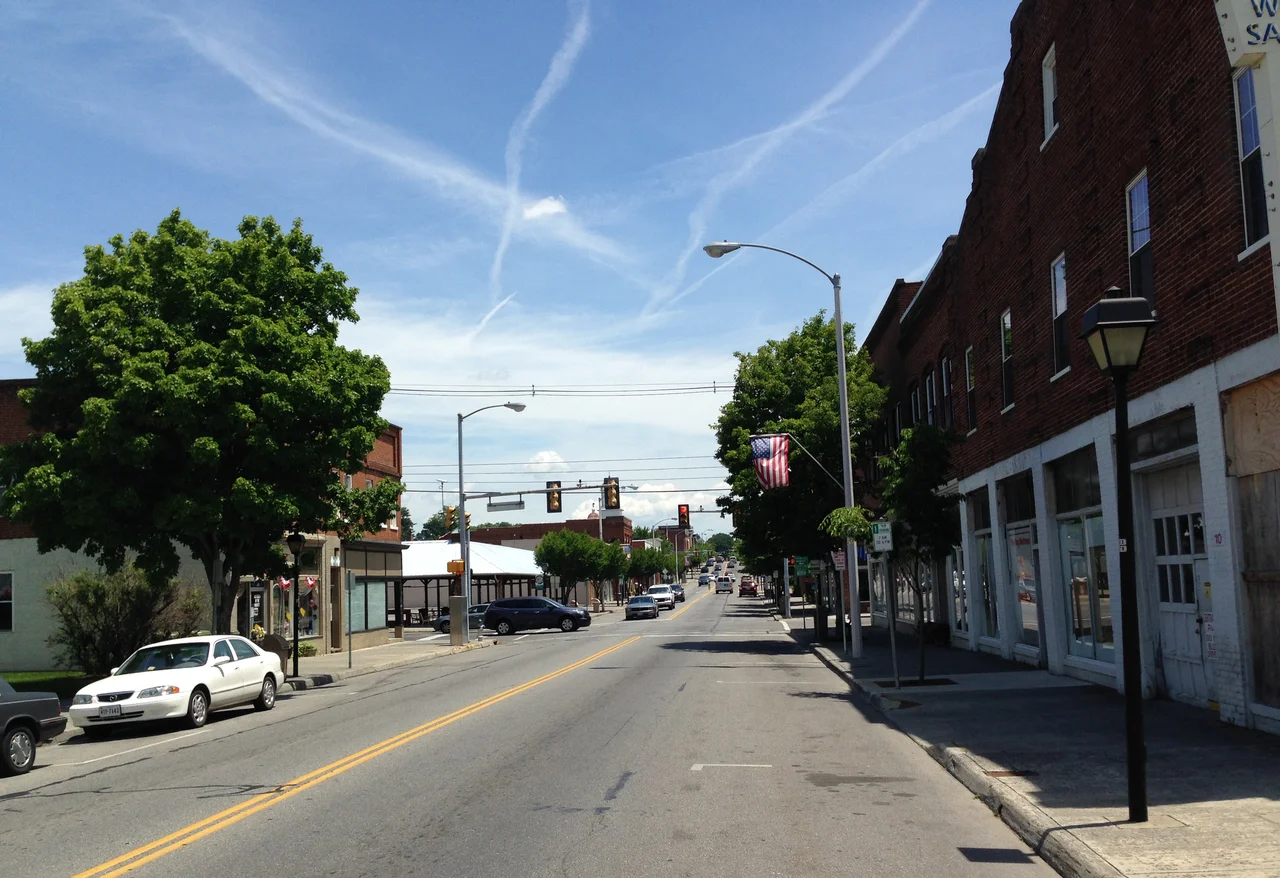

Salem, Virginia
On December 31, 1967, Salem stopped being a town and became a city. The motivation was not vanity but survival. Roanoke was growing and annexing, and the only way for Salem to stop being absorbed into its larger neighbor was to charter itself as an independent city under the Virginia constitution. Salem had already grown into Virginia's largest town - over 16,000 people after annexing South Salem in 1953 - and now it had to take the final step. The new city held onto a strange title even after separation: it remained the county seat of Roanoke County, even though the county administrative building sat in unincorporated Cave Spring and Salem itself was no longer technically part of the county.
Totero Town to Salem
Archaeological evidence at Salem reaches back 8,000 years. Europeans first explored the area in 1671, when Thomas Batts and Robert Fallam encountered a village of the Siouan-speaking Totero people - the Tutelo of later historical records - who guided them west. The explorers named what they saw Totero Town, after their hosts. Fort Lewis, named for General Andrew Lewis, went up west of the future town in 1752. Salem itself was officially founded in 1802 along what was then the Great Road - the same path U.S. 11 and Interstate 81 follow today. The town received its charter in 1806. Nobody is quite sure why it was called Salem. The most accepted story is that it was named to honor William Bryan, a prominent local citizen who had moved from Salem, New Jersey. The Salem Flying Artillery is said to have fired the last Confederate shot at Appomattox Court House before Robert E. Lee's surrender.
Two Colleges, Two Lives
Salem became a college town in 1847, when Virginia Institute - a small Lutheran boys' preparatory school - moved south from Staunton, hauling its belongings in a single covered wagon. By 1853 it had a college charter and a new name: Roanoke College, after the valley. The campus runs one block north of Main Street and now occupies seven buildings listed on the National Register of Historic Places. From 1912 to 1922, Salem was also home to a Lutheran women's college - first called Roanoke Women's College, then Elizabeth College. It burned in late 1921 and never reopened. Its campus survives as residence halls and athletic fields belonging to Roanoke College. A more recent academic chapter: in 2022, Roanoke College dedicated a highway marker on High Street to honor Kim Kyusik, a 1903 graduate who became a central figure in the Korean independence movement.
The Improbable Championship Town
Salem's biggest export, oddly, is championship sports. The Amos Alonzo Stagg Bowl - the NCAA Division III football championship - was held at Salem Football Stadium every year from 1993 to 2017. Once the NCAA discovered how well a city of this size could host a championship, more came. The Salem Civic Center now hosts the Division III men's basketball championship and the Division III women's volleyball tournament. The James I. Moyer Sports Complex hosts both the Division II and Division III softball tournaments. Salem Memorial Ballpark, a mile southeast of downtown, hosts the Salem RidgeYaks, the Boston Red Sox single-A affiliate. Salem High School's football team has taken ten state titles since 1996. Its forensics team has won eighteen state titles in a row. The city's reputation for hospitality and modern facilities - small enough to focus, big enough to deliver - keeps the events coming back.
Monuments to Many Wars
Salem's downtown carries a layered set of historical markers. The Roanoke County Confederate Monument, a 28-foot granite and marble statue of a standing soldier, was erected in 1909 by the Southern Cross Chapter of the United Daughters of the Confederacy beside the Old Roanoke County Courthouse. Its inscription reads: In Memory of the Confederate Soldiers of Roanoke County, 1861-1865. Love Makes Memory Eternal. Its dedication coincided with the courthouse opening and with Jefferson Davis's birthday. A few blocks away, a World War I bronze plaque erected by the American Legion honors Roanoke County's dead. Newer markers honor the Korean independence movement and the East Hill Cemetery. Notable Salem residents have included John McAfee, who lived here before founding the software company that bore his name; Major League outfielder Billy Sample; and Florida Supreme Court Chief Justice Leander J. Shaw Jr., who was born here.
From the Air
Salem sits at 37.29 N, 80.06 W in the Roanoke Valley, immediately west of the city of Roanoke. Cruise at 4,500 to 6,500 feet MSL for valley orientation. The Blue Ridge Mountains rise to the south and east. Roanoke College's brick campus is visible in central Salem one block north of Main Street. Nearest airport is Roanoke-Blacksburg Regional (KROA), about 5 nautical miles east. I-81 runs through Salem; U.S. 11 traces the historic Great Road through downtown.
Nearby Stories
- Battle of Galudoghson 1.8 km away
- Franklin County, Virginia 14 km away
- Poplar Forest 17 km away
- Pulaski County, Virginia 18 km away
- Alleghany County, Virginia 18 km away
- Draper's Meadow Massacre 19 km away
- Hargrave Military Academy 29 km away
- 2020 Williamsburg Massacre 42 km away