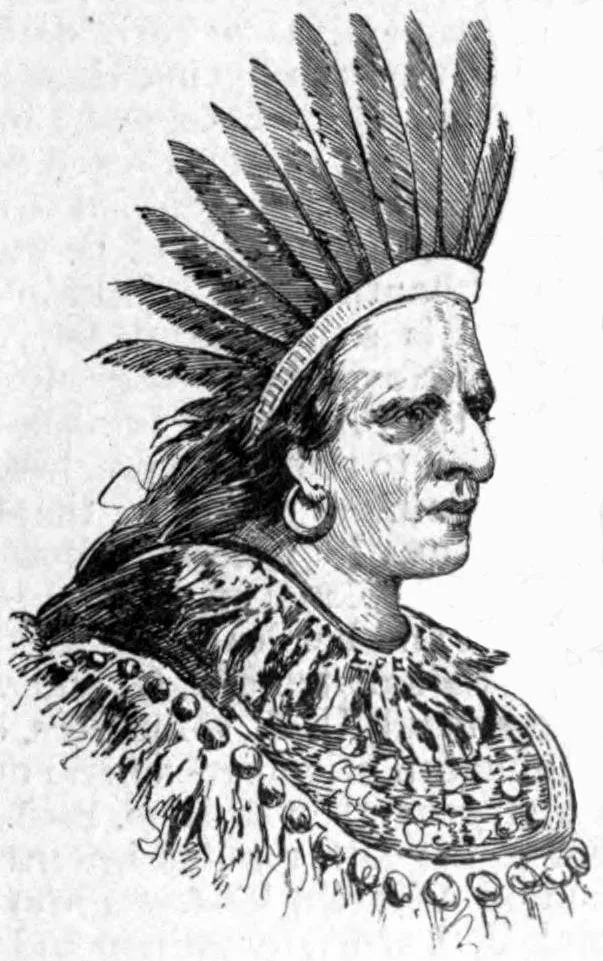

Battle of Galudoghson
Galudoghson, the Iroquois name for the river the English called James, was the language the colonists never bothered to learn. The battle that took place near its banks in December 1742 went without a formal name for more than two centuries, until a historian in 1995 finally gave it the title the warriors themselves would have recognized. By then, the Onondaga and Oneida men who died near Balcony Falls had been dead so long that almost no one in Virginia knew the river had ever been called anything else.
They were heading south. Under a chief named Jonnhaty, the war party had walked down from Pennsylvania along the Great Indian Warpath, a route their people had used long before any of the farmers now planted along the Shenandoah claimed the soil. The target was the Catawba, the historical enemies of the Iroquois Confederacy. The Virginia settlers were not the war.
A Pass and a Promise
The warriors carried a written pass from a Pennsylvania justice authorizing their passage. They understood it as a treaty document, a promise that they could move through colonial territory without trouble. The settlers they encountered could not read the Iroquois names on the paper and did not particularly care to. Crossing the Potomac into Virginia, the war party found the deer thinned out by colonial hunting and farming. They lived on what they could kill, which sometimes meant a settler's hog. According to an account given the next year to colonial agent Conrad Weiser by Shikellamy's grandson, who fought in the battle, the warriors would have starved otherwise. The settlers saw livestock loss and called it raiding. The warriors saw hunger in a country that had once fed everyone.
Whiskey at the McDowell House
On December 1, 1742, the war party stopped at the home of Captain John McDowell in Borden's Tract, the Augusta County land that had recently been opened to settlement. McDowell fed them, gave them whiskey, and pointed them toward what he said was good hunting country a few miles off. Two weeks later, on December 15, he received a different order from his superior, Colonel James Patton: assemble the militia and escort the war party out of the county. Whatever hospitality the warriors had taken from McDowell had curdled into suspicion among the colonists, who were hearing rumors that 500 Shawnee and Iroquois fighters, possibly backed by the French, were preparing a strike on the English settlements.
Balcony Falls
The 33-man militia caught up with the war party on December 17 near the homestead of John Peter Salling. For two days they followed at a distance. Near Balcony Falls, where the James River cuts a gorge through the Blue Ridge, one of the warriors stepped into the forest, possibly just to relieve himself. A militiaman fired. He was, depending on whose story you believe, the first shot of a battle or the only shot necessary to start one. The warrior cried out. The other men of the war party opened fire and killed Captain McDowell along with two mounted soldiers. Three or four warriors were killed in the firefight that followed. Colonel Patton's first account had McDowell approaching with a white flag to parley; the warriors said McDowell came at them with a sword and demanded their guns. Both sides remembered themselves as innocent. The dead, on either side, could no longer speak for what they had seen.
The Treaty That Came After
The battle was the first armed clash between European settlers and Native peoples in what colonists called Western Virginia. It was small by the scale of later wars, but it was loud enough to reach the governor's office, and from there to the diplomatic channels the Iroquois Confederacy still commanded across the colonial Northeast. The Six Nations did not consider themselves defeated. They considered themselves wronged. The negotiations that followed produced the Treaty of Lancaster in 1744, in which the Iroquois ceded what colonial officials interpreted as their claim to the entire Shenandoah Valley, in exchange for a few hundred pounds and the promise of peace. The chiefs at Lancaster understood they were ceding a path. The colonists understood they had been given a country. That difference, more than the bullets at Balcony Falls, set the next century in motion.
What the River Remembers
A historical marker stands in the McDowell family burial plot in Fairfield, naming the captain who died at the head of the war party. For 253 years there was no marker for the warriors. Their names, those that survived in colonial documents at all, were filtered through interpreters and recorded by men who did not know how to spell them. Jonnhaty, the chief, vanishes from the record after the battle. The Iroquois word that titles the engagement now, Galudoghson, was not chosen by the warriors. It was chosen for them, much later, by a researcher trying to give the engagement a name that did not belong to the side that had built the monument. Below Glasgow, Virginia, the river still cuts through the same stone. The Iroquois called it Galudoghson because that was its name.
From the Air
The site lies near Glasgow, Virginia at the confluence of the James and Maury Rivers, at 37.63 degrees north, 79.45 degrees west. Balcony Falls cuts through the Blue Ridge here, with the gap clearly visible at cruising altitudes. Lynchburg Regional Airport (KLYH) lies about 35 nm east-southeast and Shenandoah Valley Regional (KSHD) about 60 nm north. Best viewed in clear weather at 6,000 to 10,000 feet, with the Blue Ridge in cross light at low sun angles.
Nearby Stories
- The Omni Homestead Resort 3.7 km away
- Appomattox-Buckingham State Forest 5.6 km away
- Randolph College 9.3 km away
- Hollins University 16 km away
- Albemarle County, Virginia 18 km away
- Alleghany County, Virginia 20 km away
- Elliott Knob 22 km away
- Murder of Hannah Graham 27 km away