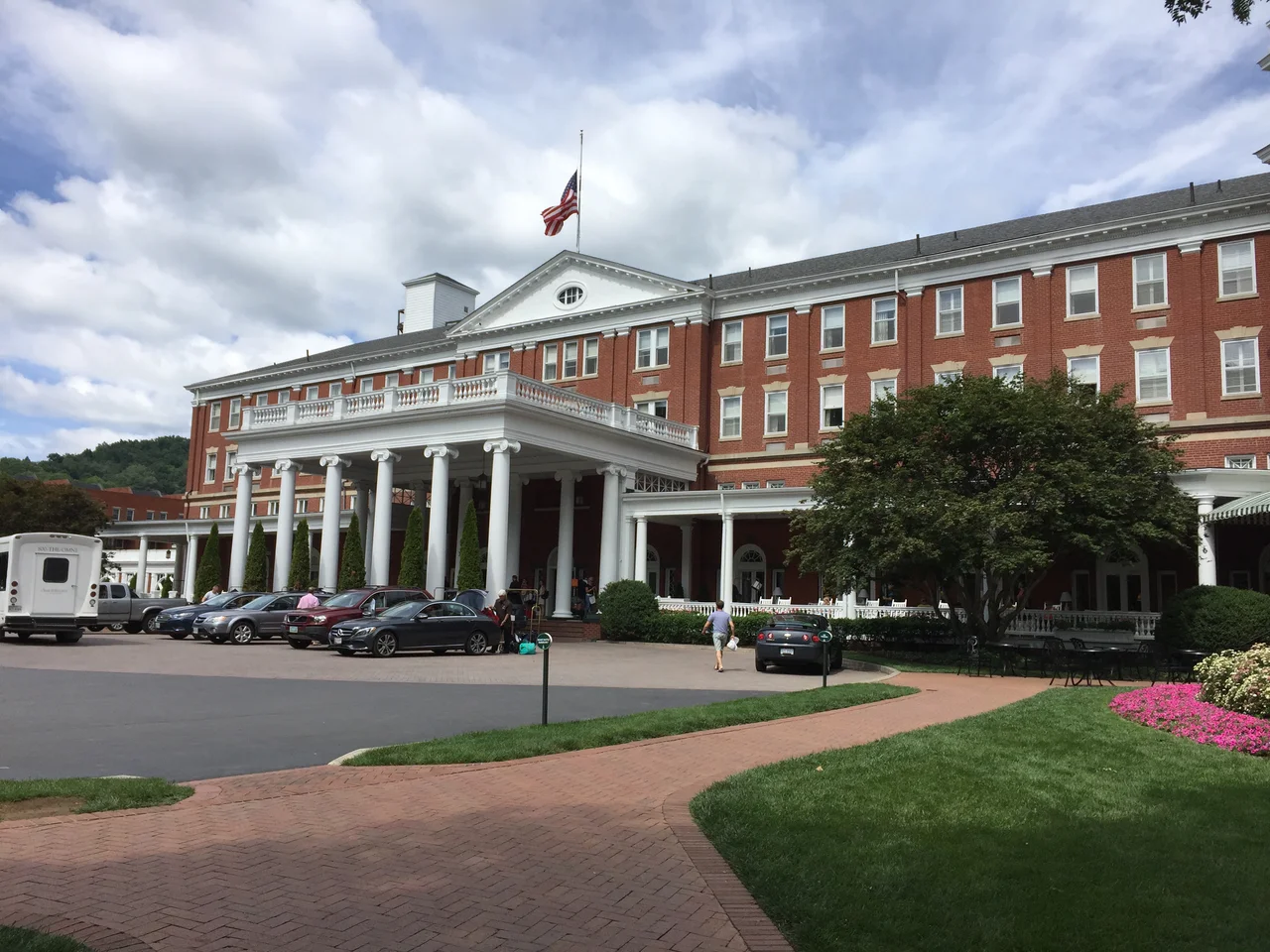

The Omni Homestead Resort
Thomas Bullitt put up a lodge on this site in 1766, when the Allegheny ridges were still considered frontier and the colonies were nine years away from a revolution. Vacationers have been coming to soak in the springs ever since - twenty-three of them eventually U.S. presidents. The mountain has been a recreation ground, a wartime detention site, the birthplace of southern skiing, and one of Sam Snead's longest professional addresses. The white-columned hotel that stands at Hot Springs, Virginia today is the third or fourth iteration of itself, depending on how you count the additions and the fires.
Bullitt's Lodge to Morgan's Hotel
Bullitt's 1766 lodge was a modest affair, drawing guests up the rough mountain roads to take the geothermal waters of Hot Springs - the largest hot springs in the Commonwealth of Virginia. The modern resort traces to 1888-1892, when a group of investors led by J. P. Morgan bought the property and started rebuilding from the foundations up. The original Morgan-era buildings burned in 1901 - a bakery fire that took down the wooden structures. The brick and steel hotel that replaced them went up one wing at a time, with the main lobby reconstructed in 1902. Donald Ross redesigned the original Old Course in 1913. William S. Flynn, one of the principal architects of Shinnecock Hills, designed the Cascades Course, which opened in 1923 and would go on to host seven United States Golf Association championships.
The Wartime Detention
From December 1941 to June 1942, in the months after Pearl Harbor pulled the United States into World War II, the Homestead held 785 Japanese diplomats and their families. They were not, in any meaningful sense, free to leave. The U.S. government had taken Japanese diplomatic personnel into custody and was negotiating their exchange through neutral channels for American diplomats held in Japan. The Allegheny mountains, far from any coast, made for a defensible site - and the Homestead's existing infrastructure could house and feed hundreds of people in conditions that, while detention, met diplomatic standards. The diplomats were later transferred to the Greenbrier Hotel in West Virginia before being exchanged. The whole episode is a small, strange chapter of the war - a luxury resort pressed into service as a holding pen for the people whose government was technically still operating in the embassy district of Washington when the war began.
Where the FAO Was Born
In 1943, while the world's most significant war ground on, the Homestead hosted a United Nations conference that established the foundations of the Food and Agriculture Organization - the FAO, the U.N. agency that has shaped global food policy ever since. The choice of venue made sense in the moment: a secure, remote, well-appointed resort with the capacity to host a substantial international delegation, in an Allied country with mountain quiet around it. The agreement signed at the Homestead helped shape what postwar agriculture would look like. The FAO that eventually emerged at the conference's instigation now operates from Rome with offices around the world. The lobby in which the framework was discussed has been renovated several times since.
Sam Snead's Course Record
Sam Snead, the PGA Tour champion who won 82 official PGA events - a record that stood until Tiger Woods tied it - lived in or near Hot Springs his entire life. He served as the Homestead's golf pro for decades, his white straw hat a familiar sight on the Cascades. In 1983, at the age of 71, Snead shot a 60 on the Cascades Course - a course record that still stands. To play under your own record at 71 is an athletic statement that almost no other professional sport allows. Snead's affection for the Homestead and for Hot Springs ran deep enough that he turned down more lucrative arrangements elsewhere. When he died in 2002, the Homestead lost the man who had been its public face longer than most of its presidents.
Ski Resort, Spa, and the Renovation
Sepp Kober opened the Homestead's ski area in 1959. It was the first alpine ski resort in Virginia and helped earn Kober his nickname of "the Father of Southern Skiing." The ski hill is small by Vermont or Colorado standards - 40 skiable acres, 700 feet of vertical, 10 runs, a single double chairlift and a couple of surface lifts - but it works because snowmaking covers 100 percent of the trails. In the spa, guests can still soak in pools fed by the natural geothermal springs that drew Bullitt's first 18th-century visitors. The associated Warm Springs Pools, a few miles away, house the same waters in historic 19th-century bathhouses. From October 2021 to October 2023, the entire resort underwent a complete renovation that cost more than $150 million. The Omni Hotels chain, which bought the property in 2013 and renamed it, was betting that 23 presidents and 260 years was a story worth investing in.
From the Air
Located at 38.00 degrees north, 79.83 degrees west, in the Allegheny Mountains at Hot Springs, Virginia. The white columned main hotel building is an obvious landmark from VFR altitudes of 4,500 to 7,500 feet AGL, set against the wooded ridges. The closest airport is Ingalls Field (KHSP) about 4 nautical miles south at Hot Springs - a public airport sitting atop a ridge that pilots should approach with caution due to its elevation of 3,793 feet MSL. Watch for mountain wave activity and turbulence in the Allegheny ridges, plus reduced visibility in valley fog typical of the watersheds below.
Nearby Stories
- Washington and Lee University 1.1 km away
- Alleghany County, Virginia 3 km away
- 2020 Williamsburg Massacre 7.1 km away
- Ramsey's Draft Wilderness 9.5 km away
- Cass Scenic Railroad 9.8 km away
- Elliott Knob 17 km away
- Monroe County, West Virginia 26 km away
- Westsylvania 40 km away