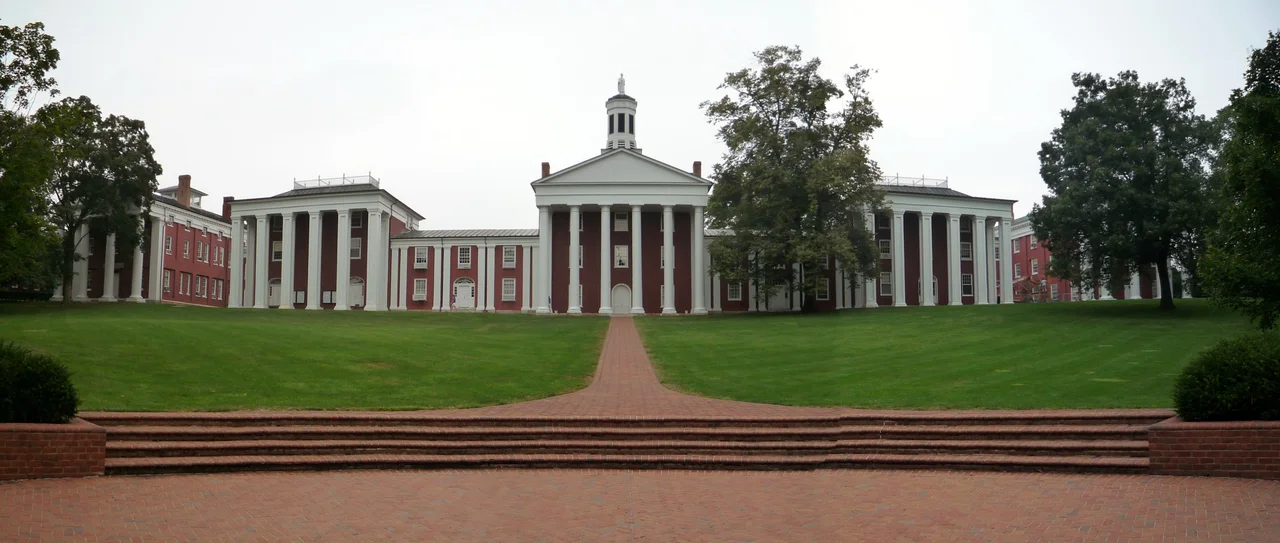

Washington and Lee University
George Washington's $20,000 gift to Liberty Hall Academy in 1796 came in the form of 100 shares of stock in the James River Canal Company. It was, at the time, one of the largest endowments any American school had ever received. Today, those original shares still throw off about $1.87 a year toward every Washington and Lee student's tuition. It is not the most useful sum in modern dollars. It is, however, the longest unbroken line of educational support in United States history.
That line runs straight through both the man on the bills and the man whose name was added later. Washington and Lee carries two names because two men, each contested in his own way, kept the place alive at moments when it could very easily have closed.
From Augusta Academy to Liberty Hall
The school was founded in 1749 by Scots-Irish Presbyterian pioneers about twenty miles north of its current campus. They called it Augusta Academy. In 1780 it moved to Lexington and was chartered as Liberty Hall Academy. The first bachelor's degree was awarded in 1785. In 1795, a free Black man named John Chavis enrolled at Liberty Hall, an act that is believed to make him the first Black student in any American institution of higher education. Chavis had fought in the Revolution, would later study at the College of New Jersey, would become an ordained Presbyterian minister, and would open a school in North Carolina that taught both white students and poor Black students. He did not receive a degree from Liberty Hall. Washington and Lee did not enroll its next African American student until 1966, in the law school. The campus took its present form in the 1820s, financed by John Robinson, an uneducated Irish immigrant called Jockey John who had made enough money trading horses to fund a new central building. For the dedication in 1824, Robinson supplied a barrel of whiskey intended for the dignitaries. The local rabble broke through the barriers and into the whiskey. Officials eventually demolished the barrel with an axe. Robinson left his estate, including about eighty enslaved people, to the school in his will. Until 1852, Washington College benefited from the labor of those enslaved people and, in some cases, from their sale.
The Lee Years
In the fall of 1865, Robert E. Lee accepted the presidency of Washington College. He had several offers from businesses that wanted to trade on his name. He chose the college, he said, because he wanted to train young men to do their duty. He served five years. During that time he added engineering, business, and law programs to a curriculum that had been almost entirely classical, on the conviction that those professions deserved the same intellectual respect as the liberal arts. He pushed for student self-governance, which became the foundation of the modern Honor System. He also recruited white men from across the reunited country, North and South. The historian Elizabeth Brown Pryor has documented that during Lee's tenure, students at Washington College formed their own chapter of the Klan and were known by the Freedmen's Bureau to attempt the abduction and rape of Black schoolgirls from nearby Black schools. Two attempted lynchings by Washington students occurred during these years. Lee punished racial violence by his students more leniently than he punished trivial infractions, when he punished it at all. He died on October 12, 1870. Within months, the trustees voted to rename the school Washington and Lee.
The Name on the Building
Lee Chapel sits at the center of campus and contains Lee's tomb. In 2014, the university removed a large Confederate battle flag from the chapel after Black students protested that the school was unwelcoming to minorities. President Kenneth Ruscio apologized publicly for the school's ownership of the eighty enslaved people from John Robinson's estate, some of whom had been forced to build a dormitory on campus. In July 2020, after George Floyd's killing, the faculty voted by more than three-quarters to remove Lee's name from the university. The executive committee of the Student Body voted the same way. The board of trustees deliberated for eleven months. On June 4, 2021, they voted 22-6 to keep the name. Ted DeLaney, the historian who taught at W&L for more than 45 years and served as the first Black chair of the History Department, said before his death in 2020: "W&L is unique because the entire campus is a Confederate monument."
The Honor System
The honor system that traces back to Lee, and is described by W&L as having taken shape in the 1840s, is unusual even among American colleges. There is no list of rules. The only forbidden offenses are lying, cheating, and stealing. The Student Body administers it through an elected executive committee, which has held that role since 1905. Punishment for a violation is expulsion. Exams are unproctored and self-scheduled. Professors regularly assign take-home, closed-book finals with the understanding that the students will not cheat. Most do not. In a typical year, four or five students leave after honor investigations. The system is reviewed every three years by referendum, and students continue to support it overwhelmingly. Alumni cite it as the single most distinctive thing they carried out of Lexington.
Traditions and Eccentricities
Every four years the school stages a Mock Convention for whichever party doesn't hold the presidency. It has correctly picked the out-of-power nominee for twenty-one of the past twenty-eight elections. C-SPAN has carried it gavel to gavel. The Washington Post once called it the nation's oldest and most prestigious mock convention. The Fancy Dress Ball, started in 1907, is a black-tie event with a different theme every year and a budget over $80,000. The Washington and Lee Swing, a football march written in 1910 by three students, is one of the most widely borrowed school songs in American history, copied by Tulane through Slippery Rock, recorded by Glenn Miller and Louis Armstrong. George William Crump, an 1804 student, was arrested for running naked through Lexington in what is the first recorded incident of streaking in the United States. He later served in Congress and as ambassador to Chile. The school's most famous alumnus by the standards of horse racing is Secretariat, who wore royal blue and white because his co-owner Christopher Chenery was a W&L graduate and trustee.
From the Air
Washington and Lee's 325-acre campus sits at the edge of Lexington, Virginia, at 37.79 degrees north, 79.44 degrees west, abutting VMI in the Shenandoah Valley. The recognizable landmark from altitude is the Colonnade, the row of brick buildings topped by Old George, the statue of George Washington on the central building. Shenandoah Valley Regional Airport (KSHD) lies 35 nm north and Lynchburg Regional (KLYH) is 40 nm east-southeast. Best viewed at 3,000 to 5,000 feet AGL in afternoon light.
Nearby Stories
- The Omni Homestead Resort 3.7 km away
- Appomattox-Buckingham State Forest 5.6 km away
- Randolph College 9.3 km away
- Hollins University 16 km away
- Albemarle County, Virginia 18 km away
- Alleghany County, Virginia 20 km away
- Elliott Knob 22 km away
- Murder of Hannah Graham 27 km away