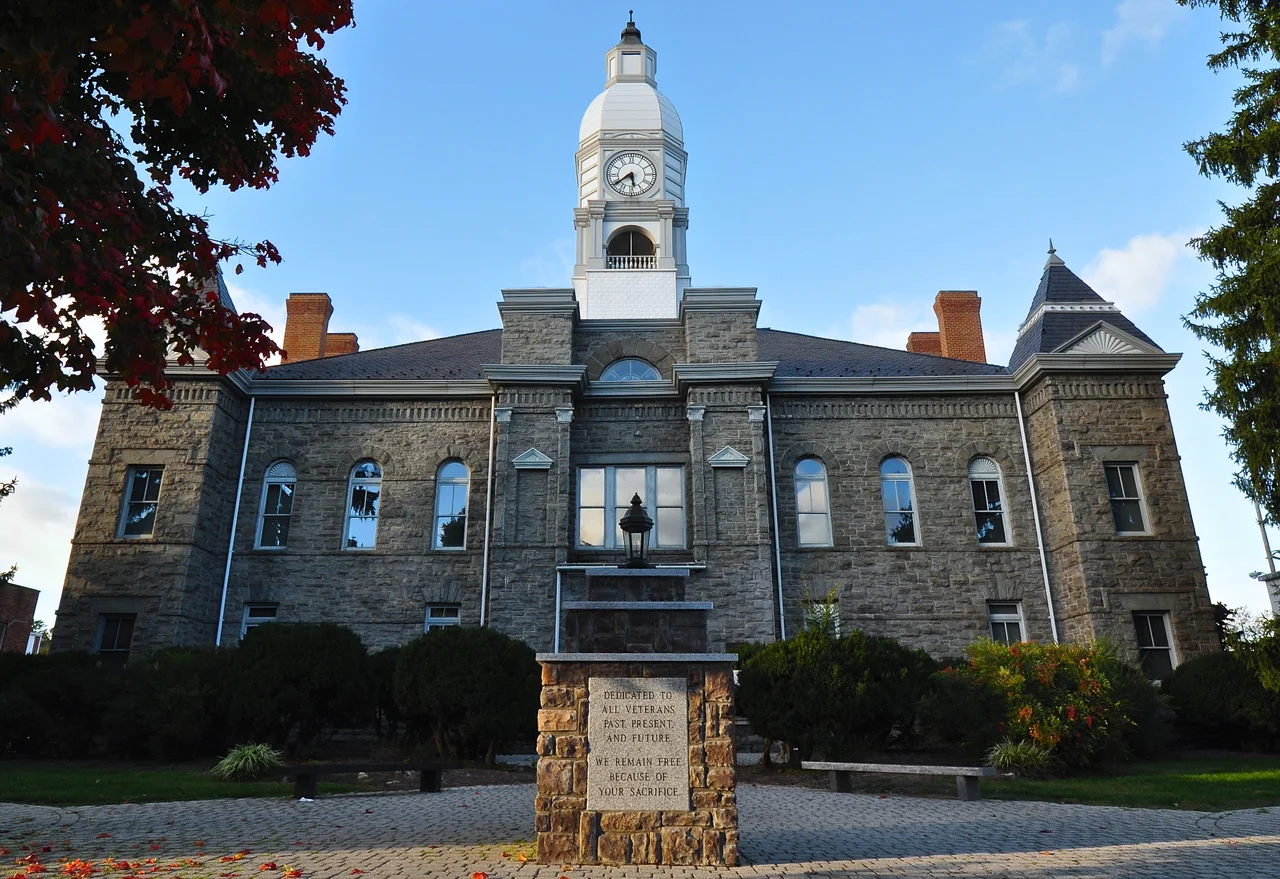

Pulaski County, Virginia
Casimir Pulaski never saw the Virginia county that bears his name. He was a Polish nobleman in exile when Benjamin Franklin recruited him in 1777 to fight for the American Revolution. He arrived in time for Brandywine, became a brigadier general and chief of cavalry under Washington, and was fatally wounded leading a charge against the British at Savannah on October 11, 1779. The county was created sixty years after his death, on March 30, 1839, the eighty-seventh county of the Commonwealth. He never set foot in the Blue Ridge. The settlers who carved their farms out of the New River valley named the place for him anyway, because the United States Pulaski died for had become the country they wanted their children to grow up in.
Yeomen and the Shenandoah Migration
The first European settlers in what would become Pulaski County were mostly Scots-Irish and German farmers who had come down the Great Wagon Road from Pennsylvania in the mid-eighteenth century. They were yeomen — small landholders who worked their own farms — and the rolling hills of the upper New River suited that economy better than the slave-driven plantation system of the Tidewater. By 1840 the county had 3,739 people, and about a quarter of them were enslaved Black Americans, a far smaller proportion than in eastern Virginia but still 971 human beings held in bondage on these hillsides. Seventeen Black residents were listed as free. The county was carved from parts of Montgomery and Wythe counties in 1839, and it has been part of the Blacksburg-Christiansburg metropolitan area ever since the U.S. Census Bureau started drawing such lines.
Claytor Lake
In the 1930s, the Appalachian Power Company dammed the New River to generate electricity, and the result was Claytor Lake: 4,500 acres of water stretching 21 miles along what had been farmland and bottomland and the homes of several hundred families. The dam was named for W. Graham Claytor, Sr., the Appalachian Power vice president who supervised its construction. He was born in 1886 in Roanoke and died in 1971. The state park on the lake's north shore — 472 acres of camping, cabins, a swimming beach, and a marina — has been Pulaski County's busiest summer destination for three generations of southwestern Virginia families. The New River, which flows through the lake, is one of the oldest rivers in the world. Geologists estimate it predates the Appalachian Mountains themselves.
The Dublin Depot
Dublin is a small town now, but during the Civil War it was a Confederate regional headquarters. The Virginia and Tennessee Railroad ran through it, and the depot — originally called Newbern, renamed Dublin for the nearby New Dublin Presbyterian Church — was the eastern hinge of the southwestern Virginia railroad operations that kept Lee's army supplied with lead, salt, and manpower. The Battle of Cloyd's Mountain was fought just five miles north of Dublin on May 9, 1864. Union General George Crook's 6,000 men overwhelmed a Confederate force of about 2,400 under Brigadier General Albert Jenkins. Jenkins died of his wounds. Crook burned the New River railroad bridge, and Confederate communications through southwestern Virginia were severed for weeks. The historic markers along Route 100 between Dublin and the bridge site are easy to miss if you aren't looking. The history isn't.
The Volvo Plant
If you have ever driven a Volvo VNL semi truck across an American highway, there is a very good chance it was built in Pulaski County, Virginia. The Volvo Trucks North America plant in Dublin opened in 1976 and is now the largest Volvo truck plant in the world, employing around 3,400 people. In 2021 the plant began assembling the all-electric VNR Electric model alongside its conventional diesel heavy-duty trucks. The plant has carried Pulaski County through the slow erosion of the textile and furniture industries that once defined small-town southwestern Virginia. When you see a green Volvo cab going by on I-81, that cab was probably stamped, painted, and assembled within sight of the New River, by people who learned the trade from parents who learned it from theirs.
What the County Means
Pulaski County's population stood at 33,800 in the 2020 census, holding steadier than most rural Appalachian counties have managed in the post-coal decades. The Jefferson National Forest covers part of the county's southern edge. Gatewood Reservoir, the 162-acre water-supply impoundment owned by the town of Pulaski, draws fishermen looking for largemouth and crappie. The Pulaski County Sheriff is Michael W. Worrell. The schools are all here. Eight Pulaski Appalachian League baseball teams over the decades have called this county home — the Counts, the Phillies, the Cubs, the Braves, the Phillies again, the Rangers, the Blue Jays, the Mariners, the Yankees, the River Turtles — and the current River Turtles still play at Calfee Park downtown, in a stadium where the cheap seats above third base look out over the same hills Casimir Pulaski never saw.
From the Air
Pulaski County centers at 37.06 N, 80.71 W, in the Great Valley of southwestern Virginia. New River Valley Airport (KPSK), elevation 2,105 feet, sits north of Dublin and serves Pulaski, Wytheville, and the I-81 corridor. From cruising altitude, look for Claytor Lake — a 21-mile narrow reservoir threading southwest-to-northeast along the New River — unmistakable from FL240 and above. The Jefferson National Forest forms the county's southeast border. Pulaski County High School and the Volvo Trucks plant in Dublin sit on either side of US-11. Roanoke Regional (KROA) is 35 nm northeast; the Blue Ridge Parkway crosses the eastern edge of the county. Watch for downstream turbulence in the New River gap on west winds.
Nearby Stories
- Salem, Virginia 9.2 km away
- Draper's Meadow Massacre 13 km away
- Ferrum College 14 km away
- Galax, Virginia 23 km away
- Henry County, Virginia 26 km away
- Mitchell Stadium 28 km away
- Welch, West Virginia 38 km away
- Washington County, Virginia 67 km away