
Henry County, Virginia
Patrick Henry - the man who shouted give me liberty or give me death in 1775, the first governor of Virginia, the orator without whom American history textbooks would be much shorter - spent five years living on a 10,000-acre plantation on Leatherwood Creek in southern Virginia. The county that surrounded his land took his name in 1777, although by a quirk of legislative drafting that the founders apparently did not notice, the official statute called the new county simply Henry. The Patrick part never made it into law. The county has held that name through 250 years of change: the cultivation of tobacco that wore out the eastern soils and drove farmers west, the textile boom that made the small city in its middle one of the wealthiest per capita in America, the moonshine trade that thrived in the Blue Ridge hollows, the NASCAR speedway that opened at Ridgeway in 1947 and is still the shortest oval in the Cup Series. Henry County is about 51,000 people on 384 square miles of rolling Piedmont hills, all of it wrapped around an independent city, Martinsville, that the county no longer governs but cannot quite separate from.
The Statute That Forgot Patrick
The Virginia General Assembly passed the bill creating the county in October 1776. The new entity took effect on January 1, 1777, the day the county legally came into being. Read the statute - The Statutes at Large, William Waller Hening, Volume 9, pages 241 to 242 - and you find this striking line: shall be one distinct county, and called and known by the name of Henry. Just Henry. Despite a long tradition of calling it Patrick Henry County, the formal name never included the first name. Patrick Henry the man was, at the time, serving as Virginia's first governor. His personal lands lay within the new county. His friend Joseph Martin would shortly found the community that grew into Martinsville. But the bill drafters wrote only the surname into law. Two centuries of misremembering have not changed the statute. The county has always been, legally, just Henry.
Patrick Henry at Leatherwood
Between his third and fourth gubernatorial terms, around 1779 to 1784, Patrick Henry lived at his 10,000-acre Leatherwood Plantation on the creek of that name. He served in the Virginia House of Delegates from Henry County while he lived here. The plantation's enslaved laborers grew tobacco, the cash crop of the era, and the household ran on their unpaid work as did every plantation of the period. Leatherwood was not the site of any single famous Henry speech, but it was a working farm where one of the loudest voices in the Revolution lived through the wartime years. A historical marker stands at the site today. The man who declared liberty or death lived here on land where most of the people around him were not free, a contradiction the county has been processing in one form or another ever since.
Joseph Martin and Scuffle Hill
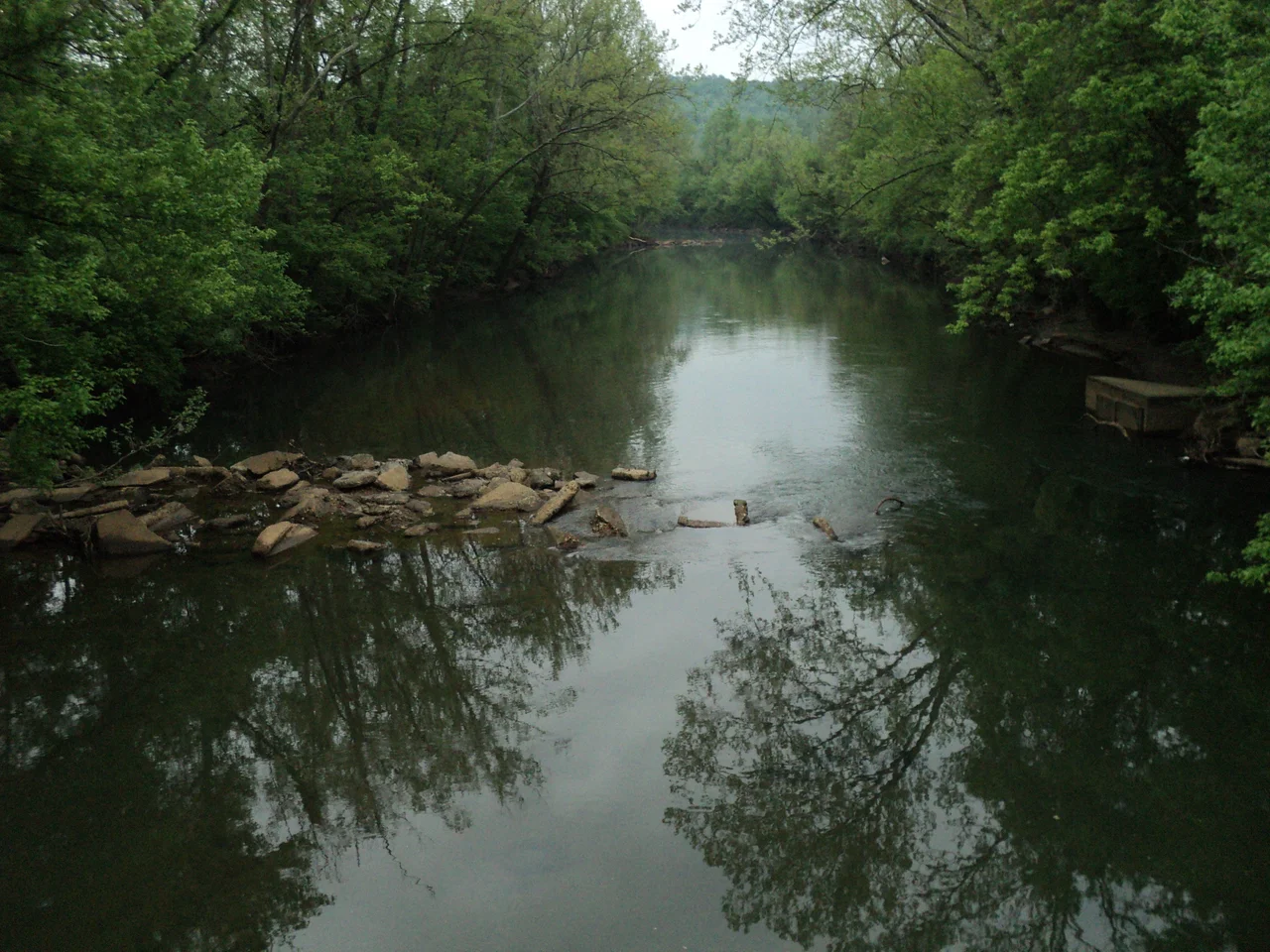
The city of Martinsville is named for Joseph Martin, a Revolutionary War general, Native American agent, and frontier explorer who built his plantation Scuffle Hill on the Smith River near the present-day southern city line. Martin and Patrick Henry were friends; the two often visited each other across the county. Martin negotiated with the Cherokee on behalf of the colonial and then state governments and lived a frontier life of unusual complexity. He died at Scuffle Hill in 1808. His house is gone, but the historical marker remains. The Smith River still runs past where the house once stood, and a state historic marker at Axton commemorates Greenwood, the home of Martin's son. Two friends of a revolution, two plantations on two streams, one county shaped around both of them.
The Paperclip Oval at Ridgeway
Henry Clay Earles, a Virginia businessman who had taken a liking to the stock car races outside Salisbury, North Carolina, in the 1940s, bought 30 acres of red clay at Ridgeway and built an oval racetrack. The first race ran September 7, 1947. Red Byron won in front of 6,013 paying spectators in a cloud of clay dust thick enough that Earles later compared it to the aftermath of an H-bomb. NASCAR ran its first Cup Series race here in 1949; Byron won that one too. The track was paved in 1955. In 1969 NASCAR's revised measurement system changed the official length from 0.500 to 0.526 miles, and that is what the speedway has been called ever since: the shortest track on the Cup Series. Its paperclip shape - two straights with tight turns at each end - turns the racing into a fender-banging traffic jam. Bristol is louder. Talladega is faster. Martinsville is the one drivers complain about and remember.
The County and the City
Virginia is unusual in American government because its cities are independent of their counties: a Virginia city is, in jurisdictional terms, a separate political entity. Martinsville became an independent city in 1928, removing itself from Henry County government. The arrangement created an oddity that persists today. Martinsville is still officially the county seat of Henry County, but the county's actual offices, courthouse, and sheriff are located on Kings Mountain Road in Collinsville - a few miles outside the city, in the county that still surrounds the city like a doughnut. In 2019 the Martinsville city council unanimously voted to begin reverting the city to a town, which would have folded it back into the county; on January 10, 2023, the council voted to end that process. The jurisdictional puzzle remains. Two governments occupy 11 square miles of city inside 384 square miles of county, each running its own affairs, neither quite able to leave the other alone.
From the Air
Henry County is centered near 36.67 degrees north, 79.88 degrees west, in the rolling Piedmont of southern Virginia near the North Carolina state line. The Smith River winds through the county. Blue Ridge Airport (KMTV) at the city of Martinsville handles general aviation; the nearest commercial airports are Roanoke (KROA) about 51 miles north and Piedmont Triad International (KGSO) about 48 miles south at Greensboro, NC. From cruising altitude look for the distinctive paperclip-shaped Martinsville Speedway near Ridgeway as the most identifiable landmark.
Nearby Stories
- Ferrum College 4.1 km away
- Wreck of the Old 97 8 km away
- Pulaski County, Virginia 24 km away
- Chang and Eng Bunker 24 km away
- Chinqua Penn Plantation 25 km away
- Battle of Shallow Ford 34 km away
- Pyle's Massacre 37 km away
- Red Hill Patrick Henry National Memorial 51 km away