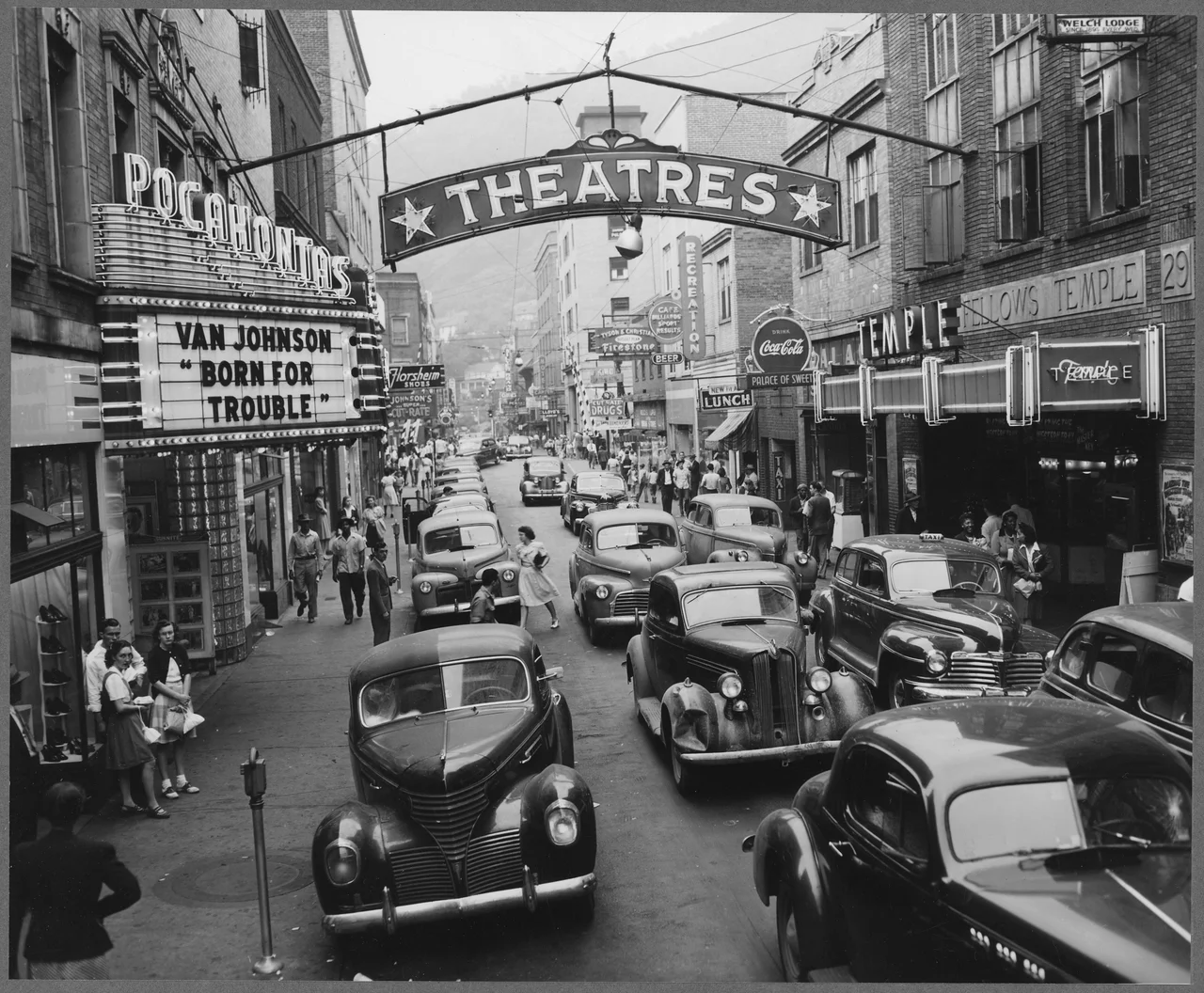

Welch, West Virginia
On May 29, 1961, in the McDowell County seat of Welch, Secretary of Agriculture Orville Freeman handed Mr. and Mrs. Alderson Muncy ninety-five dollars in federal food stamps. The Muncys had fifteen people in their household. They lived in Paynesville, about half an hour away. Reporters watched. It was the first issuance of food stamps under the Kennedy administration, the beginning of what would become a national program, and it happened in Welch because Welch was the place that had taught John F. Kennedy, the year before, what an emptying coalfield actually looked like.
Records by Wagon
Welch became the county seat of McDowell County in 1892, before it was even incorporated. The election was contested. To stop the brewing violence, James F. Strother and Trigg Tabor loaded the county records into two wagons one night and quietly moved them from the old seat at Perryville, on the Dry Fork, to Welch on the Tug. The town that resulted sits at the confluence of the Tug Fork and Elkhorn Creek, ringed by steep ridges that flood reliably and dramatically. The 2001 and 2002 floods nearly destroyed the place. Welch was incorporated in 1893, named for a Confederate captain who had surveyed the region and laid out the streets.
The Heart of the Nation's Coal Bin
By the first half of the twentieth century, Welch was the retail and medical center for a county pushing toward 100,000 people, with three hospitals and a downtown of brick commercial buildings that pulled coal miners' wages from every direction. The town built the first public children's playground in West Virginia in 1913, across the street from the McDowell County Courthouse, and in 1941 it opened the first municipally owned parking building in the United States — a 232-car structure that turned a profit its first year. The slogan on signs and letterhead read: The Heart of the Nation's Coal Bin. In 1960, McDowell County still ranked first in the nation in total coal production.
Hatfield and Chambers at the Courthouse
On August 1, 1921, Matewan Police Chief Sid Hatfield and his friend Ed Chambers walked up the McDowell County Courthouse steps in Welch to face charges related to the alleged blowing up of a coal tipple in Mohawk. Detectives from the Baldwin-Felts Detective Agency, the same agency Hatfield had faced down in Matewan the year before, shot both men dead on the courthouse steps. Their wives were with them. The killings were never seriously prosecuted, and they radicalized West Virginia's coal miners in a way that little else could. A few weeks later, miners began the march that ended at the Battle of Blair Mountain. The courthouse where Hatfield died still stands and is on the National Register of Historic Places.
What Kennedy Saw
When John F. Kennedy's campaign caravan drove into Welch in 1960, the candidate from Massachusetts saw closed storefronts, empty company houses, and lines of men out of work in the highest coal-producing county in America. In Canton, Ohio that September he repeated the contradiction: McDowell County mined more coal than ever, and yet more McDowell County families received surplus food packages than any county in the United States, because machines were doing the work of men. The Appalachian aid programs of the Kennedy and Johnson administrations grew partly from what Kennedy learned on those Welch streets. The Muncy food stamps the following year were the first concrete result.
The Long Decline and the People Who Stayed
The 1986 closure of the US Steel mines at nearby Gary erased more than 1,200 jobs in a year. Personal income in McDowell County dropped by two-thirds in the following year alone. Welch's annual Veterans Day Parade still draws crowds — Presidents Truman and Johnson both spoke at it. Welch is the hometown of author Jeannette Walls, who described it in The Glass Castle, and of comedian Steve Harvey, born here in 1957. The Welch News, the local paper, shut down on March 13, 2023, after decades of three-times-a-week publication. The 2020 census counted 3,590 people in Welch, a town that once expected to be a city. The hospitals are gone or smaller. The parking garage is still there.
From the Air
Coordinates: 37.44N, 81.58W, elevation roughly 1,300 feet (400 m). Welch sits at the confluence of the Tug Fork and Elkhorn Creek, ringed by 2,500-foot ridges. Recommended viewing altitude 5,000-7,000 feet MSL. The McDowell County Courthouse dome is a recognizable landmark from above, and the Norfolk Southern line traces the Tug Fork through town. Nearest airports: Mercer County (KBLF) about 22 nm east-southeast. Morning fog routinely fills the river valleys here; expect IFR conditions until mid-morning.
Nearby Stories
- Breaks Interstate Park 6.9 km away
- Appalachian League 8.7 km away
- Princeton, West Virginia 10 km away
- Beckley, West Virginia 18 km away
- Buffalo Creek Flood 21 km away
- Wise County, Virginia 34 km away
- Emory and Henry University 36 km away
- Prestonsburg, Kentucky bus crash 41 km away